“Inflation is in effect a hidden tax. The money that people have saved is robbed of part of its purchasing power, which is quietly transferred to the government that issues new money.”
— Thomas Sowell
Happy Friday! want some free sats? 🔥
1) Reply with your #bitcoin lightning address⚡️
2) We'll send you some sats
3) Ends at 1pm GMT
This weeks sponsor is our CFO @CoinCornerDave 🧡
#Bitcoin Sock Giveaway🧦
We have 3 pairs up for grabs- Lightning⚡️, Rocket 🚀 and our B HODL Shareholder Socks!
To enter:
✅ Follow @bitcoinhodlco
❤️ Like
🔁 RT
Winners announced tomorrow! Best of Luck
Hoe gaat het eigenlijk?
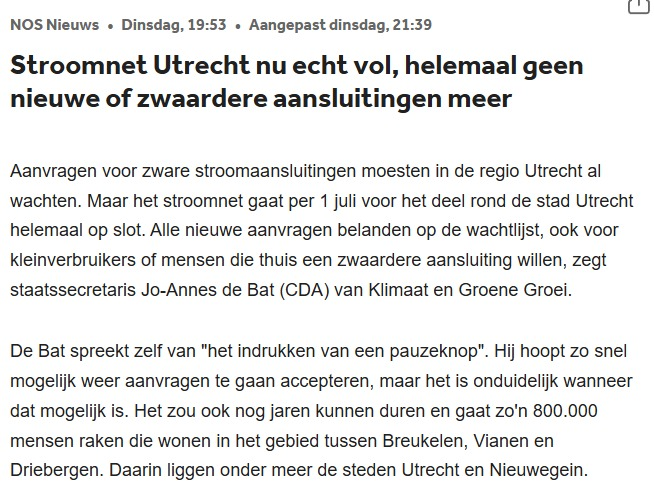
Het stroomnet rond Utrecht gaat per 1 juli volledig dicht. Particulier, bedrijf, maakt niet uit: je krijgt gewoon geen stroomaansluiting. Dit heeft impact op liefst 800.000 mensen.
Waterbedrijf Vitens waarschuwt voor een tekort aan drinkwater.
De oorzaak bij beide cruciale levensvoorzieningen, want dat zijn ze, is een gebrek aan infrastructuur. Als er al een oplossing komt, dan is dat niet voor 2031. Vijf jaar verder dus.
Ik heb eerder al geschreven over de kwaliteit van het onderwijs en dat honderdduizenden mensen niet op tijd bij een ziekenhuis kunnen komen in geval van nood.
In Den Haag weten ze de oplossing al: hogere belastingen. Reken er maar op dat je, als jij, door wat voor goede reden ook, meer dan 100 liter water gebruikt, straks een naheffing krijgt.
Als je in Nederland kritisch bent, word je weggezet als zuurpruim, ophitser of radicaal rechts (waar die altijd vandaan komt). Maar gezondheidszorg, onderwijs, veiligheid, maar dus ook stroom en water zijn cruciale aspecten die een maatschappij eenvoudig kunnen ontwrichten.
De Nederlandse overheid moet per direct stoppen met onrealistische klimaatdoelen (hoe gaat het met uw energierekening), alles slopende bureaucratie, talloze onzinnige overheidsuitgaven en (massa)immigratie.
In Nederland verzint een beleidsmaker een totaal kromme regel of wet die vervolgens nooit wordt teruggedraaid, maar structureel wordt aangepast met nog krommere regels en wetten. Meer regels en wetten, minder effectiviteit, maar wel veel meer ambtenaren. Over klimaat: kijk even om je heen wat er gebeurt. Verduurzaming is goed; daar moeten we mee doorgaan, maar wel realistisch en niet ten koste van alles. Bedrijven worden kapotgemaakt, verliezen hun concurrentiekracht door idiote (klimaat)regels en kunnen nu dus ook geen stroom meer krijgen. Maar laten we ze vooral extra belasten.
Immigratie kan een plus zijn, zolang je het totaalplaatje van de maatschappij in het oog houdt. Wat heeft het voor zin om mensen hierheen te halen als je ze geen woning, stroom en water kunt geven? En wat denk je dat het met mensen doet als je die mensen voortrekt en andere mensen dus geen woning, stroom en water geeft?
Met het cliché van ‘we hebben het hier zo goed’ kun je niets. Niet omdat het niet waar is: in Nederland zijn nog steeds heel veel dingen goed, maar die houding lokt passiviteit uit. Het gaat namelijk minder goed dan voorheen en als we daar niets mee doen, wordt het wel echt minder leuk.
Nederlandse politici, steeds meer gestuurd door "Europa", zijn volledig vervreemd van de Nederlandse bevolking, maar zijn helaas ook gewoon niet in staat om prioriteiten te stellen. Stroom en energie zouden hoog op dat prioriteitenlijstje moeten staan. Gezondheid, onderwijs en veiligheid ook.
Het belasten van mensen voor primaire levensbehoeften is een resultaat van bijzonder slecht beleid.
Lubach over volstorten van Groningse gasputten:
“Wij zijn de enige die dit doen. Maar in zo’n geval moet je je altijd afvragen: is dat omdat het geniaal is, of omdat het heel erg dom is?”
Die vraag kun je ook stellen over aanwasbelasting, trouwens.
https://t.co/1R2MmcQdUz
Coalitieakkoord VVD, CDA en D66: “We stimuleren dat mensen hun spaargeld meer beleggen in de Nederlandse economie.”
Dat was dus bullshit.
Talk is cheap.
“Until Bitcoin's invention, all forms of money were unlimited in their quantity and thus imperfect in their ability to store value across time. Bitcoin's immutable monetary supply makes it the best medium to store the value produced from the limited human time, thus making it arguably the best store of value humanity has ever invented. To put it differently, Bitcoin is the cheapest way to buy the future, because #Bitcoin is the only medium guaranteed to not be debased, no matter how much its value rises. ”
The Bitcoin Standard
Saifedean Ammous @saifedean
Bitcoin STHCB breached at $109K.
Dream scenario playing out so far.
Whispers of doubt grow into cries, cries into screams, and in the end, the frenzy of panic-driven FOMO.
For all the anticipation of nation state adoption, it's funds and corporate treasuries who've been driving this cycle
Wild, when you consider that US Investment Advisors allocate just 0.006% of their portfolio to Bitcoin
We are so early
#Bitcoin is the only fixed-supply asset in the history of humanity.
Bitcoin’s supply is capped at 21M, with 19M+ already issued.
A finite supply creates infinite opportunity.
Happy #BitcoinInfinityDay ♾
THE CHAINLINK ENDGAME
The updated Chainlink vision is here.
What started as a data solution is now an extensive platform of essential services for integrating the world into the onchain economy ⬇️
https://t.co/HlnmFeiEWY
What TCP/IP did for the Internet and the Java Runtime Environment (JRE) did for online development, Chainlink is doing for blockchains and onchain apps.
In the early days of the Internet, scaling required more than innovation—it required unification and seamless orchestration.
TCP/IP and the JRE emerged, bringing coherence to a fragmented digital world and abstracting away complexity so developers could focus on building.
Blockchains are at the same turning point.
With more chains and even more financial institutions and real-world assets moving onchain, the main challenge now is building apps that efficiently orchestrate across blockchains and existing systems.
Advanced blockchain apps now involve multiple types of data, cross-chain interoperability, compliance policies, integration with legacy systems, and much more.
Building these next-gen apps is nearly impossible to do in-house and overly complex if you have to rely on a growing list of vendors, who each only solve a small portion of the application’s overall requirements.
Chainlink changes that.
Chainlink is not just a price feed. It’s a unified oracle platform that underpins critical standards, services, and end-to-end solutions needed to unlock advanced blockchain applications:
• Data oracles for publishing mission-critical data onchain
• Interoperability oracles for moving data and value cross-chain
• Compliance and privacy oracles for meeting regulatory and internal business requirements
• Legacy system integration for seamless connecting between onchain and offchain systems
• Verifiable orchestration and compute to power entire applications in a decentralized manner
Like Java and TCP/IP before it, Chainlink unifies blockchains and abstracts away complexity, empowering developers and institutions to build and power the entire lifecycle of onchain use cases via a single, secure platform.
Now, enterprises can efficiently build onchain apps that mirror the sophistication of traditional finance yet benefit from the transparency, security, and composability of blockchains and Chainlink technology.
Chainlink is how the world integrates into the onchain economy.