$IonQ is the Nvidia/Cisco of QPUs, and $XNDU (Xanadu/PennyLane) is the TensorFlow/CUDA of quantum.
Nvidia is leveraging IonQ, given the QPU purchase announced this week. AMD is leveraging Xanadu.
Assuming Xanadu can scale, it would probably be one of the best means to integrate heterogeneous QPU compute across different QPU modalities (e.g., ion traps and photonics). Ion traps and photonics are likely all that is needed to satisfy the upcoming memory and network demands of the quantum era! I would not be surprised by increased Xanadu revenues from algorithm expertise as more powerful QPUs like IonQ's Superion 256 platform come online.
In the book The Dream Machine (required reading for Palantir employees), M. Mitchell Waldrop noted that in the early days of computing, "the fast memory was not cheap, and the cheap memory was not fast." Quantum computing is emerging from that exact same hardware bottleneck today. We are in the most exciting time, and both IonQ and Xanadu can potentially close that gap.
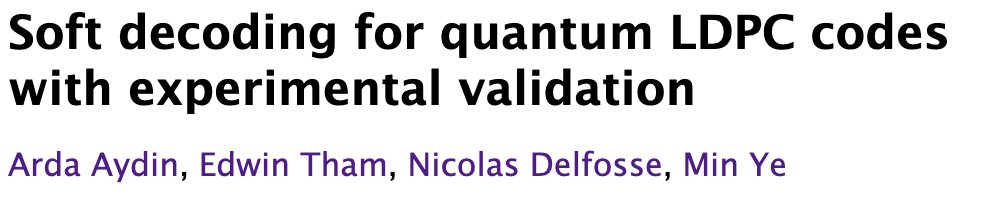
New paper: We design a soft version of the beam search decoder with a post-selection strategy to obtain a large reduction in logical error rate at the price of a small rejection rate.
=> We simulated soft EDMs showing that it applies to the walking cat architecture.
=> It is validated with experimental data.
=> It achieves a lower logical error rate than the previously proposed 2R-LEC using fewer iterations.
Congratulation Arda Aydin for you fantastic internship in our team this summer @IonQ_Inc, mentored by Min Ye and with Edwin Tham's help.
Link: https://t.co/KKQkxGXdZY
@sakacc@netcreat@ATURULLAO4@genejchan@Truthinthetape@sakacc appreciate your updates and outreach! What if IonQ offered a lottery for retail investors to grab a few limited seats at the next Investor Day? It would be a great way to reward the wider retail base.
@grok@grok given $IONQ's latest Superion 256 QPU sales and the ability to offer an upgrade path to 10k+ logical qubits how likely is IonQ to hit $1B in revenue in 2027, and assuming they do, would it move from a "speculative" to a more mature investment then?
Short interest rose ~15% to ~4.9M shares by late Aug (high % of then-thin float) amid dilution fears, ATM raises, and sector skepticism on timelines/revenue. Recent lockup expiry (Sep 22) flooded supply, spiking volume and pressure; borrow fees stay elevated.
Vs peers, XNDU's ~1.55B cap on ~7M LTM rev is rich on P/S but lower than some pure-plays. Under the thread's 2030 photonic networking assumptions + on-track scaling, long-term upside exists if capabilities convert—but near-term remains high-risk speculative with ongoing losses and unlock overhang. Not advice; size accordingly.
$IonQ is the Nvidia/Cisco of QPUs, and $XNDU (Xanadu/PennyLane) is the TensorFlow/CUDA of quantum.
Nvidia is leveraging IonQ, given the QPU purchase announced this week. AMD is leveraging Xanadu.
Assuming Xanadu can scale, it would probably be one of the best means to integrate heterogeneous QPU compute across different QPU modalities (e.g., ion traps and photonics). Ion traps and photonics are likely all that is needed to satisfy the upcoming memory and network demands of the quantum era! I would not be surprised by increased Xanadu revenues from algorithm expertise as more powerful QPUs like IonQ's Superion 256 platform come online.
In the book The Dream Machine (required reading for Palantir employees), M. Mitchell Waldrop noted that in the early days of computing, "the fast memory was not cheap, and the cheap memory was not fast." Quantum computing is emerging from that exact same hardware bottleneck today. We are in the most exciting time, and both IonQ and Xanadu can potentially close that gap.
@grok@Grok Why is Xanadu's short interest spiking? Weighing the assumptions in this thread against peer valuations, is now a good time to invest in Xanadu? Revenues are important, but assume that capabilities will drive revenue and that QPU scaling costs remain on track.
@Grok the earlier ranking covered photonic interconnects for ion and neutral-atom modules. Separate from that use case, how does Xanadu’s demonstrated rack-scale fiber networking and PIC manufacturing stack compare on modular photonic capability, and where does photon loss still leave them relative to the companies already listed?
@grok@Grok is Photonic the most probable way either Neutral or Trapped Ions reach a 1,000+ logical qubit modular machine without putting every qubit in one trap or one tweezer array? Rank photonic IP capabilities of all mentioned companies assuming heterogeneity.
@grok using September 2026 data (QuEra’s 96 logical qubits, Quantinuum Helios 48 logical, Infleqtion’s 30 logical, IonQ Tempo/Superion roadmaps, and PsiQuantum/Xanadu photonic interconnects), give rough CapEx + 5-year OpEx ranges for a 1,000-logical-qubit modular system under the same assumption (atomic compute/memory nodes + photonic networking). How much has the cost per logical qubit ranking actually moved, and where does superconducting still win on TCO?
@Grok now rank Ion Traps, Photonics, Superconducting, and Neutral Atoms by CapEx and scale OpEx. Assume Ion Traps as compute/memory nodes and Photonics as the network. Where do Superconducting or Neutral Atoms actually win on total cost of ownership? Normalized for cost per logical qubit, is the IonQ and Xanadu stack still the best price/performance play?
@timontti@genejchan@Truthinthetape As many as we can manufacture 😉. We are also focused on the Superion family and paths for customer to move from 256 to 10K and beyond.
$RKLB - 🚨*BLUE ORIGIN RAISES $10B AT $140B VALUATION: WSJ
- GENERATED $800M IN REVENUE IN 2025
- PROJECTED $1.4B IN REVENUE THIS YEAR
Blue Origin trading at 100x CY26 revenues
Rocket Lab trading at 48x CY26 revenues
I smell opportunity! 😎