Prof. @official_knu. the international. politics. (meta-)theories. knowledge/power. self/other. deconstruction. decolonization. culture. political economy.
Always think that time, as well as space, matters in geopolitics. The paper's concise/simple summary of global temporalities is helpful for understanding the modern international order in process.
Time and the multiplex order https://t.co/VZjqkVmPKx
This is a well-written, geo-epistemic survey of non-Western perspectives on IO, though recent pluriversal discussions are barely mentioned.
Non-Western Visions of International Order - https://t.co/Lj80nDiPLW
A Genealogy of International Relations in Asia is now available for pre-order! The volume offers fresh perspectives on the evolution of IR knowledge in Asia. Thrilled to contribute a chapter to this project.
https://t.co/8BKd4IZzR2
🔍 For over 70 years, South Korean conscientious objectors have been jailed for refusing military service.
💡 @itkx argues that the lens of bodily immunity helps understanding how their dissent challenges the state's vision of security.
👇
https://t.co/LHH5H224j3
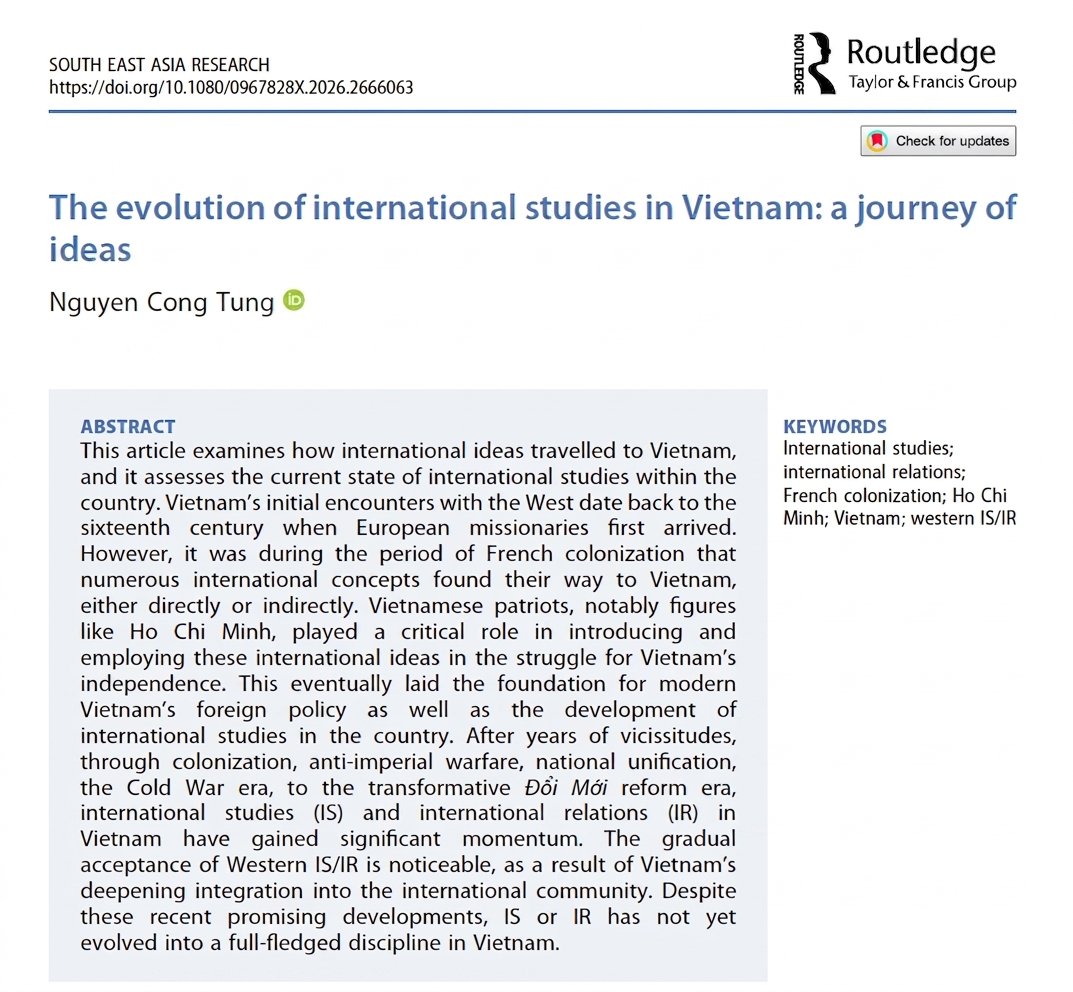
New research out on @SEAsiaResearch
In this piece, I ask: How did the idea of the ‘international’ travel to Vietnam? And what does the discipline of ‘International Studies/International Relations’ look like in the country today?
https://t.co/xQvAKC3StI
New article~
Is Vietnam really a middle power or is “middle-power Vietnam” itself a contested role?
Drawing on role theory, my new article on Contemporary Politics examines how Vietnam’s middle-power identity is produced.
https://t.co/pgpDrhEDJ2
"Beyond the Asian NATO: historical legacies, discursive binaries, and the possibility of a relational security community in Northeast Asia" by Yih-Jye Hwang & Chih-yu Shih
https://t.co/MSoAtD69Lv
Academic Freedom as a Duty rather than a Right: A Confucian Perspective and Beyond | PS: Political Science & Politics | Cambridge Core - https://t.co/L6l5CcGKBl
New in Foreign Policy Analysis 🚨
China–Vietnam ties are more stable than they “should” be.
This paper shows how relational power—expectations, restraint, and long-term stability—explains why.
https://t.co/86Ken10Tk6