New in Foreign Policy Analysis 🚨
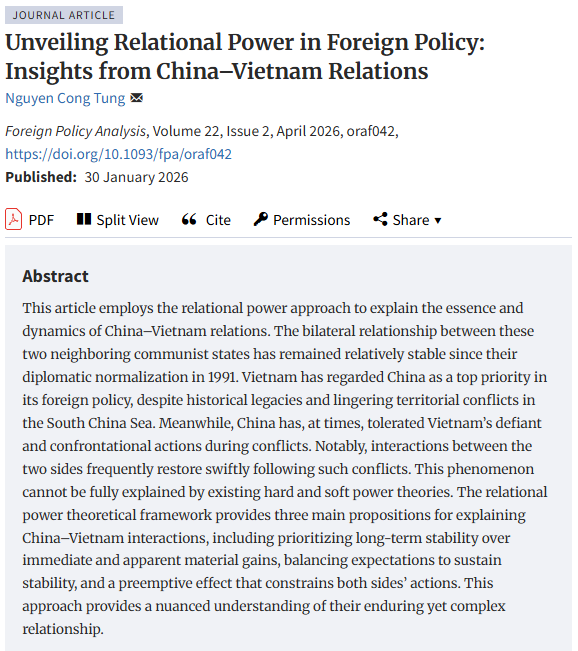
China–Vietnam ties are more stable than they “should” be.
This paper shows how relational power—expectations, restraint, and long-term stability—explains why.
https://t.co/86Ken10Tk6
New Cambridge Element, Decolonizing Security in East Asia by Chih-yu Shih @cyshih3, Chiung-Chiu Huang and Yih-Jye Hwang, out now! Read for free for the next 2 weeks at
https://t.co/x95yucxp9r
#cambridgeelements#politics
A Genealogy of International Relations in Asia is now available for pre-order! The volume offers fresh perspectives on the evolution of IR knowledge in Asia. Thrilled to contribute a chapter to this project.
https://t.co/8BKd4IZzR2
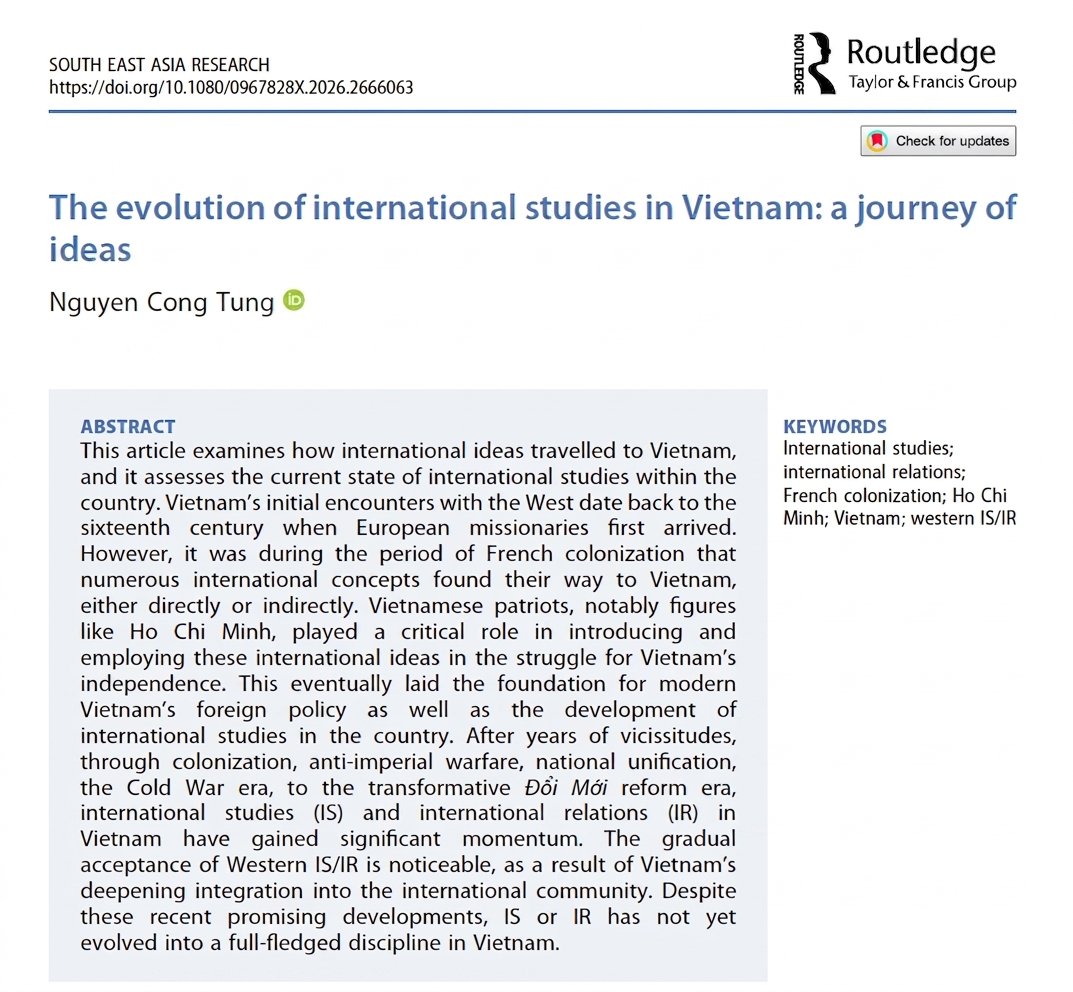
New research out on @SEAsiaResearch
In this piece, I ask: How did the idea of the ‘international’ travel to Vietnam? And what does the discipline of ‘International Studies/International Relations’ look like in the country today?
https://t.co/xQvAKC3StI
New article~
Is Vietnam really a middle power or is “middle-power Vietnam” itself a contested role?
Drawing on role theory, my new article on Contemporary Politics examines how Vietnam’s middle-power identity is produced.
https://t.co/pgpDrhEDJ2
Love and hate. Alignment and resistance. Vietnam-China relations have always been both.
Have a look at my 2022 article at @cpcs_journal on how “Chineseness” in premodern Vietnam still informs Hanoi’s thinking today:
https://t.co/1bfANlLa0d
Walking a Tightrope ONCE MORE…
How has Trump’s return shaped Vietnam’s approach to US-China rivalry?
Check out my latest in @IssuesStudies !
https://t.co/jxwM0ecS8d
Small and middle powers must therefore prioritize strategic autonomy. This means avoiding excessive dependence on any single great power. At the same time, states can pursue selective alignment where opportunities emerge.
Finally, what does Trump 2.0 mean for the Global South? My new article argues that the changing global order creates both risks and opportunities for smaller states.
3. Regionalization of global supply chains
Tariffs and technological competition are fragmenting the global economy into regional blocs. Three emerging production hubs are forming:
🇺🇸 North American supply chains
🇪🇺 European manufacturing networks
🇨🇳 East Asian production systems
2. Decentralization of the global security architecture
Trump’s pressure on NATO and allies is pushing countries toward strategic autonomy.
Europe is increasing defense spending and reconsidering long-term dependence on U.S. security guarantees.
1. The “East Rising, West Declining” dynamic
Trump’s transactional diplomacy and unilateral policies have eroded trust in U.S. leadership.
This creates political space for China and other Global South actors.
My new article examines how Donald Trump’s return to the White House is accelerating structural changes in the global order.
Is the disruption we see today about one leader—or deeper shifts in global power?
🚨NEW ARTICLE🚨
Nguyen (2026) explains how, despite a contentious history and context, Vietnam attaches importance to its bilateral relationship with China, using a relational power framework, providing three propositions to explain these interactions.
https://t.co/frh91No6A9