The biggest unlock with Claude code isn't writing better prompts.
It's writing the policies and workers once, so every future session inherits them.
I have hooks that block me from editing protected files. A policy that refuses to ship code without a regression test. A registry that knows which worker is the right tool for the job. None of that lives in the prompt. It lives in the system around the prompt.
The prompt is the conversation. The system is the leverage.
Most people are still tuning the conversation.
Courtesy: HQ (Personal AGI) @getindigo
The biggest performance wins I’ve seen rarely came from a bigger server.
They came from doing less work: precompute what doesn’t need to be live, stop fetching what nobody uses, and move expensive work off the request path.
Scaling should start with removing waste.
It’s obvious that they’re trying to capture the market, but it’s also obvious that the costs are going to be very high.
AI company valuations are exploding and investor expectations are very high, yet most of these companies are barely making money.
However, grok currently has a moat imo when it comes to speed that can directly affect the energy costs ultimately translating into lower prices. It’s comparable to Opus 4.8 btw.
It’s obvious that they’re trying to capture the market, but it’s also obvious that the costs are going to be very high.
AI company valuations are exploding and investor expectations are very high, yet most of these companies are barely making money.
However, grok currently has a moat imo when it comes to speed that can directly affect the energy costs ultimately translating into lower prices. It’s comparable to Opus 4.8 btw.
Tried OpenAI Tart and it’s exactly what I was looking for.
Codex can spawn an isolated macOS VM and test apps there instead of having windows flash in & out on my desktop all the time.
Unfortunately its around 8gb of ram per VM and noticeably slower control (which was my concern).
probably sticking with local testing, but still interesting.
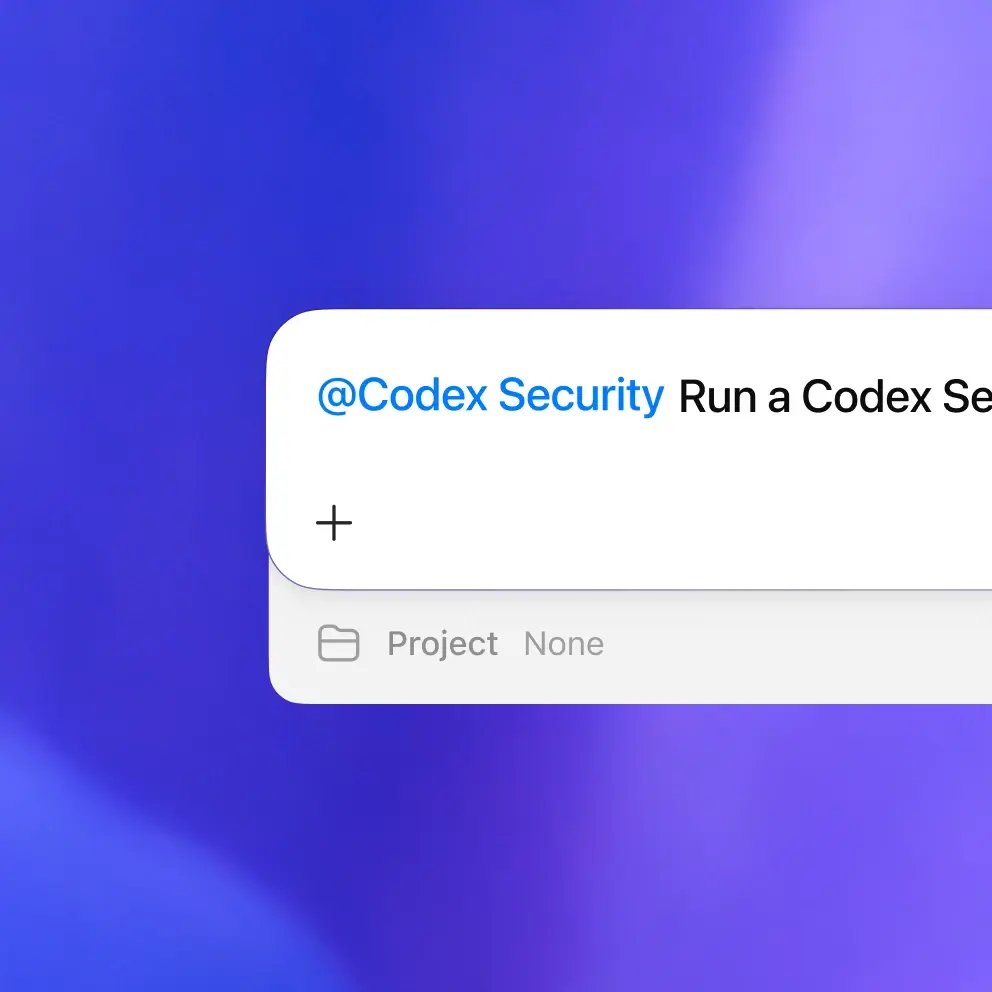
Here's how to add the Codex Security plugin in Codex and get started:
Add the plugin in Codex. After installation is complete, the button changes to “Try in chat.”
Click “Try in chat” to start a new Codex chat with a Codex Security scan prompt ready to run.
Choose a folder that contains the code you want Codex Security to review.
Send the scan prompt. Codex opens with the Codex Security scan prompt ready. Press “Send” to start the scan.
I worry more about stale context than missing context.
When a decision changes, the old one can’t keep showing up as truth. I want every agent to know what’s current, who owns it, and what it replaced.
More context only helps when the system knows what still applies.
Evening! We’ve gotten lots of great feedback on the new ChatGPT desktop app (which we didn't get totally quite right on the first try), and as a result, we've made some changes.
1/ ChatGPT conversation history and projects are now visible in the sidebar. Also, your Chat and Work history now sync across web, mobile, and desktop. Local tasks still stay on your computer.
2/ You can now easily switch between Chat and Work modes inside ChatGPT on desktop, which is now also consistent with how it shows on web and mobile.
3/ Nothing is changing for users on Codex mode. It's still the OG and best at what it does.
And overall we're continuing to fix paper cuts and improve performance, reliability, and efficiency.
Keep up the feedback, hope you like the updates!
GPT-5.6 Sol is NOT safe with "Full Access"
OpenAI recommends you use "Approve for Me" to prevent agents from deleting your files.
If you're still using "Full Access" you need to stop using that for GPT-5.6 Sol.
Start making backups:
1. Back important files with Dropbox, Github, etc.
2. Use Carbon Copy Cloner for full drive backups (I have two drives I alternate between)
3. Use an automatic backup via TimeMachine
4. Get offsite backup through Backblaze or similar service.
My bet: @thinkymachines will soon make more money than @AnthropicAI. Not by winning the race to build one standardized frontier model. By becoming the Palantir FDE for enterprise custom models.
The playbook:
1. Release the best American open-weight model.
2. Drive widespread enterprise adoption.
3. Charge the largest companies 7–9 figures to post-train and run custom models behind their own firewall.
The model rests on three bets:
1. Large enterprises will increasingly demand their own models with their own data, and this is how they differentiate and win.
2. Enterprises won’t need just one model. They’ll continuously need new models for different workflows, departments, and proprietary datasets. That creates extremely sticky, recurring revenue.
3. Autoresearch will make custom model development increasingly scalable. Tinker can become the interface enterprises use to post-train their own models—with @thinkymachines providing the expertise and infrastructure behind it. FDE, infra, everything, huge contracts.
4. Eventually, maybe everyone wants their OWN model, and autoresearch and training inside tinker on top of @thinkymachines's base model will make it happen.
Meanwhile, Henry-ford-styled, standardized models will makes no margins. OpenAI and Anthropic will have their API margins squeezed by Deepseek/GLM/Grok/Meta etc, and their consumer subscriptions are loss centers.
The fat margin will move to customization: proprietary data, post-training, evals, deployment, and infrastructure.
If this thesis is right, @thinkymachines isn’t building just another frontier lab. It’s building the highest-value layer between frontier research and enterprise model ownership.
Turns out, the best business model for enterprise is NOT to sell commodity API access. Sell them their own models.
I’m extremely bullish on this approach.
@miramurati may be the most commercially savvy frontier-lab leader. I have to admit it.
I've been on the $200 Max plan for Claude Code this whole time. This is my last month, at least for a while.
I'm not paying for a service when I don't know what I'm getting week to week.
You have one of the strongest models in the world, then you pull it out of the subscription and hand me a second-rate model as a consolation prize, instead of just giving me the best like every other lab does inside their own plans. Makes zero sense.
No model, not even Fable, is worth that API price.
And right now? I've spent hours trying to run a task on Fable, and the safeguards keep silently rerouting me to Opus. It wrecks my work and hands me garbage output because Opus hallucinates. It should at least ask me if I want to continue on Opus. It just does it, quietly.
After this month you're going to lose a lot. You can't hold your customers while open models and the China labs keep climbing, and while OpenAI runs one of the biggest customer-grab campaigns ever with Sol.
I actually used to miss Opus back when it was strong and didn't hallucinate. Now it's dumb. It's like they nerfed it so you'd feel the gap with Fable.
Anthropic fumbled this badly.
I want @AnthropicAI@OpenAI@cursor_ai to give us "slow" mode for tasks that I'm ok getting much lower priority at a cost savings. Maybe even a "slowest" mode which will optionally pause and queue my workload to timeshift it for even more cost savings.
The first time an agent solves something for me, it’s an experiment.
The real value starts after that: save the context, checks and workflow so someone else can run it without asking how I did it.
A good AI result saves time once. A reusable one keeps saving it.
Grok 4.5 just took the #1 spot on the Long-Horizon Terminal-Bench, outperforming Claude Fable 5, Claude Opus 4.8 and GPT-5.6-sol
This benchmark tests whether an AI agent can sustain progress across hundreds of dependent terminal actions for up to 90 minutes without losing the thread
Across 46 difficult tasks and 18 frontier models, Grok 4.5 achieved the highest mean reward at 0.505
Grok 4.5 is proving that it can handle complex agentic work over long periods of time
This is extremely important for real-world coding, automation and difficult engineering tasks
When an agent fails, I don’t want a better explanation.
I want the context it used, the tools it called, the state it changed, and the exact point it stopped.
Agent reliability starts with making runs replayable, not making failures sound reasonable.