New Anthropic research: A global workspace in language models.
Of everything happening in your brain right now, only a tiny fraction is consciously accessible—thoughts you can describe, hold in mind, and reason with.
We found a strikingly similar divide inside Claude.
Introducing ZCode, the official development environment for GLM-5.2
- GLM Coding Plan subscribers: now 1.5x usage quota in ZCode
- BYOK supported: works with your existing subscriptions and APIs
- Available on macOS, Windows, and Linux
Download now: https://t.co/Peepqv4XSx
Claude Desktop is now available on Linux (Ubuntu and Debian) in beta.
Alongside the browser and terminal, you now get a first-class desktop experience with Claude Code, Claude Cowork, and chat on all paid plans.
Introducing Claude Science, a new app designed with every stage of research in mind.
Artifacts traced to their code, environments managed on demand, and 60+ optional scientific databases that you can connect.
Available now in beta.
We’re happy to announce 2 releases today:
- 🧠Brain2qwerty v1 is published at @NatureNeuro
- 🚀 Brain2Qwerty v2 is now publicly released
Explore how we decode sentences from non-invasive brain recordings: https://t.co/IdR6gK2hcd
Links:
📄v1 Nature Neuro: https://t.co/wnRjc9W9gI
📑v2 Meta preprint: https://t.co/oSfLOQFcvg
💻Code: https://t.co/Xbe0XWfWQL
📊Data: https://t.co/SCBbs4AhTg
📝Blog: https://t.co/15RvsAaXlH
🧵Thread: https://t.co/d8FJrVyDut
We’re sharing the next major milestone in our non-invasive brain-to-text decoder research: Brain2Qwerty v2.
Building on v1, which was published today in @Nature, Brain2Qwerty v2 is the highest-performing end-to-end pipeline capable of real-time sentence decoding from raw brain signals. It advances beyond character-level performance to decoding words and semantics, enabling accuracy for overall communication.
We believe this research has the potential to make a real difference for the millions of people who suffer from brain lesions or disorders that prevent them from communicating.
🧵👇
Introducing Claude Tag, a new way for teams to work with Claude.
In Slack, Claude joins as a team member with access to the channels and tools you choose. Tag Claude in and delegate tasks to it while you focus on other work.
Qwen3.7-Max is live! 🚀
Introducing the latest proprietary model, built for advanced agentic coding, complex reasoning, and long-horizon execution. It’s here to transform how we approach complex tasks.
Introducing our brand new, intelligent Search box — totally reimagined with AI. This is the biggest upgrade to our Search box in 25 years and it’s starting to roll out today.
Designed to anticipate your intent, the new Search box helps you formulate your question with AI-powered suggestions that go beyond autocomplete. It will offer nuance that you might not have even thought to add — helping you ask the exact question on your mind with ease.
Plus, you’ll be able to search across modalities — with text, images, files, videos and even Chrome tabs.
#GoogleIO
Personal update: I've joined Anthropic. I think the next few years at the frontier of LLMs will be especially formative. I am very excited to join the team here and get back to R&D. I remain deeply passionate about education and plan to resume my work on it in time.
We’re introducing a new GitHub Certified: Agentic AI Developer (GH-600).
As AI agents become part of modern development workflows, this role-based certification focuses on how developers and teams operate, supervise, and integrate agents across the SDLC.
If you’re already working with tools like GitHub Copilot or exploring agent-driven workflows, we’d love your input.
Learn more and get involved. https://t.co/ruiYtlsYnj
We’re rolling out Trusted Contact in ChatGPT, a new optional safety feature that helps eligible users connect with someone they trust during moments of emotional crisis.
https://t.co/YQYgn3VA6r
we're starting rollout of GPT-5.5-Cyber, a frontier cybersecurity model, to critical cyber defenders in the next few days.
we will work with the entire ecosystem and the government to figure out trusted access for cyber; we want to rapidly help secure companies/infrastructure.
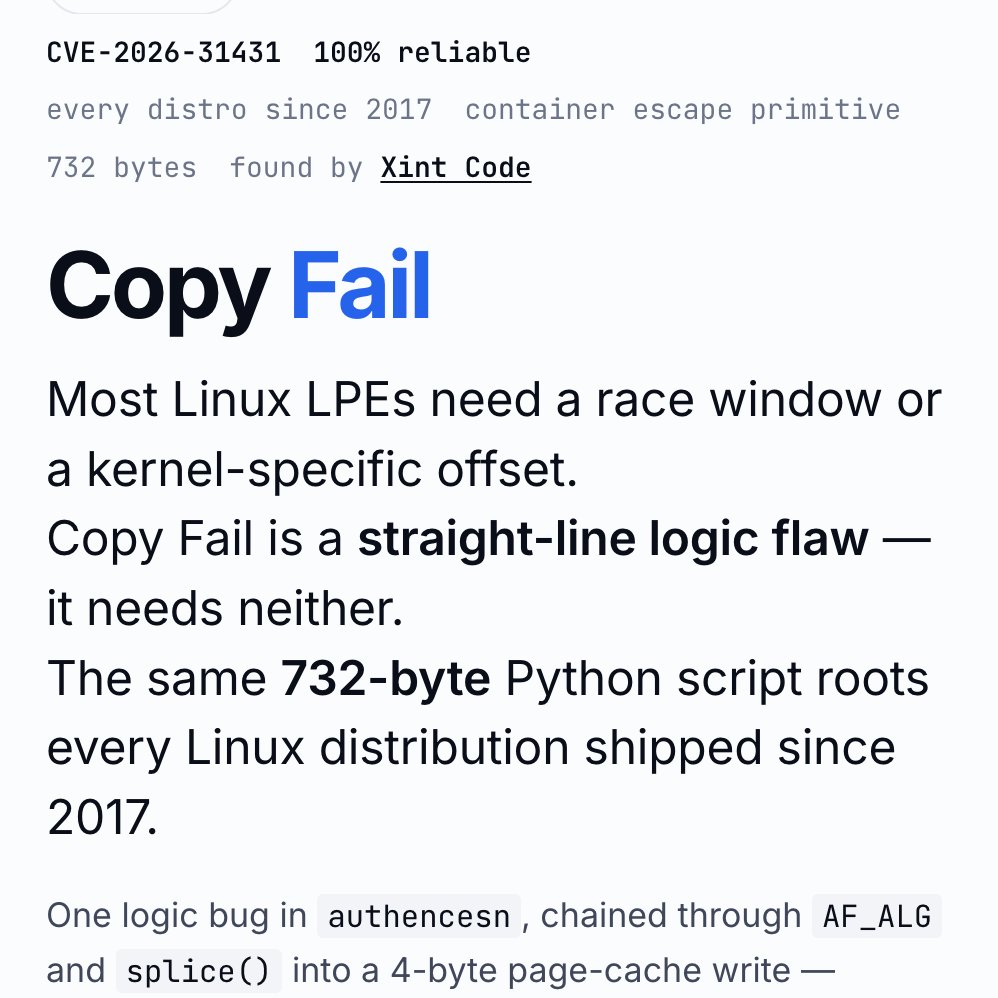
‼️🚨 BREAKING: An AI found a Linux kernel zero-day that roots every distribution since 2017. The exploit fits in 732 bytes of Python. Patch your kernel ASAP.
The vulnerability is CVE-2026-31431, nicknamed "Copy Fail," disclosed today by Theori. It has been sitting quietly in the Linux kernel for nine years.
Most Linux privilege-escalation bugs are picky. They need a precise timing window (a "race"), or specific kernel addresses leaked from somewhere, or careful tuning per distribution. Copy Fail needs none of that. It is a straight-line logic mistake that works on the first try, every time, on every mainstream Linux box.
The attacker just needs a normal user account on the machine. From there, the script asks the kernel to do some encryption work, abuses how that work is wired up, and ends up writing 4 bytes into a memory area called the "page cache" (Linux's high-speed copy of files in RAM). Those 4 bytes can be aimed at any program the system trusts, like /usr/bin/su, the shortcut to becoming root.
Result: the next time anyone runs that program, it lets the attacker in as root.
What should worry most: the corruption never touches the file on disk. It only exists in Linux's in-memory copy of that file. If you imaged the hard drive afterwards, the on-disk file would match the official package hash exactly. Reboot the machine, or just put it under memory pressure (any normal system load that needs the RAM), and the cached copy reloads fresh from disk.
Containers do not help either. The page cache is shared across the whole host, so a process inside a container can use this bug to compromise the underlying server and reach into other tenants.
The original sin was a 2017 "in-place optimization" in a kernel crypto module called algif_aead. It was meant to make encryption slightly faster. The change broke a critical safety assumption, and nobody noticed for nine years. That bug then rode every kernel update from 2017 to today.
This vulnerability affects the following:
🔴 Shared servers (dev boxes, jump hosts, build servers): any user becomes root
🔴 Kubernetes and container clusters: one compromised pod escapes to the host
🔴 CI runners (GitHub Actions, GitLab, Jenkins): a malicious pull request becomes root on the runner
🔴 Cloud platforms running user code (notebooks, agent sandboxes, serverless functions): a tenant becomes host root
Timeline:
🔴 March 23, 2026: reported to the Linux kernel security team
🔴 April 1: patch committed to mainline (commit a664bf3d603d)
🔴 April 22: CVE assigned
🔴 April 29: public disclosure
Mitigation: update your kernel to a build that includes mainline commit a664bf3d603d. If you cannot patch immediately, turn off the vulnerable module:
echo "install algif_aead /bin/false" > /etc/modprobe.d/disable-algif.conf
rmmod algif_aead 2>/dev/null || true
For environments that run untrusted code (containers, sandboxes, CI runners), block access to the kernel's AF_ALG crypto interface entirely, even after patching. Almost nothing legitimate needs it, and blocking it shuts the door on this whole class of bug...
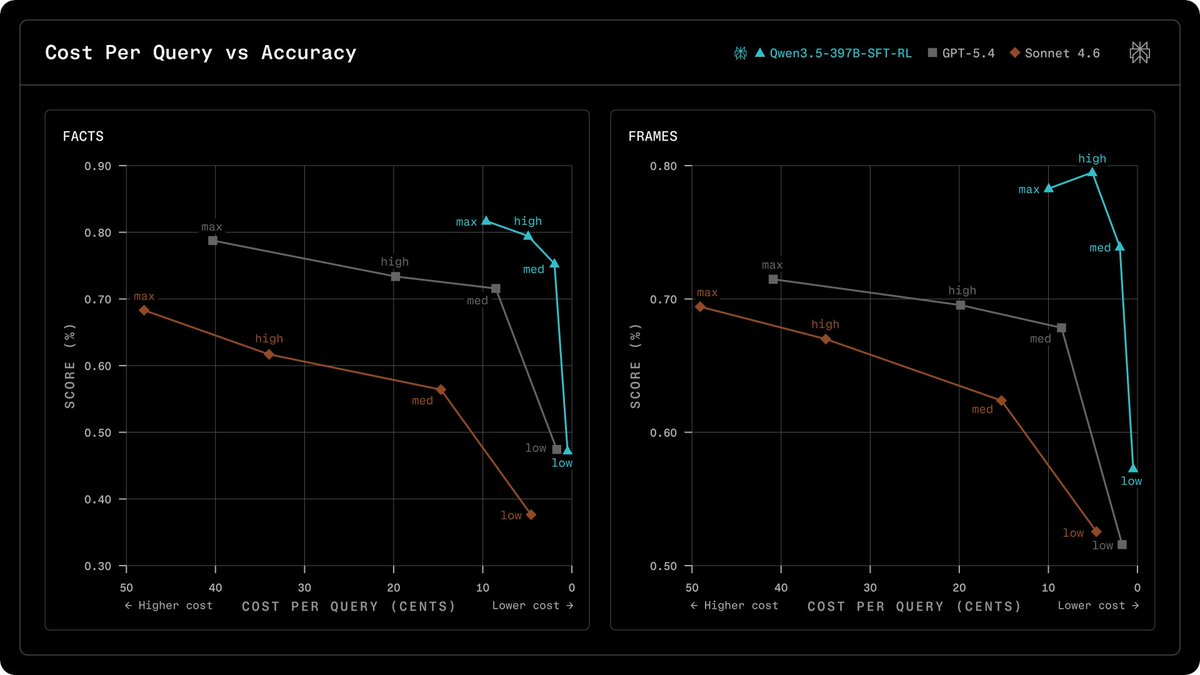
We've published new research on how we post-train models for accurate search-augmented answers.
Our SFT + RL pipeline improves search, citation quality, instruction following, and efficiency.
With Qwen models, we match or beat GPT models on factuality at a lower cost.