Qwen3.7-Max is live! 🚀
Introducing the latest proprietary model, built for advanced agentic coding, complex reasoning, and long-horizon execution. It’s here to transform how we approach complex tasks.
Introducing our brand new, intelligent Search box — totally reimagined with AI. This is the biggest upgrade to our Search box in 25 years and it’s starting to roll out today.
Designed to anticipate your intent, the new Search box helps you formulate your question with AI-powered suggestions that go beyond autocomplete. It will offer nuance that you might not have even thought to add — helping you ask the exact question on your mind with ease.
Plus, you’ll be able to search across modalities — with text, images, files, videos and even Chrome tabs.
#GoogleIO
Personal update: I've joined Anthropic. I think the next few years at the frontier of LLMs will be especially formative. I am very excited to join the team here and get back to R&D. I remain deeply passionate about education and plan to resume my work on it in time.
We’re introducing a new GitHub Certified: Agentic AI Developer (GH-600).
As AI agents become part of modern development workflows, this role-based certification focuses on how developers and teams operate, supervise, and integrate agents across the SDLC.
If you’re already working with tools like GitHub Copilot or exploring agent-driven workflows, we’d love your input.
Learn more and get involved. https://t.co/ruiYtlsYnj
We’re rolling out Trusted Contact in ChatGPT, a new optional safety feature that helps eligible users connect with someone they trust during moments of emotional crisis.
https://t.co/YQYgn3VA6r
we're starting rollout of GPT-5.5-Cyber, a frontier cybersecurity model, to critical cyber defenders in the next few days.
we will work with the entire ecosystem and the government to figure out trusted access for cyber; we want to rapidly help secure companies/infrastructure.
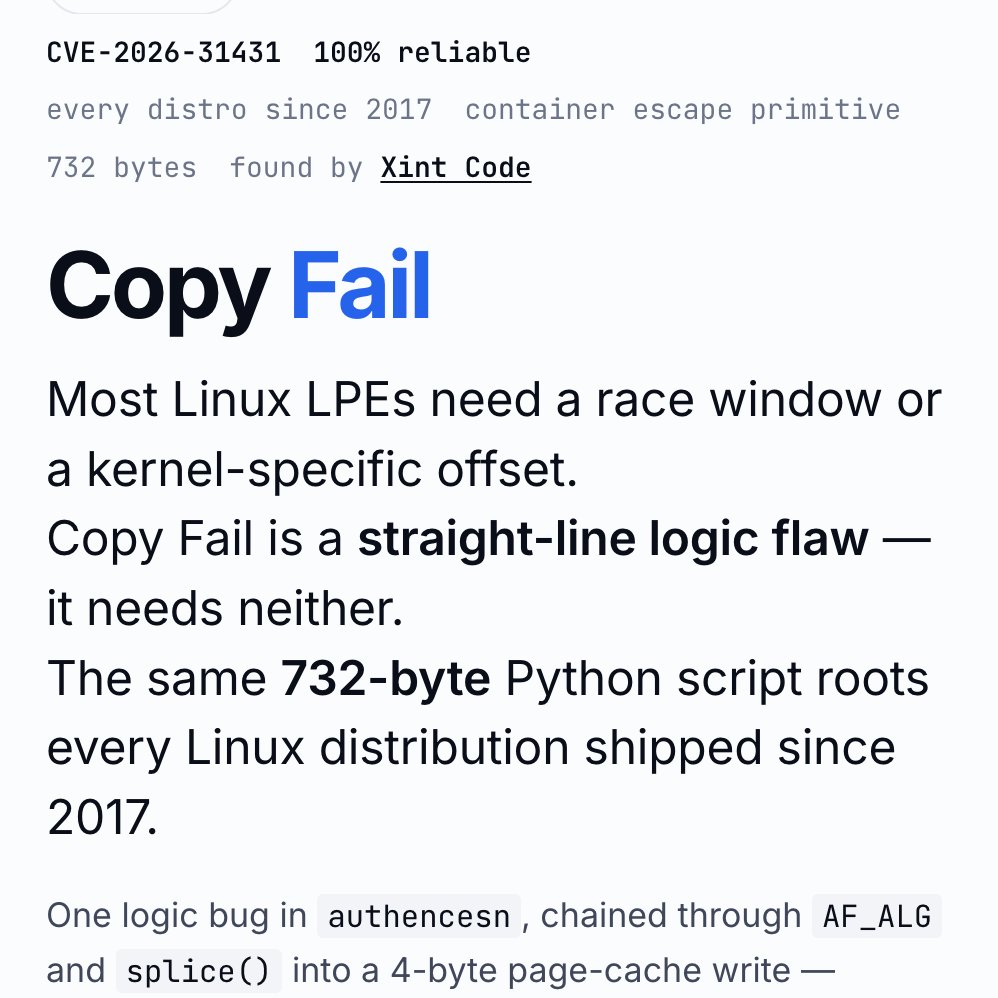
‼️🚨 BREAKING: An AI found a Linux kernel zero-day that roots every distribution since 2017. The exploit fits in 732 bytes of Python. Patch your kernel ASAP.
The vulnerability is CVE-2026-31431, nicknamed "Copy Fail," disclosed today by Theori. It has been sitting quietly in the Linux kernel for nine years.
Most Linux privilege-escalation bugs are picky. They need a precise timing window (a "race"), or specific kernel addresses leaked from somewhere, or careful tuning per distribution. Copy Fail needs none of that. It is a straight-line logic mistake that works on the first try, every time, on every mainstream Linux box.
The attacker just needs a normal user account on the machine. From there, the script asks the kernel to do some encryption work, abuses how that work is wired up, and ends up writing 4 bytes into a memory area called the "page cache" (Linux's high-speed copy of files in RAM). Those 4 bytes can be aimed at any program the system trusts, like /usr/bin/su, the shortcut to becoming root.
Result: the next time anyone runs that program, it lets the attacker in as root.
What should worry most: the corruption never touches the file on disk. It only exists in Linux's in-memory copy of that file. If you imaged the hard drive afterwards, the on-disk file would match the official package hash exactly. Reboot the machine, or just put it under memory pressure (any normal system load that needs the RAM), and the cached copy reloads fresh from disk.
Containers do not help either. The page cache is shared across the whole host, so a process inside a container can use this bug to compromise the underlying server and reach into other tenants.
The original sin was a 2017 "in-place optimization" in a kernel crypto module called algif_aead. It was meant to make encryption slightly faster. The change broke a critical safety assumption, and nobody noticed for nine years. That bug then rode every kernel update from 2017 to today.
This vulnerability affects the following:
🔴 Shared servers (dev boxes, jump hosts, build servers): any user becomes root
🔴 Kubernetes and container clusters: one compromised pod escapes to the host
🔴 CI runners (GitHub Actions, GitLab, Jenkins): a malicious pull request becomes root on the runner
🔴 Cloud platforms running user code (notebooks, agent sandboxes, serverless functions): a tenant becomes host root
Timeline:
🔴 March 23, 2026: reported to the Linux kernel security team
🔴 April 1: patch committed to mainline (commit a664bf3d603d)
🔴 April 22: CVE assigned
🔴 April 29: public disclosure
Mitigation: update your kernel to a build that includes mainline commit a664bf3d603d. If you cannot patch immediately, turn off the vulnerable module:
echo "install algif_aead /bin/false" > /etc/modprobe.d/disable-algif.conf
rmmod algif_aead 2>/dev/null || true
For environments that run untrusted code (containers, sandboxes, CI runners), block access to the kernel's AF_ALG crypto interface entirely, even after patching. Almost nothing legitimate needs it, and blocking it shuts the door on this whole class of bug...
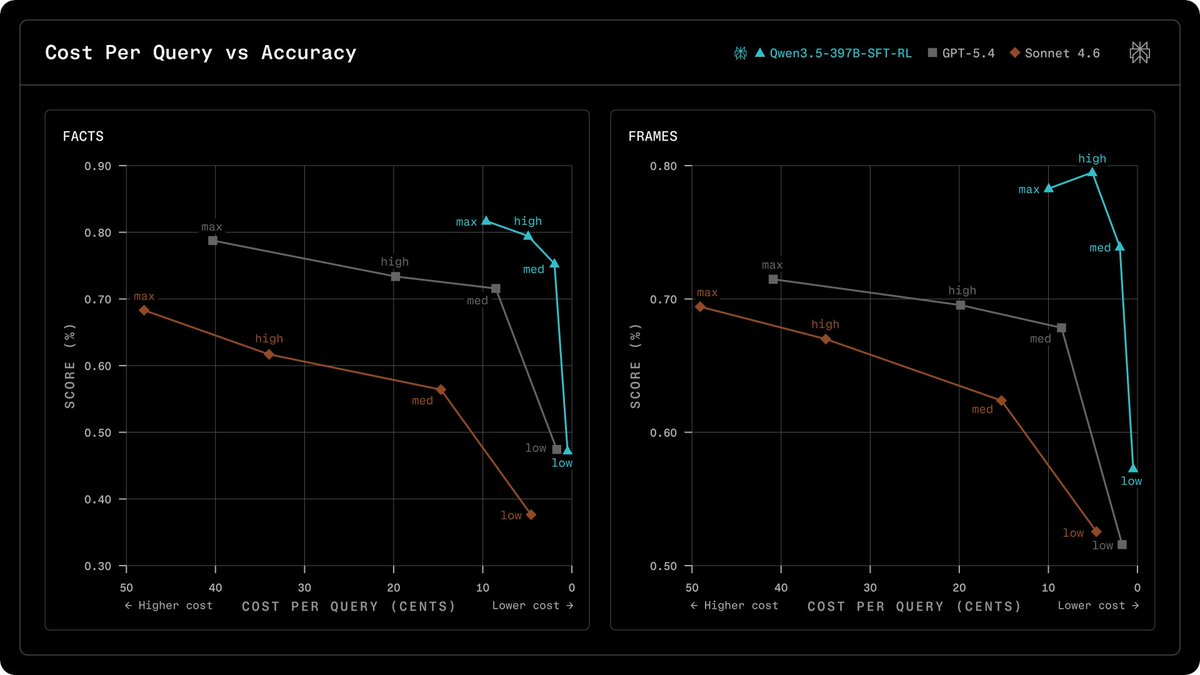
We've published new research on how we post-train models for accurate search-augmented answers.
Our SFT + RL pipeline improves search, citation quality, instruction following, and efficiency.
With Qwen models, we match or beat GPT models on factuality at a lower cost.
We're making a big change to the Copilot experience.
Agent Mode is generally available and now the default across Copilot in Word, Excel, and PowerPoint.
As models become more capable, we’re bringing that power to where real work happens, right in the canvas.
The power of a spreadsheet as an example is its spatial representation of information. What sits next to what, what feeds what. Give an agent that canvas to reason over, and a single prompt can reshape the model, the bridge, and the narrative at once.
Read more: https://t.co/73zVIFWnuI
The conversation around AI agents is no longer about how to build them — it’s about how to manage thousands of them. Today we’re introducing Gemini Enterprise Agent Platform, a new way to build, scale, govern and optimize agents.
It combines the models and services you’re familiar with from Vertex AI with new features, like a new Agent Studio, so agents can more easily handle your complex workflows. #GoogleCloudNext
Build workspace agents for your team, on top of a cloud-hosted Codex harness. Hook them up to tools, give them recurring tasks, and talk to them from surfaces like Slack.
Easier than ever to bring the power of agents to your computer work.
Gemini Embedding 2 is now generally available in the Gemini API and Vertex AI!
Start building with our first natively multimodal embedding model, now equipped with the stability and optimizations required for production apps.
Today, we’re open-sourcing the draft specification for DESIGN.md, so it can be used across any tool or platform. We’re also adding new capabilities.
DESIGN.md lets you easily export and import your design rules from project to project. Instead of guessing intent, agents know exactly what a color is for and can even validate their choices against WCAG accessibility rules.
Watch David East break down this shared visual language in action👇. New capabilities and links in 🧵
sniffnet diye rust ile yazılmış bir araç var, internet trafiğini izlemek için. açıp ağ kartını seçiyorsun ve o an hangi cihaz nereye paket gönderiyor, hangi servisle konuşuyor, hangi ülkeye bağlanıyor hepsini
görebiliyorsun.
windows mac linux hepsinde çalışıyor, tek binary. hostların domain ve asn bilgisini çözüyor coğrafi konumu gösteriyorr.
açık kaynak ve ücretsiz.
Introducing Claude Design by Anthropic Labs: make prototypes, slides, and one-pagers by talking to Claude.
Powered by Claude Opus 4.7, our most capable vision model. Available in research preview on the Pro, Max, Team, and Enterprise plans, rolling out throughout the day.
Welcome Salesforce Headless 360: No Browser Required! Our API is the UI. Entire Salesforce & Agentforce & Slack platforms are now exposed as APIs, MCP, & CLI. All AI agents can access data, workflows, and tasks directly in Slack, Voice, or anywhere else with Salesforce Headless 360. Faster builds, agentic everything. 🚀
#Salesforce #Agentforce #AI
https://t.co/mxySdJS7HR
Introducing Claude Managed Agents: everything you need to build and deploy agents at scale.
It pairs an agent harness tuned for performance with production infrastructure, so you can go from prototype to launch in days.
Now in public beta on the Claude Platform.