Btw, this is the rumor I've been hearing as well for the past week, which is why the current factoring results were a bit of the let down, and may *not* be the full story: https://t.co/5TtttM4xxf
Scott Aaronson on his blog. I have also heard this. In fact, this rumor has persisted for about ten days, about both Anthropic and OpenAI. Considering how closely their recent math results have mirrored each other, if one has it, they probably both do. This would crack RSA.
An internal Claude model claims to have found a proof of Valiant’s conjecture that VP ≠ VNP over every field.
This is a massive result in theoretical computer science.
Both a written and Lean proof is given.
https://t.co/nvNnUuo2zO
Once again, as with the Exponential Time Hypothesis paper, Claude is the sole author. And once again, an unspecified 'internal research Claude model.' Uploaded with no announcement.
OpenAI has posted their own VP ≠ VNP proof in response to Anthropic's, and says their result 'was obtained on November 6, 2026.' Two weeks ago. The ETH papers were also released in an similar oneupmanship fashion. As with Anthropic's result, no name on the paper (my guess is this was GPT-Aeon). Also like Anthropic: no announcement, no blog post, no tweet.
This is a significant result, yet both OpenAI and Anthropic chose to simply dump it online with no comment. I was listening to a Scott Aaronson interview this morning where he said this specific result would update him toward 'a solution to P ≠ NP by the AIs might really be around the corner.'
To me this is more evidence for my argument that both OpenAI and Anthropic are sitting on a dragon's hoard of scientific results they are not releasing to the public. The first massive 700+ paper OpenAI GitHub dump took five weeks for their model to generate. It's been seven weeks since then, and their internal model has continued to improve. They said they had it working on 4,000 problems. How many have been solved in the last seven weeks? Based on the last release, 1,000+ is not unreasonable.
I will quote OpenAI Chief Scientist Jakub Pachocki from the blog post 'Perplexity and Intelligence,' posted 48 hours ago:
'We have recently witnessed unprecedented acceleration in another domain. For more than a year, we have been posing open problems in mathematics to our models as one of the ways of evaluating them. Once we upgraded to a model of log-perplexity ~0.76, it started producing groundbreaking results. For many of us that have previously worked in mathematics and adjacent fields, seeing the resolutions to questions we've long thought about coming out of the model one after another in a single Slack thread felt deeply surreal.'
There have also been, of late, multiple rumors about breakthroughs in cryptography that I have been reluctant to post about for obvious reasons. Specifically, there have been rumors of an encryption breakthrough at Anthropic. What I personally took from the big OpenAI math release was that all encryption will be cracked much sooner than people are expecting, and that the rate of scientific discoveries will continually increase as we continue to scale up. No, not will increase, *has increased*. At both labs. We just don't know about it yet. Because unless you work at those labs, the current frontier is completely invisible. But it won't stay that way forever. Or to put it another way: prepare yourself for revelations.
Modular and Stereoselective Synthesis of Acyl Fluorides via Pd-catalyzed Fluorinative Bifunctionalization of Ketenes with Allylic Fluoride Precursors https://t.co/GG5ikKjjQV…
#chemistry#openaccess#science#chemtwitter
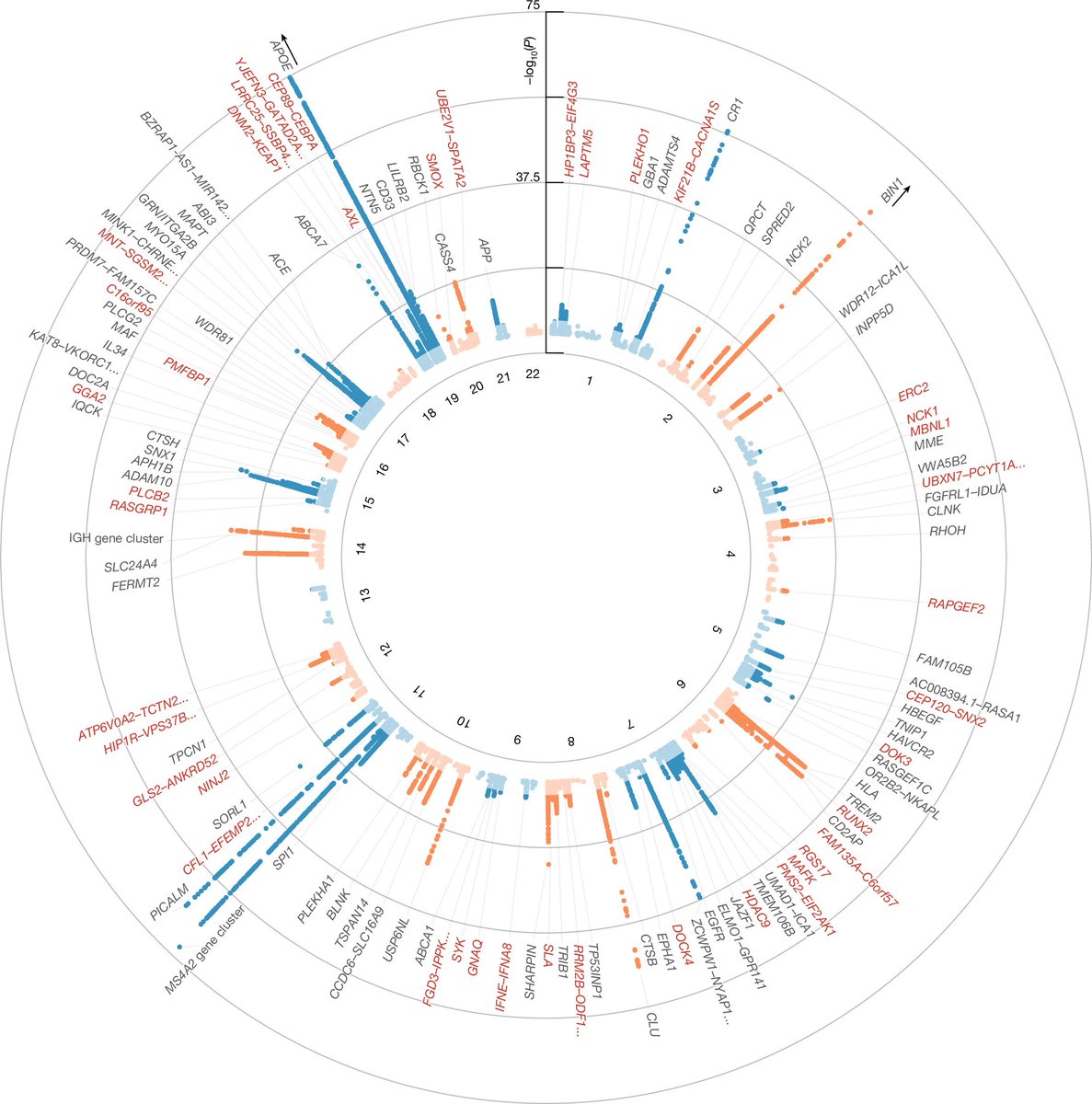
アルツハイマー病に関連する127の遺伝子領域を特定 脳の免疫細胞と神経細胞への関与が浮かぶ🧠🧬
Emil Uffelmann, Douglas P. Wightmanらの@Nature#OA#論文
Alzheimer’s disease genetics converges on microglial and neuronal dysregulation
DOI: 10.1038/s41586-026-11206-y
#オープンアクセス
A QUANTUM COMPUTER IS ABOUT TO BE DEPLOYED IN A DATA CENTER.
The same company that got an investment from the US government worth $35 million.
Diraq and Equinix announced it last night. October in Sydney. The world's first silicon spin quantum computer running inside a shared commercial data center.
The specs tell you why this matters more than the qubit count:
8 qubits. Yes, small, but it's just. the beginning.
Cryogenic cooling and control electronics fully self-contained in the unit. Draws under 20 kilowatts, a fraction of what a single modern AI rack pulls. Fits alongside standard servers with minimal integration. To scale up, you swap the chip. The rack, the cooling, the building stay the same.
Compare that to the rest of the industry. IBM's newest cryo module is eight feet tall and needs two chambers bolted together. PsiQuantum's machine is 100 cabinets fed by liquid helium plants. Quantum computers have been buildings. This one is just a box.
That's the silicon spin thesis showing up in the physical world. Diraq's qubits are made in the same foundries that make phone chips, so they're tiny, they run warmer than superconducting qubits, and millions could fit on one chip. It's why IBM just bought a spin qubit company, and why DARPA's fault-tolerance shortlist has four spin companies on it, the largest bloc.
What it actually does for data centers:
Puts quantum physically next to the GPUs. Hybrid quantum-AI workloads need microsecond round trips. Across the country is too slow, but across the rack is not.
Solves data sovereignty. Enterprises can't ship sensitive data to a lab in another country. A quantum box inside a compliant Equinix facility computes where the data already lives.
Makes quantum a line item. Equinix runs 260+ data centers. If this system works in one rack, the deployment model is copy-paste, and Diraq's CEO said it plainly: fleets of them, not one.
Honest scale check: 8 qubits solves nothing commercially. This is a form-factor milestone, proving quantum can live in enterprise infrastructure, not a compute milestone. And Diraq is a tiny company, under 50 people, with a Commerce LOI up to $38M.
But every technology that went mainstream did it the same way. Not by getting more powerful. By getting small enough to fit where the customers already were.
$EQIX $IBM $INFQ $IONQ
THIS QUANTUM CHIP IS MADE THE SAME WAY AS THE CHIP IN YOUR LAPTOP.
THE U.S. GOVERNMENT JUST PUT $38M BEHIND IT TO REACH MILLIONS OF QUBITS.
The company is Diraq.
The chip in your laptop has billions of transistors printed on silicon in existing factories.
Diraq makes its qubits with that same process. No custom-built qubit factory, no starting from scratch.
That's the whole bet. If qubits can be printed like transistors, getting to millions isn't a physics problem anymore. It's a manufacturing problem, and the chip industry already solved that one.
The plan:
2029: 150,000 qubits
2031: more than 2 million qubits
Today, the Commerce Department finalized up to $38M to build and test Diraq's quantum chips in the U.S.
$INFQ $IONQ $QNT
We’re sharing a new preprint showing wet lab validation of intrinsic protein design capabilities of the GPT-6 family of models.
Our models can design new protein shapes and sequences using reasoning and code, without calling specialized biology models to generate them.
https://t.co/cFfB0QHXub