Now online in @CD_AACR: Same-Slide Spatial Multi-Omics Integration with IN-DEPTH Reveals Tumor Virus-Linked Spatial Reorganization of the Tumor Microenvironment - by Stephanie Pei Tung Yiu, @Yuzhou_Chang, @yeoyaoyu, Huaying Qiu, Wenrui Wu, @SizunJ, and colleagues
Chuffed to share KRONOS: A foundation model for Spatial Proteomics! https://t.co/Fp09v1irAi
Exciting work with the indomitable @AI4Pathology, led by the amazing @mshaban_ai, @Yuzhou_Chang, with Huaying, @yeoyaoyu, @GuillaumeJaume, Andrew Song, and our collaborators
We are so happy to publish our new foundation model in Nature Methods. we trained OmiCLIP, a vision-omics due modalities model to bridge pathology image and transcriptomic, and Loki, a platform using OmiCLIP as backbone for ST and HE image cross analysis. https://t.co/UkHryBRFqQ
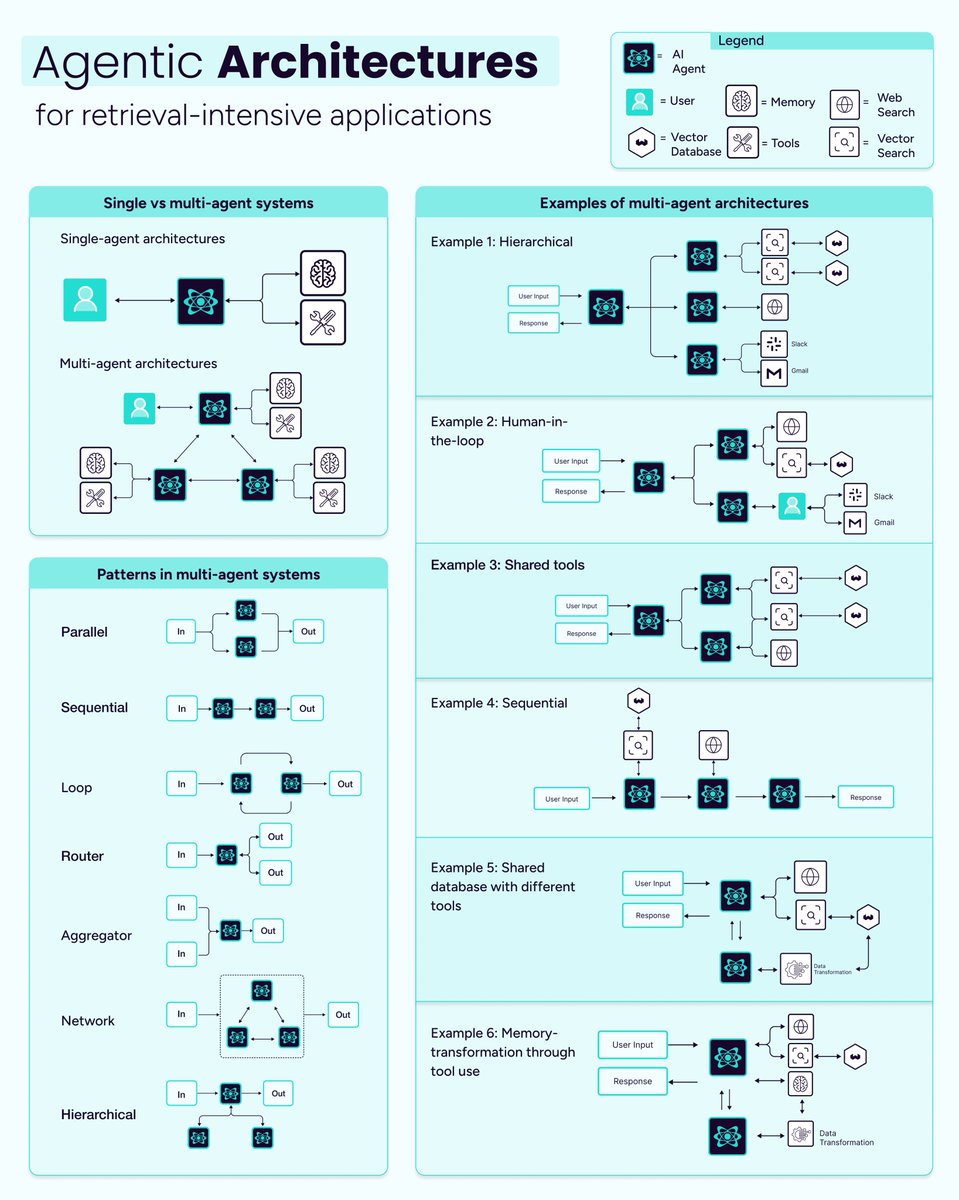
Multi-agent architectures are the FUTURE
Here are 6 different types:
𝟭. 𝗛𝗶𝗲𝗿𝗮𝗿𝗰𝗵𝗶𝗰𝗮𝗹 (𝗩𝗲𝗿𝘁𝗶𝗰𝗮𝗹) 𝗔𝗿𝗰𝗵𝗶𝘁𝗲𝗰𝘁𝘂𝗿𝗲
A supervisor agent orchestrates multiple specialized agents.
𝘌𝘹𝘢𝘮𝘱𝘭𝘦:
• One agent retrieves information from internal data sources
• Another agent specializes in public information from web searches
• A third agent specializes in retrieving information from personal accounts (email, chat)
𝟮. 𝗛𝘂𝗺𝗮𝗻-𝗶𝗻-𝘁𝗵𝗲-𝗟𝗼𝗼𝗽 𝗔𝗿𝗰𝗵𝗶𝘁𝗲𝗰𝘁𝘂𝗿𝗲
Incorporates human verification before proceeding to next actions, used when handling sensitive information.
𝟯/𝟱. 𝗡𝗲𝘁𝘄𝗼𝗿𝗸 (𝗛𝗼𝗿𝗶𝘇𝗼𝗻𝘁𝗮𝗹) 𝗔𝗿𝗰𝗵𝗶𝘁𝗲𝗰𝘁𝘂𝗿𝗲
Agents communicate directly with one another in a many-to-many fashion. Forms a decentralized network without strict hierarchical structure.
𝟰. 𝗦𝗲𝗾𝘂𝗲𝗻𝘁𝗶𝗮𝗹 𝗔𝗿𝗰𝗵𝗶𝘁𝗲𝗰𝘁𝘂𝗿𝗲
Agents process tasks in sequence, where one agent's output becomes input for the next.
𝘌𝘹𝘢𝘮𝘱𝘭𝘦: Three sequential agents where:
• First query agent retrieves information from vector search
• Second query agent retrieves additional information from web search based on first agent's findings
• Final generation agent creates a response using information from both query agents
𝟱. 𝗗𝗮𝘁𝗮 𝗧𝗿𝗮𝗻𝘀𝗳𝗼𝗿𝗺𝗮𝘁𝗶𝗼𝗻 𝗔𝗿𝗰𝗵𝗶𝘁𝗲𝗰𝘁𝘂𝗿𝗲
Includes agents dedicated to transforming data.
𝘌𝘹𝘢𝘮𝘱𝘭𝘦:
• A transformation agent that enriches data at insert-time or transforms existing collections
There are also some other patterns that can be combined with these architectures:
• 𝗟𝗼𝗼𝗽 𝗽𝗮𝘁𝘁𝗲𝗿𝗻: Iterative cycles for continuous improvement
• 𝗣𝗮𝗿𝗮𝗹𝗹𝗲𝗹 𝗽𝗮𝘁𝘁𝗲𝗿𝗻: Multiple agents working simultaneously on different parts of a task
• 𝗥𝗼𝘂𝘁𝗲𝗿 𝗽𝗮𝘁𝘁𝗲𝗿𝗻: A central router determining which agents to invoke
• 𝗔𝗴𝗴𝗿𝗲𝗴𝗮𝘁𝗼𝗿/𝘀𝘆𝗻𝘁𝗵𝗲𝘀𝗶𝘇𝗲𝗿 𝗽𝗮𝘁𝘁𝗲𝗿𝗻: Collecting and synthesizing outputs from multiple agents
Check out this ebook for more info: https://t.co/pfM1lcp3SC
Spatial proteomics is here, but spatial functional proteomics?
Here is our Nature BME paper on spatial protein interactomics (https://t.co/xGZ6DUQTWh) illuminating how 47 proteins co-localize/ interact within 20 nm and their function in tissues.
@naturemethods@rita_strack
Lastly, I am very excited to integrate GSP, a novel mathematical theory based on graphs with novel types of spatial omics data. Moving forward, we will continue to explore and develop new theoretical models in conjunction with spatial biotechnology. ⏭️ To be continued ⏭️
Following Yao's post @yeoyaoyu , I'm very excited to share the principles of spectral graph cross-correlation (SGCC). I would also like to express my gratitude for the support and guidance from my co-mentors @SizunJ and @QinMaBMBL.
Spatial proteomics & transcriptomics are amazing technologies that have transformed how we study diseases. Can we do more?
Here's our new preprint that combines both assays into one! (massive thanks to @SizunJ@Yuzhou_Chang Huaying @QinMaBMBL et al.
https://t.co/I0bsLsjhXk
Fifth, we apply SGCC across multiple samples, obtaining a series of SGCC scores as spatial factors. We then use differential expression analysis or time-series modeling to calculate gene expressions that correlate with these spatial factors. Yao has previously described.
Spatial proteomics & transcriptomics are amazing technologies that have transformed how we study diseases. Can we do more?
Here's our new preprint that combines both assays into one! (massive thanks to @SizunJ@Yuzhou_Chang Huaying @QinMaBMBL et al.
https://t.co/I0bsLsjhXk