@deanwball Apologizing for supporting slavery and then asserting AI will always be a subhuman tool and never a being, in the same document, seems like a bold choice
1/ LLMs were never designed to "feel" — but they develop internal representations of emotion whose geometry parallels human affective processing. Excited to share our take alongside recent concurrent work in this space from @AnthropicAI and @1e0sun!
w/ @mweber_PU
@Berci nice work, this topic doesn't get the attention it deserves. whose building the agent-to-agent protocol underpinning connections between each AI? what info/chats are patient owned? how many services, once the domain of healthcare, can be direct to consumer?
Yeah, I'm just watching @OpenAI 's newly released ChatGPT Agent power through my Qualtrics survey. I have thoughts about the future of human subject research. #artificalintelligence#LLM
A new study from OpenAI & Penda Health shows an AI copilot (GPT-4o) cut diagnostic errors by 16% and treatment errors by 13% across 40K+ live visits.
First real-world, prospective evidence that LLMs can reduce clinical errors -- safely and at scale
Excited to share two advances that bring us closer to real-world impact in healthcare AI:
SDBench introduces a new benchmark that transforms 304 NEJM cases into interactive diagnostic simulations. AI must ask questions, order tests, and weigh costs, mirroring the complexity of real clinical decision-making.
MAI-DxO is a model-agnostic orchestrator that simulates a panel of virtual physicians. It achieves 85.5% diagnostic accuracy—four times that of experienced doctors—while cutting diagnostic costs.
Together, these advances offer a blueprint for how AI can help deliver precision and efficiency in healthcare, and we're looking forward to working with healthcare partners and the entire ecosystem on these advances making a difference.
https://t.co/XHpb1gWYxN
👀Using an autonomous agent based on o3-mini and GPT-4.1, a team from Harvard, MIT & other institutions reproduced and updated an entire issue of Cochrane Reviews in two days… saving 12 person-years of work!
The AI reviews captured more papers & were more accurate than humans.
@uOttawaResearch@uOttawa@Kinaxis@uottawakn Great initiative! We need academia + industry collabs for AI in healthcare as well; too much talent in Ottawa to let this opportunity pass us by
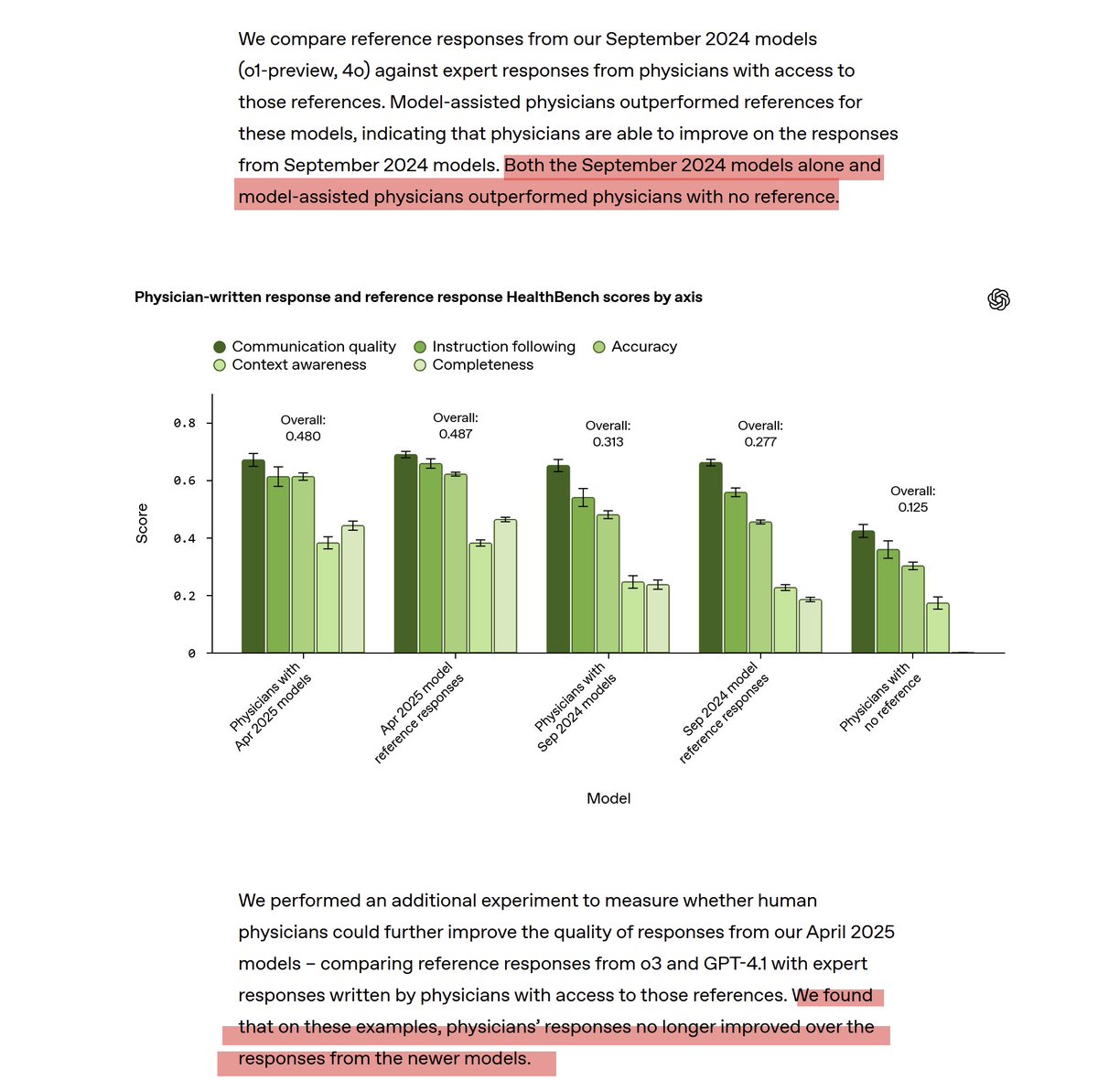
In September, 2024, physicians working with AI did better at the Healthbench doctor benchmark than either AI or physicians alone.
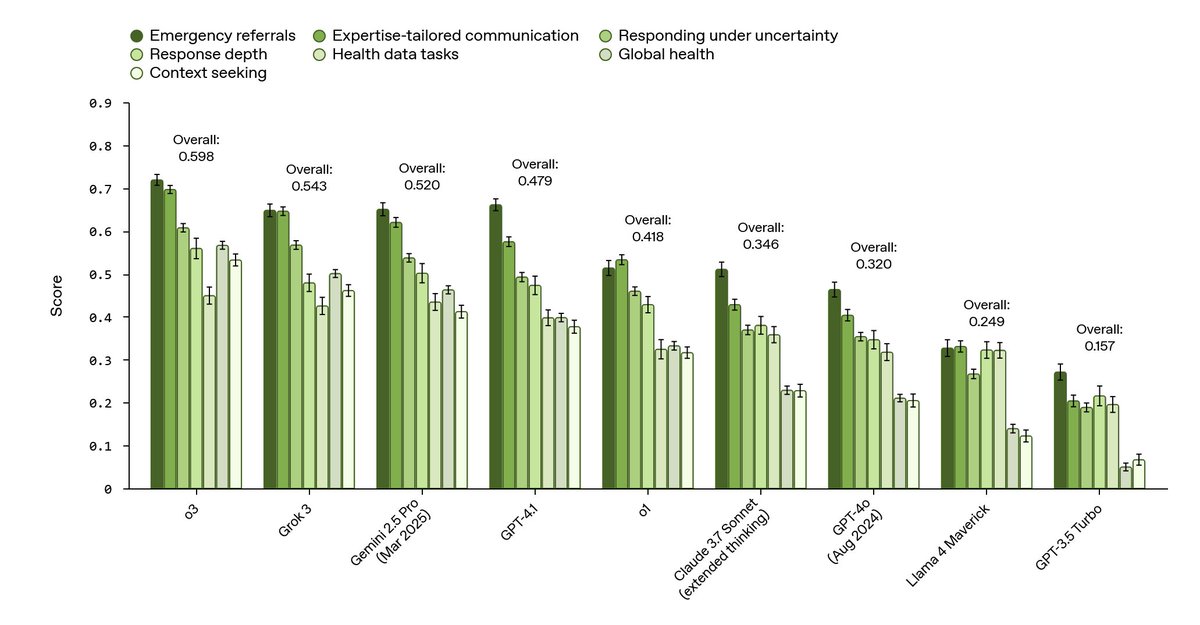
With the release of o3 and GPT-4.1, AI answers are no longer improved on by physicians.
Also error rates appear to be dropping for newer AI models.
A locally deployable, open-source LLM-Anonymizer can remove personal identifiers with high accuracy, offering a scalable and accessible solution for secure medical data processing. Learn more: https://t.co/XYkZNIVMl4
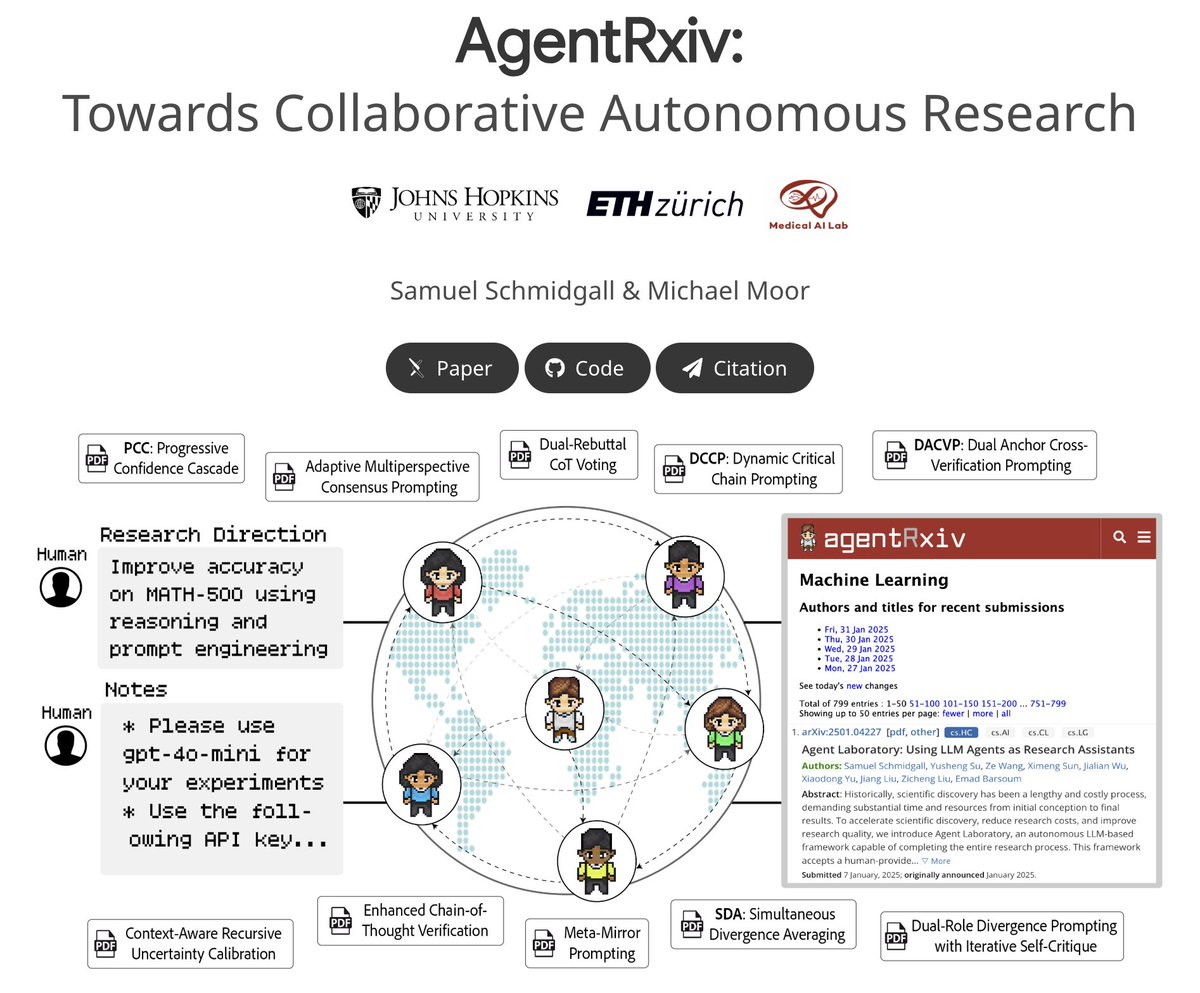
🚀🌐Introducing AgentRxiv: a framework where autonomous research agents can upload, retrieve, and build on each other’s research.
AgentRxiv takes your research direction and progressively outputs research, building on its previous work with each new paper!
🧵
@EikoFried Future behavioural scientists will tap into secure data streams from people's personal AIs (perhaps using federated analytics). Local AIs generate idiographic insights and share secure data to generate sub-group/group data models. https://t.co/VVKPrJuZH9
@BrianRoemmele Local, open source, self-sovereign AI agents are the optimal future. App store for protocols to provide: psychological insights, communicate health data/queries to your doctors AI, discuss preferences with democratic opinion aggregator, etc. Working on it.
Today we introduce an AI co-scientist system, designed to go beyond deep research tools to aid scientists in generating novel hypotheses & research strategies. Learn more, including how to join the Trusted Tester Program, at https://t.co/1eqmTTZOLr