🚀 Big news in healthcare AI! I'm thrilled to announce the launch of OpenMed on @huggingface, releasing 380+ state-of-the-art medical NER models for free under Apache 2.0.
And this is just the beginning! 🧵
- Autistic Children Are Faster at Turn-Taking Than Neurotypical Controls Especially with Unfamiliar Interlocutors, but Equally Adjust to Their Interlocutors - Saturday 11.30-13.30 - Poster 056
Something we've done in genAI engineering for @louie_ai for over a year now, I've been advising folks since GPT4 came out... and hopefully makes more sense now:
Only** build for GPT-4-grade models. Focus on GPT-4, Claude 3, and looks like Llama 3. Build for the future by living in the future.
Don't waste time on models that can't reason. Mistral, your favorite 7b fine-tune, etc. It's hard to get dumb models to do basic things reliably. Every hour wasted on generating correct JSON, avoiding derpy reasoning, etc means you're taking precious hours writing piles of tech debt code you'll want to delete in 6mo. Worse, it's zero-sum: you're not spending time on what matters.
GPT-4-grade code is easier to write, and more importantly, works & looks different. As models get better, your code will work even better and faster, and more importantly, still be the type you want to run. You trust the LLM to do more interesting & powerful things, which changes your product, code, etc.
Another day, I'll rant on the same time being wasted on most fine-tunes.
---
**: Sometimes we do want to run on the edge, or some subtasks that 100X faster & cheaper. Small models can be good there. E.g., @louie_ie <> @GroqInc means analysts get more done when interacting, and analytics pipelines can cover more ground. But even in these cases, I'd start with GPT-4 reasoning grade to make sure things work, and only go to smaller models when there's an optimization like edge AI or needs to run on 100X more data, and we can treat it as an optimization problem where we have a summarizing preprocessor before it goes to the smarter model.
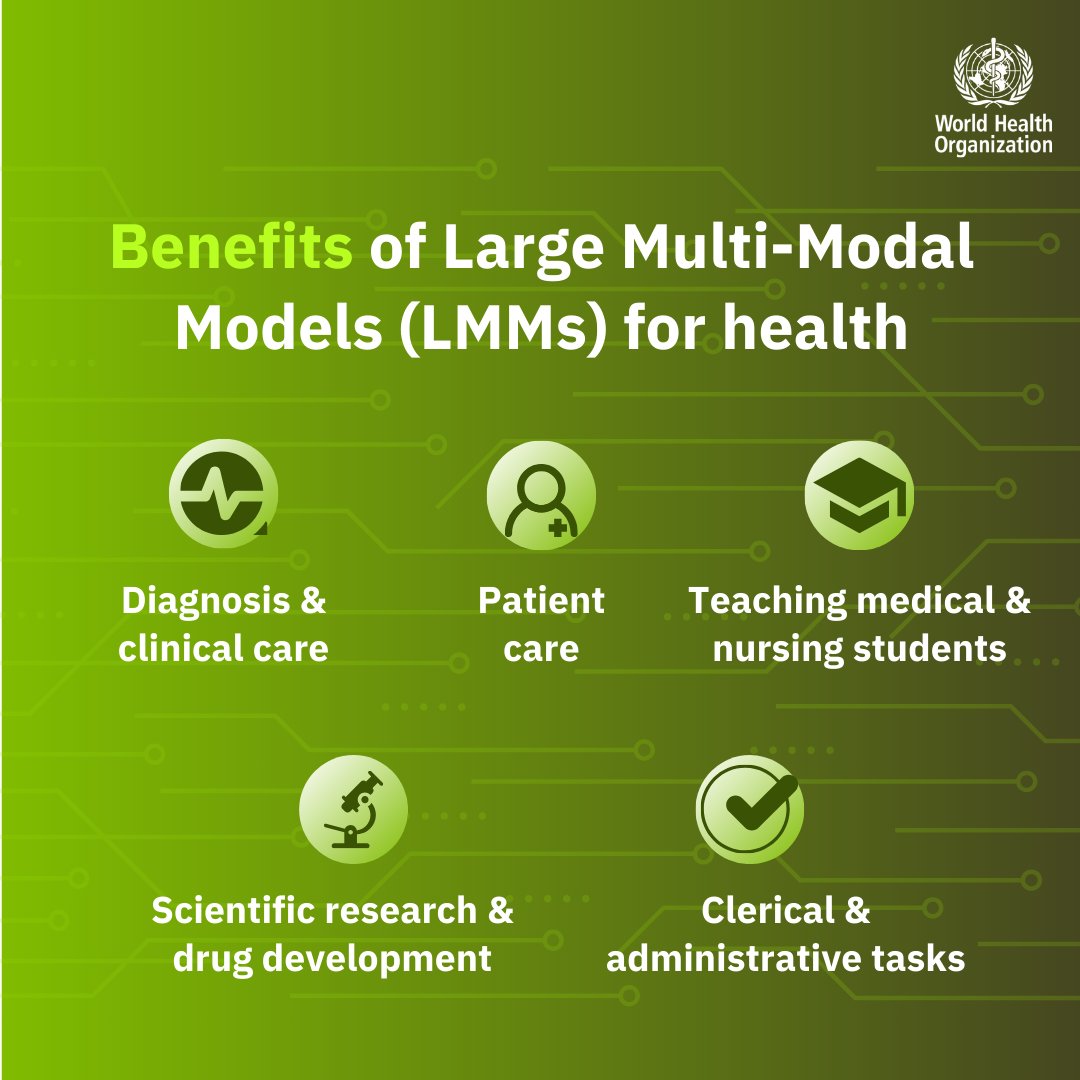
📢 WHO launches guidance for Large Multi-Modal Models (LMMs) - technologies like ChatGPT, Bart, and Berd - to shape the future of #ArtificialIntelligence in healthcare.
Check out WHO's latest guidance, which introduces 5⃣ impactful applications 👉 https://t.co/mK6WVMecsB
GPT-4 for radiology. Far from perfect, but state-of-the-art performance on some tasks: “Surprisingly, we found radiology report summaries generated by GPT-4 to be comparable and, in some cases, even preferred over those written by experienced radiologists”
https://t.co/bi6RwqgeHw
The LLaVA-Med model by @MSFTResearch is now open access! 🌋🩺
LLaVA-Med is a 7B biomedical vision-language model initialized from the general-domain LLaVA model and then trained on a large dataset of PubMed Central figure-captions
Check it out on @huggingface (link below)!
GPT-4V can now tell and SHOW what it means
SoM overlays several spatial and speakable marks (like masks and reference IDs) on the images to unlock the grounding capabilities of large multimodal models (LMMs).
https://t.co/g4RHUw2AqE
Amazing, Zephyr-7B-β was just released!
I was researching Zephyr 7B for some upcoming posts and just stumbled upon it. Can't wait to try this out😀
Also, a big shoutout to @huggingface and @MistralAI for focusing on small models. The GPU-poor thank you 🙌