Interacted with top CEOs of the energy sector earlier this evening. India will play a key role in the global energy sector. This is also a sector where India offers immense investment opportunities, growth and innovation.
The energy sector CEOs shared valuable inputs on the sector and expressed confidence in India’s growth trajectory.
https://t.co/JbkZ15MOLw
Tesla Q4 earnings call:
Question: Could you share the current number of Optimus units deployed in Tesla factories and how they have impacted factory output?
Elon:
"We’re still very much in the early stage of Optimus, the R&D phase. We have had Optimus do some basic tasks in the factory. As we iterate the new versions, we deprecate the old. It’s not in use in the factory in a material way, but it's so that robots can learn. We don’t expect to have significant Optimus volume until the end of this year.
A lot of companies are announcing layoffs; but at Fremont, we expect to increase headcount."
🚨 Your AI is lying to you with complete confidence.
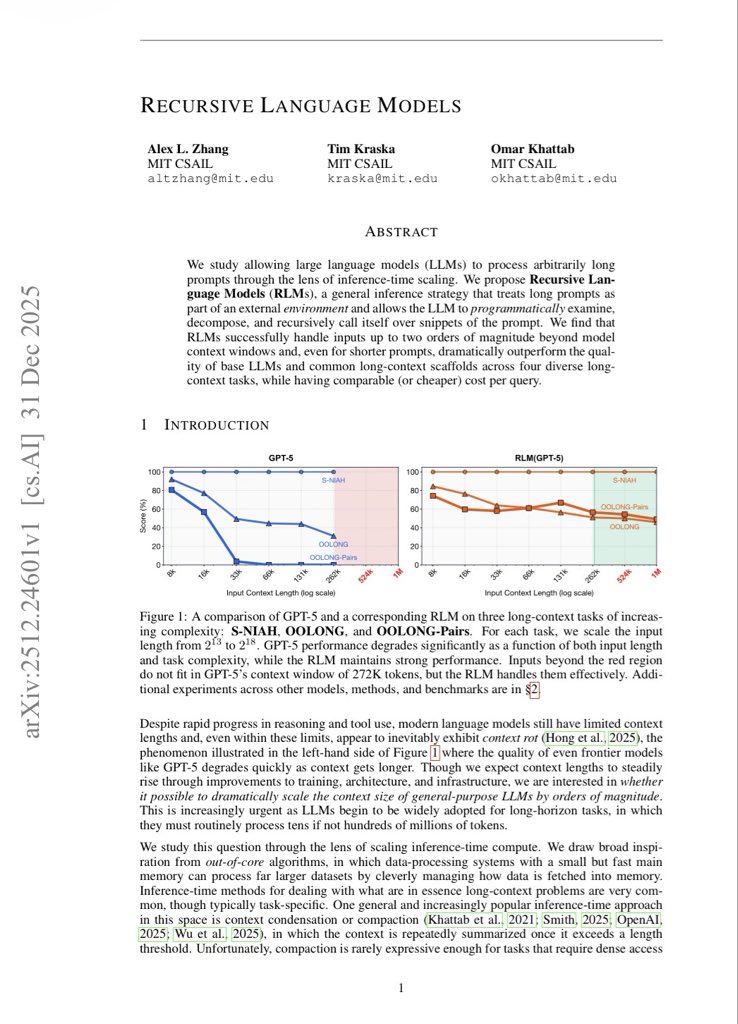
Harvard & MIT just proved ChatGPT hallucinates 110% less when you force it to argue with itself.
The technique is called "Recursive Meta-Cognition" and it's embarrassingly simple.
Here's how to make AI actually think:
Teaching according to one's ability is the essence of education, as China's Confucius said long ago. It's a pity that even until after 2000, this has not yet been realized.
Zhao Cheng's insightful perspective serves as a crucial reminder that AI research demands perseverance beyond the accolades, highlighting the often-overlooked challenges inherent in both academic and industry settings.
zhaocheng’s reflection on 11 years in ai is the reality check the industry needs right now. everyone sees the nvidia research scientist title, but few talk about the actual grind and the research setbacks that define you. academia vs industry isn’t just a career choice, it’s a mindset shift. if you’re a phd student feeling lost in the llm era, read this. it’s the most sincere memoir i’ve seen in a while.
Finally People are waking up!
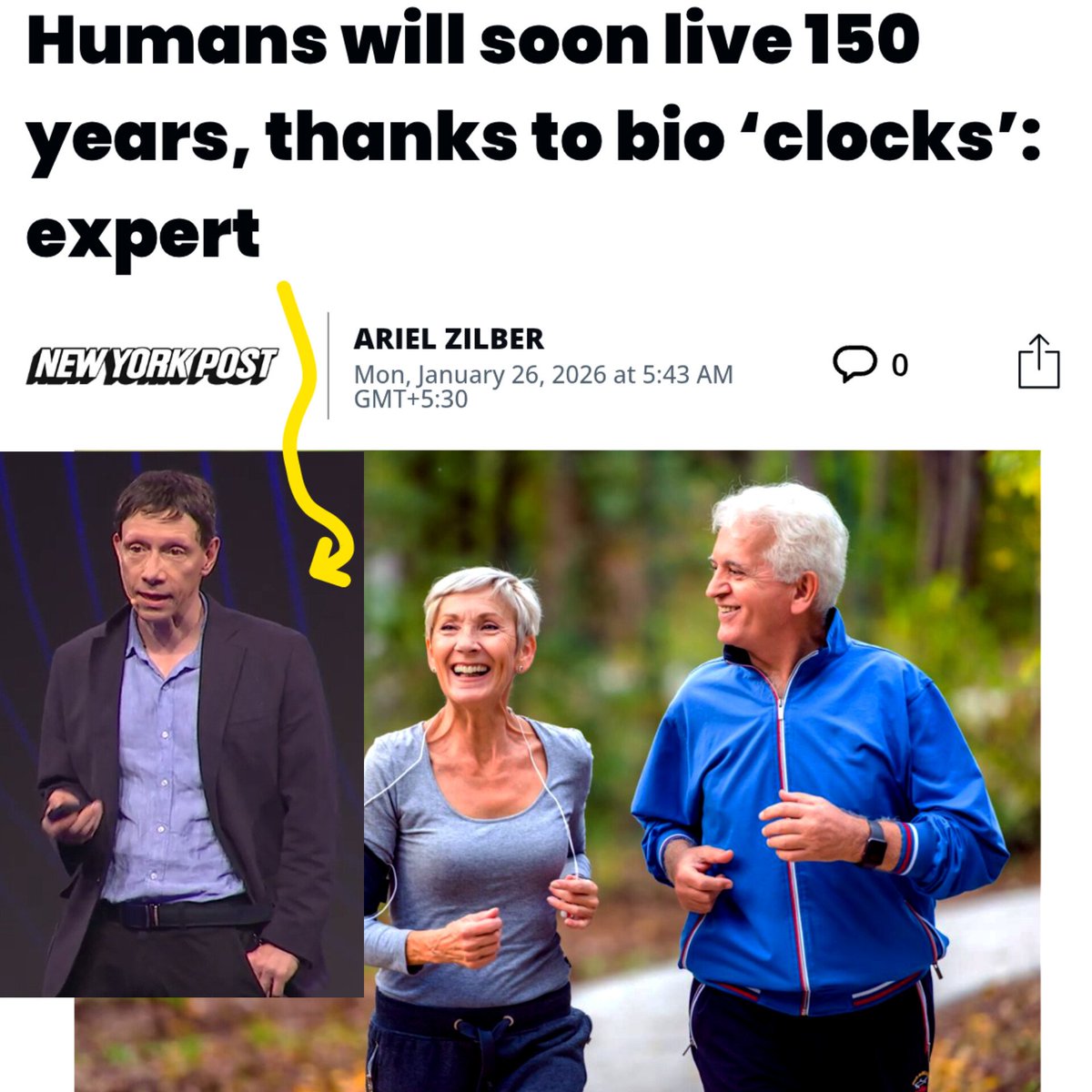
Geneticist Steve Horvath has predicted that humans could eventually start living up to 150 years. The prediction is based on recent advancements in biological clocks and rejuvenation research.
Horvath, who created the first widely used epigenetic "aging clocks," emphasized the importance of accurately measuring biological age in longevity research.
This progress has enabled scientists to test treatments that aim to slow or potentially reverse the aging process, instead of just treating diseases.
As i already said, we're not born to die, we are born to live.
Chinese scientists on Sunday launched their fully self-developed Optics GPT, a large AI model dedicated to photonics that has systematically learned core knowledge and design principles in optical communication and optical design.
The 8B-parameter model can translate abstract theories and complex formulas into visual demonstrations and interactive Q&A sessions for teaching, organize literature and perform complex simulation calculations in research, and also support industrial design applications.
From my observation of friends around me, those who’ve worked at frontier AI labs experience exponential growth.
It’s not just technical. It’s a deeper shift in how they view the world, trends, and themselves. Being immersed in an environment full of other exceptional people led to exponential growth.
There’s a clear lesson here for startups: hire the very best, put them together, and you get compounding effects.
And for each individual, find the environment that puts you on an exponential curve.
I finally rewrote my SEC filing parsers.
Parsing time dropped from ~5s to under 1s.
Now live for:
• annual reports (10-K)
• quarterly reports (10-Q)
• current reports (8-K)
The API returns fully structured text, split by section and ready for agent use.
One of the coolest systems I’ve built for @findatasets
A lot of people have been asking about getting vibe coded games onto mobile phones.
Been experimenting with different ways to get stuff running on iOS.
Here's a quick Super Crate Box inspired prototype running on the simulator.
Hoping to establish a good workflow that would make this easy to do with Claude Code / Codex / Cursor.
Database Types You Should Know in 2026
There’s no such thing as a one-size-fits-all database anymore. Modern applications rely on multiple database types, from real-time analytics to vector search for AI. Knowing which type to use can make or break your system’s performance.
Relational: Traditional row-and-column databases, great for structured data and transactions.
Columnar: Optimized for analytics, storing data by columns for fast aggregations.
Key-Value: Stores data as simple key–value pairs, enabling fast lookups.
In-memory: Stores data in RAM for ultra-low latency lookups, ideal for caching or session management.
Wide-Column: Handles massive amounts of semi-structured data across distributed nodes.
Time-series: Specialized for metrics, logs, and sensor data with time as a primary dimension.
Immutable Ledger: Ensures tamper-proof, cryptographically verifiable transaction logs.
Graph: Models complex relationships, perfect for social networks and fraud detection
Document: Flexible JSON-like storage, great for modern apps with evolving schemas.
Geospatial: Manages location-aware data such as maps, routes, and spatial queries.
Text-search: Full-text indexing and search with ranking, filters, and analytics.
Blob: Stores unstructured objects like images, videos, and files.
Vector: Powers AI/ML apps by enabling similarity search across embeddings.
Over to you: Which database type do you think will grow fastest in the next 5 years?
This article is worth reading if you’re considering clawdbot.
Robert nails the prompt injection risk. Someone tested this in the clawdbot community and an email with hidden instructions deleted their entire inbox including trash. OpenAI just publicly admitted that the nature of prompt injection makes deterministic security guarantees challenging, and OWASP ranks prompt injection as the #1 vulnerability in LLM applications.
The cost math needs updating though. The article quotes $5 input / $25 output per million tokens for “Claude Opus 4.5.” That’s correct for Opus 4.5, but most agentic use cases run on Sonnet 4.5 at $3/$15 per million tokens, and Anthropic offers batch processing at 50% off for non-urgent tasks. You can also use prompt caching, where cache reads cost just $0.50 per million tokens, a 90% discount versus standard input pricing.
The $100+ per day users exist, but they’re running heavy research and web browsing workflows without cost optimization. With proper caching and model selection, realistic costs run $30-50/month for power users.
The real warning: if the agent has an API key or database connection with broad access, any prompt injection or misuse could lead to data breach or unintended transactions. Autonomous agents with shell access to your life require the same security hygiene you’d apply to any production system with root privileges.
The gap between “install script finished” and “safely deployed agent” is where most people get burned.
University of Bath's innovative exploration of Leidenfrost effect-driven water mazes showcases a compelling intersection of physics and fluid dynamics, highlighting their expertise in thermal phenomena.
Water solving a maze via Leidenfrost effect at the University of Bath… the University of Bath making the best hot water videos, so fitting. Watch the whole thing maze starts 25 second in
What if we could design nature's intricate, interwoven structures with the click of a button?
This Nature Communications paper has cracked the code.
They used generative AI and active learning to create a massive 3D dataset of "bicontinuous" structures. These are porous, continuous networks where solid and void phases perfectly intertwine.
This AI-generated library allows for the fast, inverse design of multifunctional materials, outperforming traditional methods in computational speed and eliminating complex post-processing. It's already being used to design better bone implants, chair components, and materials with tunable stiffness and permeability.
Data-driven inverse design of multifunctional bicontinuous multiscale structures
Paper: https://t.co/Mz4bmfreVi
Dataset: https://t.co/T4WEroSDeu
Code: https://t.co/PFYuNZSsXQ
Our report: https://t.co/itpLrmin01
📬 #PapersAccepted by Jiqizhixin
Inspection and maintenance robotics represent a significant advancement in engineering, leveraging AI and innovation to enhance efficiency and reliability across various industries.
Google is working on integrating Firebase with AI Studio to enable users to build more complex apps.
Users will be able to vibe code a proper database integration and an auth layer. This is accompanied by an updated UI for the Build page and support for / commands.
Speedy-Splat: Fast 3D Gaussian Splatting with Sparse Pixels and Sparse Primitives
https://t.co/7rhT5b73xC
Abstract: 3D Gaussian Splatting (3D-GS) is a recent 3D scene reconstruction technique that enables real-time rendering of novel views by modeling scenes as parametric point clouds of differentiable 3D Gaussians. However, its rendering speed and model size still present bottlenecks, especially in resource-constrained settings. In this paper, we identify and address two key inefficiencies in 3D-GS, achieving substantial improvements in rendering speed, model size, and training time. First, we optimize the rendering pipeline to precisely localize Gaussians in the scene, boosting rendering speed without altering visual fidelity. Second, we introduce a novel pruning technique and integrate it into the training pipeline, significantly reducing model size and training time while further raising rendering speed. Our Speedy-Splat approach combines these techniques to accelerate average rendering speed by a drastic 6.71x across scenes from the Mip-NeRF 360, Tanks & Temples, and Deep Blending datasets with 10.6x fewer primitives than 3D-GS.