*EXTREMELY* TIME-SENSITIVE:
Mena has until September 5th (only a week) to raise the funds she needs to evacuate. Even if you can't donate, sharing it will help give the fundraiser the visibility it urgently needs. Please help in any way you can!
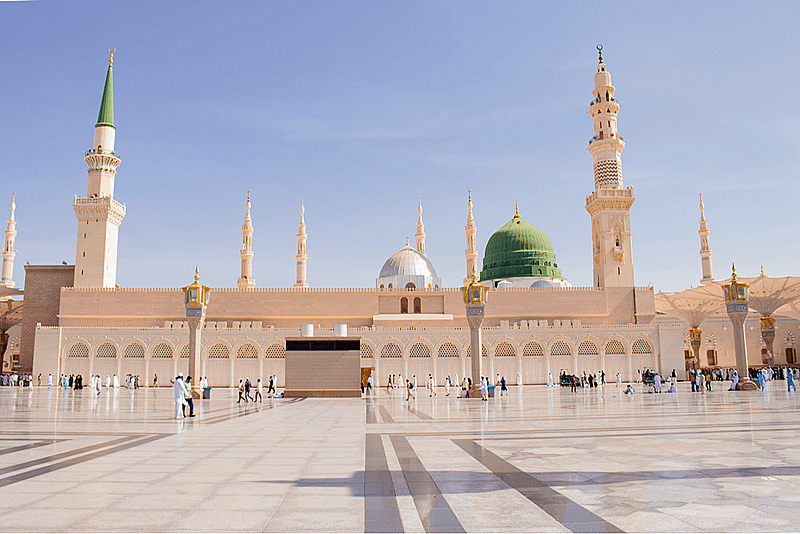
Come, harken! Come, harken!
A Prophet is born!
With a hungry stand
For the tyrant band
No longer may they scorn
Come and let his light fill up your heart
Come and let your troubles all depart
The full moon now is born!
ﷺ
https://t.co/Qqqho459dp
https://t.co/jQLCSCZMBf
Allah bless Thine alderliefest
Best of the praised, to praise Thee best
Prince of every territory
Herald of celestial glory
Allah bless the Prophet of War
Sea of mysteries without shore
Crown of all Thy vast creation
Noblest liege of noblest nation
I spent some time with Ibn Taymiyyah’s Kitab al-Nubuwwat, and a single central thesis runs through the entire work. The author never gathered it into a single chapter, but you find it throughout the book, with every line of argument eventually returning to it: the proof of prophethood is not confined to the disruption of natural laws, nor can it be a staff turning into a serpent or a sea splitting asunder. Rather, the Prophet himself is the greatest proofs of his own prophethood. As Ibn Taymiyyah notes: "The life of the Messenger ﷺ is among his signs; his character, sayings, actions, and law are all among his signs."
In other words, the familiar and continuous may be far more compelling than the isolated and scattered. A miracle occurs once; a single generation witnesses it, and it then becomes a report passed down to believers. A life lived, however, is an abiding sign and an ever-renewed miracle day after day. Each part bears witness to the other, its end confirms its beginning, and its finest details join together until the entirety of his life forms a unified proof. Thus, the evidence is no longer an event outside of him; he himself becomes the evidence for that which he brought.
Khadijah believed him before the splitting of the moon. She did not rely on an extraordinary occurrence; she deduced Muhammad through Muhammad: "You maintain ties of kinship, bear the burdens of the weak, earn what is lacking for others, show hospitality to the guest, and assist against the vicissitudes of life." He would mend his own sandals, sew his own garments, and engage in the service of his family. He rode a donkey with a companion behind him, walked in the markets as people do, and ate what they ate. He would go hungry for an entire month without a fire being lit in his house.
Anas served him for ten years, a length of time long enough for any pretense to fall away. He later said: "He never said 'Uff' to me, nor did he ever say regarding something I did 'Why did you do it?' or regarding something I did not do 'Why did you not do it?'"
A slave woman would take him by the hand and lead him wherever she wished through the streets, and he would not act superior as the leader of the city nor hurry her citing his obligations. A woman with a mental illness would stop him, and he would give her his time, walking with her along the way until her need was fulfilled. A Bedouin would pull him from his cloak so hard it left a mark on his neck, then speak with him harshly; he would answer by smiling and order that he be given a gift. Another would urinate in the mosque, prompting the people to rise against him, but he held them back, excused the man, then purified the place with a bucket of water. He would pass by kids and be the first to greet them with peace. When Abu Umayr's little bird died, he consoled him. He would enter prayer intending to lengthen it, only to shorten it upon hearing a child cry. When the Black woman who used to sweep the mosque passed away unnoticed, he missed her, asked after her, and went to perform the funeral prayer over her. When the people forgot Julaybib among the slain, he did not forget him, saying: "Yet I miss Julaybib..."
When a Jewish youth who had served him fell ill, he went to visit him and sat by his head. When a Jewish funeral procession passed by, he stood up for it; when others expressed surprise, he remarked: "Is it not a human soul?" He interceded with Barirah on behalf of Mughith, to which she asked, "O Messenger of Allah, are you ordering me?" He replied, "I am only interceding." When she declined to return to her husband, he did not grow angry, nor did he use his prophetic authority to compel her against her choice. He would joke with Zahir, who was unattractive, and when Zahir said, "You will find me unsellable market goods," he replied, "But in the sight of Allah, you are far from unsellable." When a creditor spoke harshly to him, prompting his companions to intervene, he said, "Leave him, for the one who holds a right has a say." When a man brought for drinking alcohol was punished and then cursed by some present, he cautioned, "Do not help the devil against your brother." After he was insulted in al-Taif, vengeance was offered to him freely by the angel of mountains, who said he could crush the people to pieces, but he refused and placed his hope instead in the infidels' descendants. After he conquered Mecca, the people of Medina felt aggrieved and thought he'd go back to his hometown, he did not dismiss their grievance nor confront them with the suspicion; instead, he gathered them for an intimate talk, listened to them, acknowledged their contributions, and filled their hearts until they wept.
He entered Mecca not as a conquerer but as a servant of God, his head bowed so low that his beard almost touched his saddle. When his son Ibrahim died and an eclipse occurred, people said the sun had eclipsed for the prophet's sadness; he corrected them: "The sun and the moon do not eclipse for the death or life of anyone." When Aisha was falsely accused during the Incident of the Slander (Al-Ifk) and revelation was delayed, he did not fabricate news to ease his heart, nor did he attribute to the Heavens his wishes. He inquired, sought counsel, and waited until the Quran delivered judgment.
These are not mere heart-softening anecdotes to be appended to the proofs of prophethood, nor are they tales meant merely to entertain. They are the very heart of the evidence and the essence of the proof: a physical miracle testifies for a prophet at a single moment, but a perfected character testifies every hour, until the sum total of his life stands as an abiding sign of the truth he brought.
May the peace and blessings of God be upon our master, the Messenger of God.
(Original Arabic by @AnasGhanayem2, translated by myself)
I used to work at an orphanage for Gaza refugees in Cairo. The old man who ran it had a heart attack recently. Please donate what you can, to help the children and to support him.
This is an absolute emergency; the situation they are facing is beyond cruel—it is impossible to describe.
They need you.
Please, I beg you to donate and share this campaign.
This is an extreme emergency. Faraj and his family are being consumed by poverty, disease, and hunger. Their tent is completely worn out, and they have no money at all. I implore you, a million times over, to donate and help them.
They are in desperate need of your support. What you might consider a small amount can fundamentally improve their lives and the lives of their family.
Please, donate and share this campaign.
https://t.co/Slu9uoocpw
Salam everyone, as many of you know, my mum passed away three weeks ago. We’re hoping to build a water well in her name as Sadaqah Jāriyah. If you’d like to contribute, even a small amount would mean a lot. Please also keep her in your du’as.
https://t.co/W4jqPzM6xy
My birthday is coming soon, and this year I have only one wish: to be able to put food on my family's table.
If you'd like to give me a birthday gift, please consider making a small donation instead. Your kindness will help us buy food and get through these difficult days.
Every contribution, no matter how small, means more than you can imagine. Thank you for standing with us. ❤️🙏
https://t.co/p1eCx1csiA
My family consists of 22 people, 10 of whom are children, and I am the sole provider for all of them. We are going through an extraordinarily difficult crisis and harsh conditions, and I am no longer able to support them on my own. I sincerely hope you can help us overcome this ordeal amidst these dire circumstances.
I beg you a million times: please donate and share this campaign.
https://t.co/x8jBsPWtRz
I’ve been following Al-Qassam’s Moons of the Flood (أقمار الطوفان) series on Telegram for the past seven months, and I’ve noticed that the tributes I’m always drawn to and make a point of watching all the way through are those of fighters who were born the same year as me.
There’s something unsettling about watching the life of a man your own age condensed into a few minutes. You begin to measure time differently. Not by birthdays or accomplishments, but by what a life was spent on, what it produced, and what it will leave behind.
And inevitably, I find myself wondering about the person I might’ve become had I been more faithful to what Allah entrusted me with. What would that version of me look like today? Where would he have been five years ago? Ten?
Of course, all of us live within what Allah has decreed. But belief in qadar doesn't relieve us of responsibility. We’re still commanded to act, to strive, to resist, and to answer for what we did with what we were given. And I often find myself wondering how I have responded to what Allah has decreed for me and what I've done with the life, capacity, and opportunities He placed in my hands.
The Prophet ﷺ said: “The son of Adam will not be dismissed from his Lord on the Day of Resurrection until he is questioned about five matters: his life and how he lived it, his youth and how he expended it, his wealth and how he earned it and spent it, and how he acted upon his knowledge.”
When I watch tributes to men my age whose lives, youth, wealth, and knowledge seem to have been spent in the service of what they believed Allah required of them, the question that stirs within me is what I have allowed this world to make of me.
Because we live in a world that seems almost deliberately constructed to ensure that every one of those five things is spent on what is trivial: that life passes in distraction, youth is consumed by appetite, wealth is spent on vanity, knowledge is reduced to performance, and conviction is softened until it asks absolutely nothing of us.
And somewhere beneath all of that noise is the question I can't seem to silence: When I stand before Allah and am asked what I did with what He gave me, will I have an answer worthy of the life I was given?
We ask Allah not to allow our lives to be consumed by what will mean nothing when we stand before Him. We ask Him to make us faithful to what He has entrusted us with, to place barakah in our lives and our youth, to purify our wealth, to make our knowledge a proof for us rather than against us, and to grant us the courage to spend what remains of ourselves in what pleases Him.
It took a little longer than expected, but we have created a website for people to view the footage collected from Gaza in one place. You no longer have to download the entire archives to see them.
It includes:
64,537 videos
17,905 photos
Ability to download individual videos
Searchable index
Exhaustive sources list (300+ journalists)
Geolocation data
Livemap with minute to minute updates
Victim list
It can be accessed here: https://t.co/s0Se94PXWF
Please share & quote tweet to help this post break out of the twitter algorithm prison.
We will keep adding the rest of the archives to the site, be patient- it is difficult work. Continue to seed the torrents provided, as that is the best way to ensure the footage remains stored in decentalized way.
God bless all those who sacrificed their lives to get this footage out, and everyone invovled in collecting/archiving it.
Join our telegram:
https://t.co/bvcis3b9GT
Follow our backup accounts:
@ZionismExposedx & @IsraelExposedAr