it's official: the biostasis @xprize is coming
winner of this year's visioneering, the prize will target organ biostasis in pig models to end the organ shortage and push the frontier of preservation
cryo is finally getting the momentum it deserves
Many longevity founders ask me what I would be working on if not for DNA damage.
Lipid elongation, the topic of a newly published paper, would be towards the top of that list.
I first became interested in this when I was working on something very different: epigenetic clocks
Every river in Germany, drawn by nothing but the rivers themselves. Twenty months of daily flow: the water reaching the sea swings almost 9 times over from its February 2026 flood peak to its late-summer low.
#rivers#dataviz#maps
🚨 It's finally out! 🚨 This is the big one. 100 cultures, 12,000 people, 108 researchers. Why people (and our most-used surveys) get collectivism wrong and how to fix it. Join me for a fun thread! �� @NatureHumBehav https://t.co/4JZhjbuwcV
JUST IN: Alex Gladstein's new essay on Bitcoin featured in WSJ:
"When dollar users dismiss bitcoin, they aren’t simply ignoring its origin story as a protest against a corrupt system—they are blinded by their financial privilege."
"We should be able to appreciate what bitcoin has given us: a world in which “transaction denied” doesn’t exist. A world in which we—and no one else—control our own savings. A world in which we do not have to ask for permission to buy what we want and to transact with whomever we want."
"Bitcoin has played a vital role for hundreds of millions of people around the world far less fortunate than us, whose financial systems didn’t get a half-trillion-dollar bailout. Maybe bitcoin isn’t for you, but it is for them."
@gladstein
One of the most comprehensive studies of human mutations across tissues and age was released last week. 53 cell types, 172 people, ages 0-93.
Many takeaways, but the big highlight is that mutation rates vary a lot - and not in the ways you'd expect.
A thread:
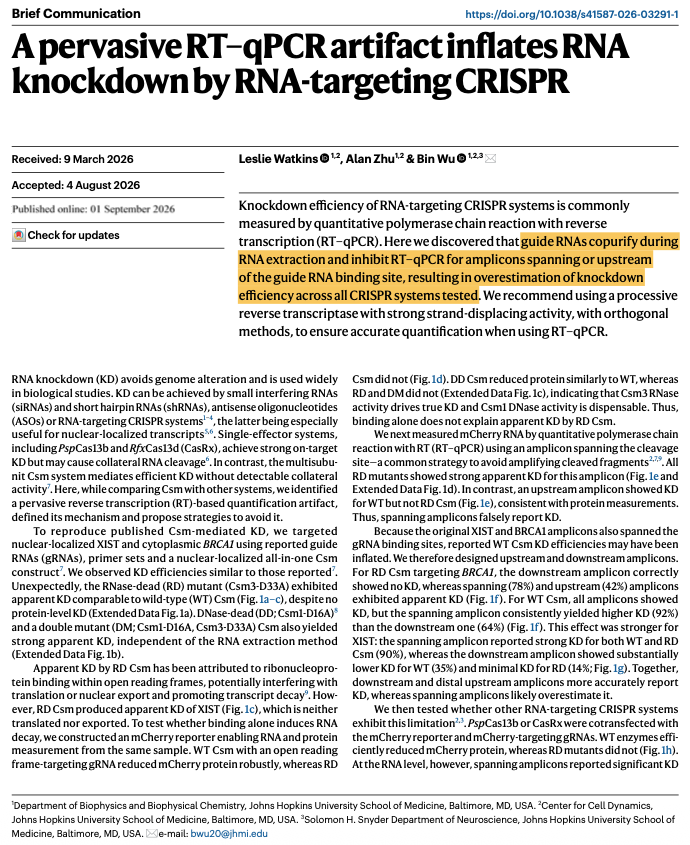
This is a "detective story" paper that shows how setting up the right negative controls can lead to real discoveries.
Basically, the authors wanted to reproduce a published result showing that a specific CRISPR tool, called Csm, could chop up RNA molecules and lower their levels in a cell. They measured this with RT-qPCR, a common experiment that quantifies how much of a given RNA is present before and after the CRISPR knockdown.
When they went to reproduce this result, they found that Csm did reduce RNA levels. But a negative control, a mutated version of Csm that shouldn't be able to cut anything, also knocked down RNA by roughly the same amount. Weird!
So the authors started varying the experimental parameters to solve this dilemma. First, they tried different RNA extraction methods and tested several more CRISPR tools. They confirmed, too, that the mutant Csm couldn't cut RNA. The RT-qPCR results persisted anyway.
Second, they built an mCherry reporter to measure protein levels directly. Normal Csm reduced protein levels, which makes sense since it's cutting the RNA. Mutant Csm did not change protein levels at all. This was another good sign that the mutant Csm was producing some kind of artifact.
To figure out why, we need to talk about RT-qPCR. This is a method that, first, converts RNA into DNA using reverse transcriptase, an enzyme that builds a matching DNA copy. qPCR then counts how many DNA copies got made from a short stretch of that RNA, called an amplicon. More copies of DNA = more RNA was present at the start.
Normally, scientists place this amplicon so that it overlaps with the guide RNA's binding site, since that's the region expected to get cut. But with mutant Csm, an amplicon located at the guide RNA site showed false knockdowns. When the amplicon was moved to *before* the binding site, the artifact disappeared and RNA levels appeared unchanged.
Why was this happening?
The reason, oddly, was that the guide RNAs (without any protein!) were blocking reverse transcription, making it look like mutant Csm was reducing RNA levels. The researchers tested this by spiking synthetic guide RNA, made with no CRISPR protein at all, directly into the reverse transcription reaction. This reproduced the false knockdown.
If a guide RNA can bind a target without a CRISPR protein at all, then we should also see similar gene silencing in cells. Right? Well, no; it turns out guide RNAs break down quickly in cells unless a CRISPR protein binds and stabilizes them. The proteins protect the guide RNA.
So TL;DR: guide RNAs can bind a target and block reverse transcription in test tubes. This causes weird experimental artifacts and likely means dozens of CRISPR papers that used RT-qPCR are wrong, in either a minor or possibly major way.
if someone wants to fund it, i will project manage and deliver a series of (beautiful!) physical and digital billboards across the us that do the same.
dm and we'll refine scope/scale.
After ZEUS and IL-6, now Lp(a) HORIZON, another long-awaited phase 3 trial testing a novel approach for lowering cardiovascular risk, Lp(a) reduction, failed to meet its primary endpoint.
That is great work and critically needed. Question: Do you count it as 1 formulation if you used the same compoments in a mixture but tested out different concentrations of the individual compoments? In other words, is one formulation a matrix dose response of the individual compoments (in case of CPA1042 you tritrate the 4 compoments against each other)?
Or does every change in concentration count as a new formulation?
@MartinBJensen Thank you for saying it. The GLP1 hype is getting ridiculous. And even if this data would be relevant, there are many good arguments that caloric restriction (or sema) will not have the same lifespan effect in humans. Unless of course you are starting from an obese baseline.
You keep proclaiming you have the 1st FDA approved clinical trial of age reversal. That's false.
The language by the FDA to @lifebiosciences was to clear a Phase 1 clinical trial testing ER-100 in people with certain optic-nerve diseases. Nothing about reversing age.
Any changes observed for the individuals in the trial for their eye disease is not the same as reversing age.
You can say it's the first human trial of partial epigenetic reprogramming, but apparently that's not enough for you.