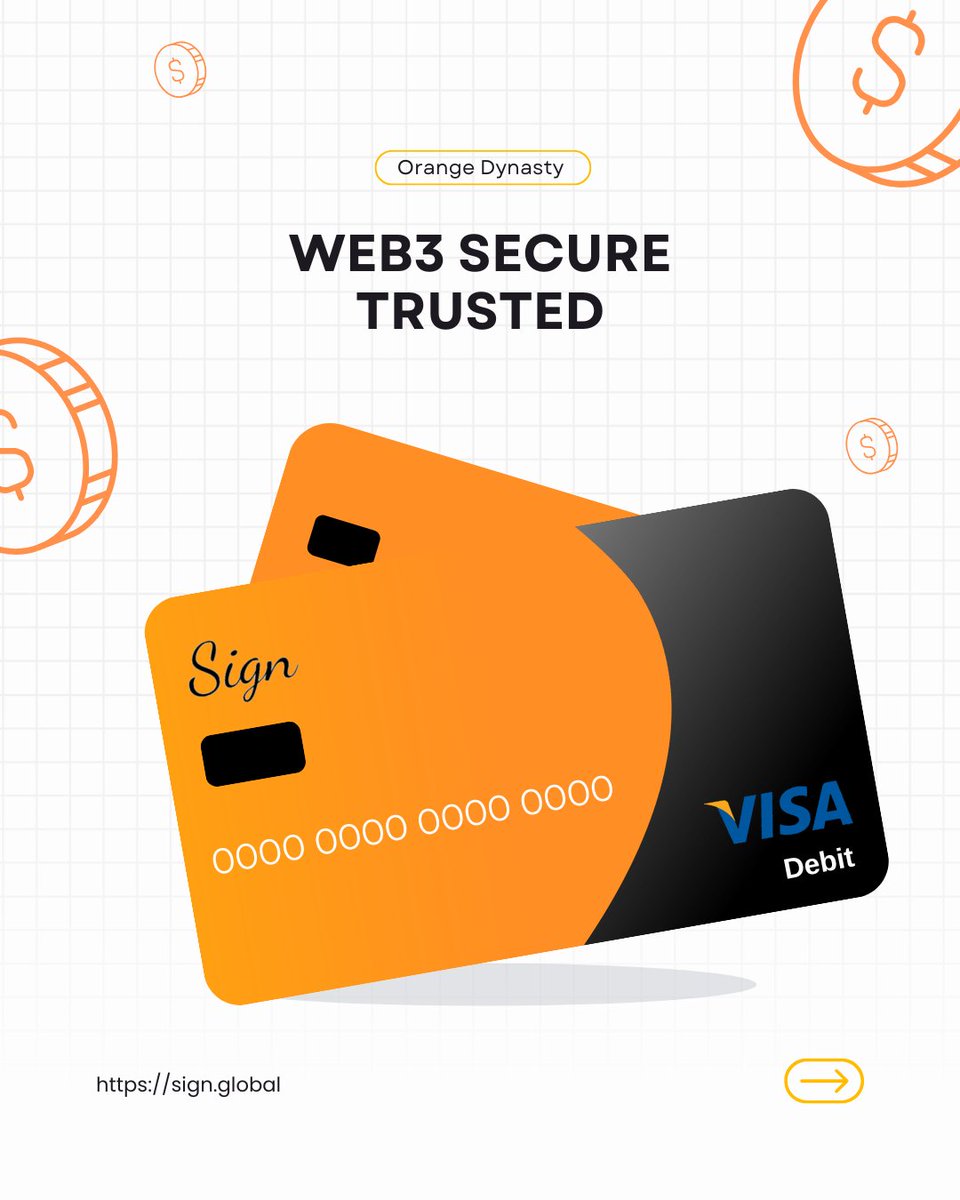
Sign Card: The Future of Digital Identity and Trust in Web3 Finance
The Sign Project is redefining what it means to trust and transact in a decentralized world. As part of this bold movement, the Sign debit card is more than a payment tool, it’s a powerful symbol of global recognition, security, and innovation in the Web3 era.
Inspired by globally respected institutions like Visa, the Sign Card is designed to become a visible mark of authenticity and credibility across the digital and physical worlds. Whether it’s used for financial transactions, embedded into digital identities, or recognized across platforms, Sign represents the future of seamless, secure, and borderless engagement.
What Sets the Sign Card Apart
1. Iconic Branding:
With a vision to become as recognizable as Visa, the Sign logo is being strategically integrated into a wide range of real-world and digital touchpoints, from cards to official IDs.
2. Globally Connected:
The Sign card allows users to tap into the power of decentralized finance (DeFi) while enjoying the familiarity and convenience of traditional payment networks.
3. Security Meets Simplicity:
Engineered with cutting-edge blockchain security, the card ensures every transaction is verified, private, and tamper-resistant, backed by the principles of trustless systems.
4. Beyond Payments:
In the near future, you won’t just use Sign to buy a coffee, you’ll see it on IDs, websites, apps, and smart contracts as a trusted marker of legitimacy.
5. Designed for Mass Adoption:
With a clean, modern look and user-first approach, Sign is positioning itself not only as a fintech product but as a movement toward secure identity and universal access.
Join the Sign Movement
In a world where trust is the true currency, Sign is building the foundation for a future where identity, finance, and reputation converge into one secure, seamless ecosystem. Whether you're a creator, a builder, or a visionary, the Sign card puts the power of Web3 in your hands, trusted, recognized, and ready for the world.
The future isn’t just coming, it’s signing in.
One of the few.
One of the early.
One of the first inside The Bitcoin Banking Experience.
Powered by $28.5M in funding and world-class backers like @PanteraCapital, @Multicoin, @GSR_io& more.
@MezoNetwork Bankcard claimed at https://t.co/8agClrNzLs
Fight Points are now on-chain with our @BNBCHAIN integration on https://t.co/Yt6cHqmve0 🥊
We are running a special campaign which allows you to stack more FP by boosting your picks before #UFC322.
Here's how you can increase your FP:
• Sign in and lock your picks on: https://t.co/PI98epHQBI
• Go to https://t.co/Yt6cHqmve0, mint your FP and boost your picks using @BinanceWallet or any wallet with BSC integration.
You will receive FP for just making your picks on @UFCStrike and additional FP based on the boosts and outcomes.
This is your chance to participate in the fights, support your fighters, on-chain on BSC and increase your airdrop allocation.
Make it count.
The Shinkai Ambassador Program is now live 🐙
30 days. $2,000 in rewards.
We’re bringing in the builders, leaders, and voices who will shape the Local AI movement
Join here 👇🧵
2/ Products of the GRID
Recursive Open Meta Agent (ROMA): Multi-agent framework that breaks down complex queries into smaller, more achievable tasks. The first use-case (deep research) outperforms all existing deep research model platforms and is open for builders to fork/improve.
Open Deep Search (ODS): Open-source search framework that splits reasoning, search, and calculation tasks, achieving SOTA performance on standard search benchmarks.
Dobby: Open-source model that was one of the first models to prioritize human-like values (tone, loyalty/core beliefs, etc.) and built through 2M+ community members’ feedback.
Fingerprinting: Training library/method that protects a model’s identity, ensuring that open-source developers can verifiably prove their model ownership even if the model weights are fully revealed.
Sentient Chat: AI platform that coordinates intelligence within the GRID, providing a UI interface to the world's largest network of intelligence.
2/ Products of the GRID
Recursive Open Meta Agent (ROMA): Multi-agent framework that breaks down complex queries into smaller, more achievable tasks. The first use-case (deep research) outperforms all existing deep research model platforms and is open for builders to fork/improve.
Open Deep Search (ODS): Open-source search framework that splits reasoning, search, and calculation tasks, achieving SOTA performance on standard search benchmarks.
Dobby: Open-source model that was one of the first models to prioritize human-like values (tone, loyalty/core beliefs, etc.) and built through 2M+ community members’ feedback.
Fingerprinting: Training library/method that protects a model’s identity, ensuring that open-source developers can verifiably prove their model ownership even if the model weights are fully revealed.
Sentient Chat: AI platform that coordinates intelligence within the GRID, providing a UI interface to the world's largest network of intelligence.