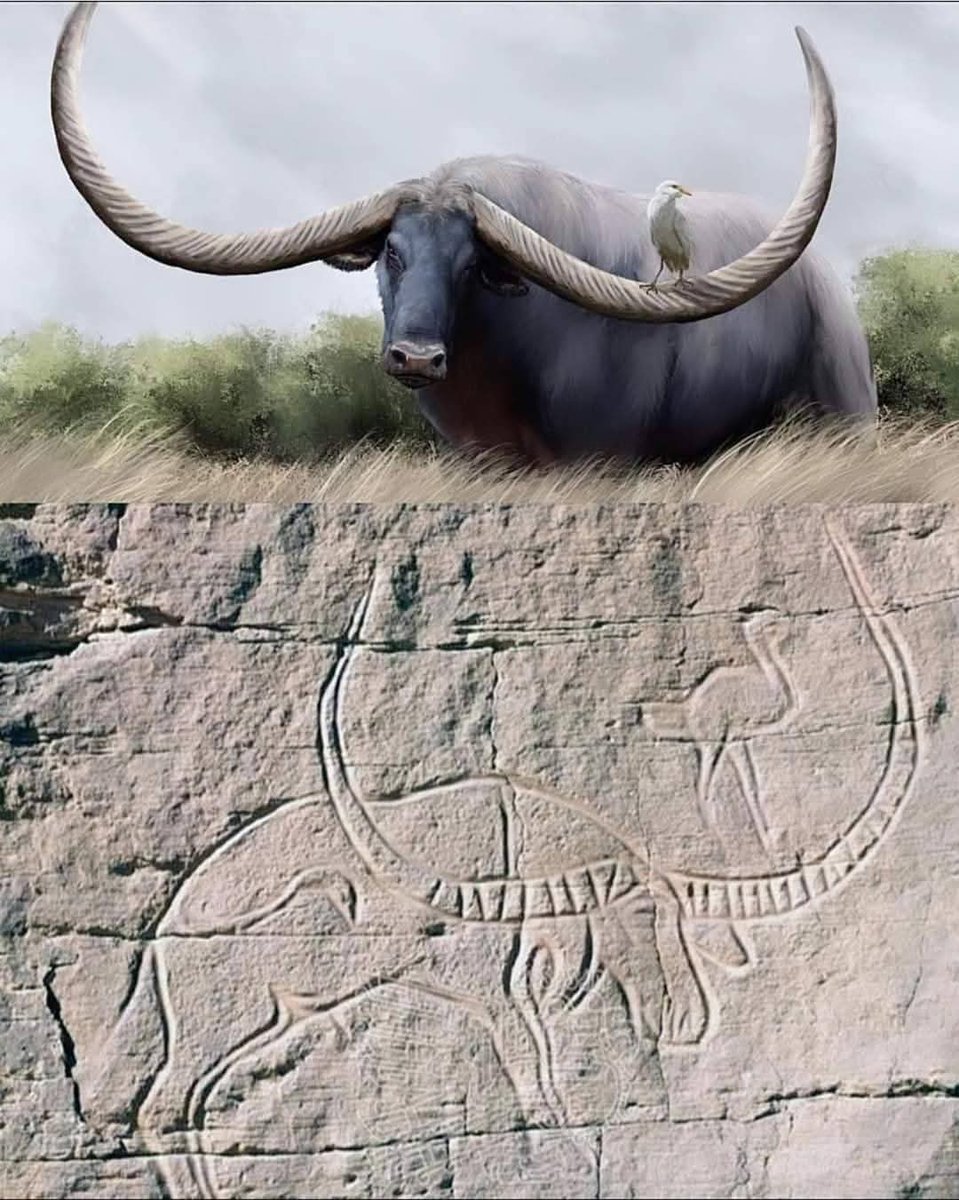
At Wadi Mathendous in Libya 🇱🇾 petroglyphs dating back around 8,000 years depict the now-extinct Syncerus antiquus, an enormous African buffalo species. This massive bovid, with horns spanning up to 3 meters from tip to tip, was the largest of its kind ever recorded in Africa.
In one striking image, a cattle egret is perched on one of its horns, reflecting a fascinating ecological relationship that still exists today between large herbivores and these birds, which feed on insects stirred up by their movement.
What makes this petroglyph particularly intriguing is that it captures not only the grandeur of this extinct species but also the ancient understanding of symbiotic relationships in nature—an early glimpse into the interconnectedness of wildlife that predates modern ecology by millennia.
📷 : Credit to the Owner
#archaeohistories
Ancient Egyptian Gold Ring with a Carnelian Bezel in form of a Cat (symbol of goddess Bastet); belonged to the Third Intermediate Period (1070-712 BC), from eastern Delta region, Egypt 🇪🇬
According to Egyptian mythology, gods and goddesses had the power to transform themselves into different animals. The goddess named Bastet, had the power to become a cat. Ancient Egyptians held cats in such high regard because of practices and preferences of their gods, but also because their kings, pharaohs, kept giant cats,” Skidmore says. “Members of the Egyptian royal class dressed their cats in gold and let them eat from their plates.” Although members of the lower classes weren’t in a position to dress their cats in precious metals, she notes that they did make and wear their own jewelry featuring feline designs. While cats were a favorite of pharaohs, some of their characteristics were more important during some dynastic eras than others, Skidmore explains. “Bastet, daughter of the gods Ra and Isis was first depicted as a fierce lioness, but later as a domestic cat: a dutiful mother with several kittens, and a protector of the family.
Along with hieroglyphics, obelisks and geometric patterns, cats feature prominently in ancient Egyptian art, reflecting animal’s unique status among people who dwelled along Nile River. Animals were initially adopted as useful predators in ancient Egypt and gradually became symbols of divinity and protection. Whether or not they were worshiped as deities, cats were an integral part of ancient Egyptian life. And, based on mummified cats discovered in tombs alongside humans, they carried an important role in the afterlife, as well.
For most of civilization’s history, ancient Egyptians saw cats as mutually beneficial companions, cats might come inside when it was hot, and they in turn would chase away dangerous animals, such as snakes many of which were venomous and scorpions. Some of what we know about the function of cats in ancient Egyptian society comes from scenes of everyday life depicted in paintings on the walls of tombs. “In tombs scenes, cats are shown laying or sitting below chairs, chasing birds and playing,” Troche says. “In some mortuary texts, they are shown with a dagger, cutting through Apopis: the snake deity who threatens Ra (the sun) at night in the Underworld.”
Cats in ancient Egypt were also seen as possessing another type of power: fertility. “They are often depicted sitting under women's chairs, implying a connection to women, and perhaps fertility more broadly,” Troche says, noting that the association may stem from the fact that cats have multiple kittens in a litter.
Egyptians believed cats were magical creatures, capable of bringing good luck to the people who housed them. To honor these treasured pets, wealthy families dressed them in jewels and fed them treats fit for royalty. When cats died, they were mummified. As a sign of mourning, the cat owners shaved off their eyebrows, and continued to mourn until their eyebrows grew back. Art from ancient Egypt shows statues and paintings of every type of feline. Cats were so special that those who killed them, even by accident, were sentenced to death.
(Ring D: 2cm; Bezel L: 1cm)
British Museum
#archaeohistories
Lascaux Cave, located in France’s Dordogne region, is famous for its intricate Paleolithic artwork...
The paintings, primarily of animals, date back approximately 17,000 years, placing them within the Upper Paleolithic period, likely the late Solutrean or early Magdalenian cultures.
Researchers have used various dating methods, including radiocarbon analysis and the examination of artifacts such as a carved reindeer antler, to estimate their age.
#drthehistories
In northwestern Australia’s Kimberley region, rock art dating back 41,000 to 50,000 years ranks among the oldest on Earth.
Found in rock shelters and boulders, these sites number in the tens of thousands. The Gwion Gwion paintings feature intricate, dynamic figures, while Wandjina spirit images are known for large eyes and halo-like heads.
Artists used ochre, carvings, beeswax, and stone arrangements, with some techniques revealing contrasting colors. Protected by remote locations and ochre’s durability, these artworks endure as Indigenous Rangers and archaeologists work to preserve them.
#drthehistories
One of the most beautiful and delicate fresco paintings from the Roman world is this one depicting an enthroned Venus receiving a flower from her son, Cupid. The goddess’ handmaiden is placing a sheer lilac veil over her head. 1/
Early 1st c. CE. Palazzo Massimo, #Rome.
📸 me
"Investigating the Challenges and Solutions in Cybersecurity using Quantum Computing and Cryptography" — interesting article quoting me @ResearchGate: https://t.co/9rnvx4gam3