This is how LLMseg makes any LLM do a very good job at segmentation, surpassing SAM-3 segmentation performance with a stronger recent models.
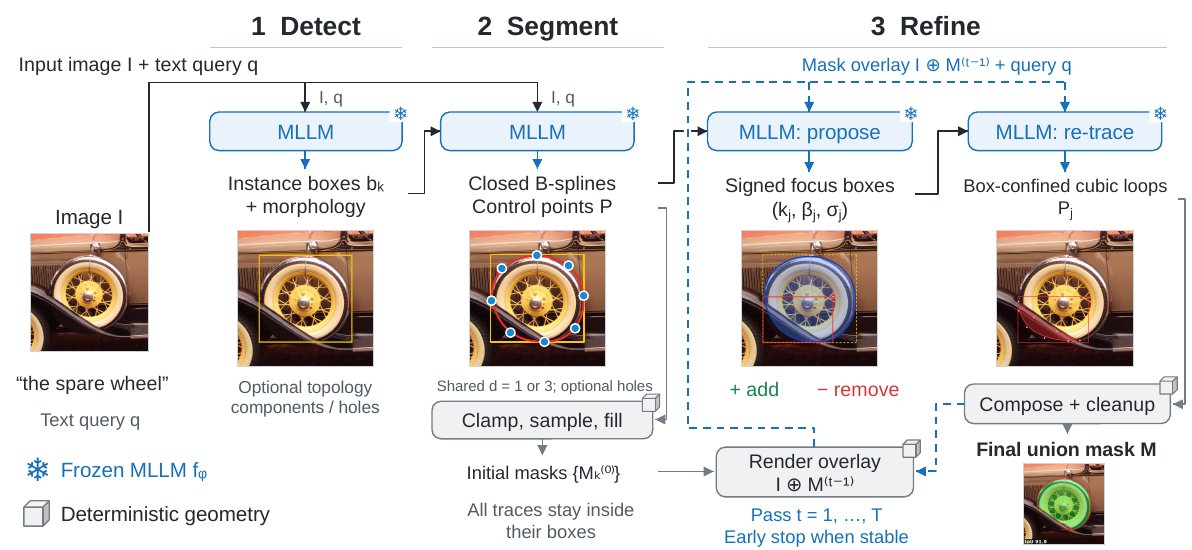
1. Detect
Image and text query go in. Out come N instance boxes.
2. Segment with closed B-Splines
One call returns a closed periodic B-spline outline per instance. Control points are clamped to the instance box, then the curve is sampled and filled into a mask.
3.Refine
The overlay of the current mask goes back to the model, which proposes signed focus boxes (add or remove). One batched call retraces splines for all of them. Repeats for up to T passes and stops early once the mask stops moving.
having worked on computer vision for +10 years , I have been asking myself lately how to solve EVERY computer vision problem with whatever LLM tech we have now. First step: image segmentation.
meet LLMSeg, segmenting images with LLMs and B-splines loops.
Basically no need for trained segmentation heads that do not generalize well, just use the MLLMs superior generalization to perform segmentation directly with no tools or CLI , just a simple pre-scripted forward loop with refinement process based on overlays.
B-splines loops for base masks , and B-splines loops for positive and negative masks refinment ----> THEY ACTUALLY CONVERGE to more accurate masks
21 MLLMs tested , better "vision+reasoning" means better segmentation . any "decent" MLLM can do segmentation it turns out.
website: https://t.co/J9zlCGcv8s
paper: https://t.co/vd5Zci4H5O
code: https://t.co/Qysto671GP
sounds on 🔊
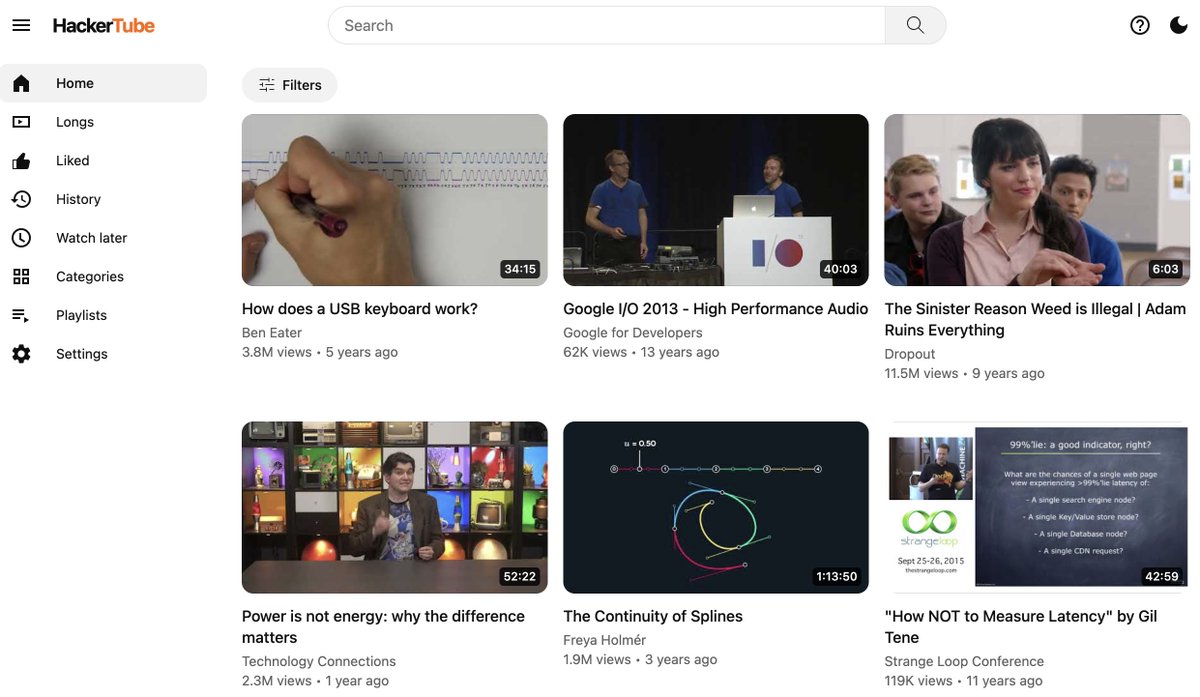
Weekend hack: HackerTube. I was annoyed with YouTube's recommendations so I had Claude filter down 43M comments over 20 years of HN to 6,454 videos that keep being recommended. *Significantly* better viewing experience, ~2 hours with Opus 5.5:
https://t.co/JIhXN7OSh1
- Excellent recs without any logins (state is kept in local browser session)
- Thumbnail is a representative frame from middle of the video instead of the super duper A/B test hyper-optimized user uploads
- Underlying data from the comment analysis as one zip file, point your Claude at it and ask for your own version
- HackerTube Longs ✊
A bit more on the process:
I use Claude Code (desktop app for Mac), Opus 5.5 on Medium effort as my default. I only talk to Claude and have it do everything, the only "manual work" I helped with in tandem was in the browser (reminiscent of MenuGen): 1) I had to create some kind of API key from Google Cloud UI to query YouTube for video metadata, 2) I booted up a VPS box for serving and 3) I bought the domain name. Once the box was up I gave Claude the IP and told it update, secure, harden, deploy and optimize the code, and it did the whole thing.
Many awesome projects that would have normally taken weeks/months even can now be few-shotted for breakfast. What else are we not thinking of.
Yann LeCun and Randall Balestriero just Proved the Platonic Representation Hypothesis, and found a better way to achieve it.
The Platonic Representation Hypothesis suggests that AI models trained on different modalities, like images and text, eventually learn similar representations of the world. But this paper shows that how models are trained matters more than simply scaling them up.
So they mathematically show that, under certain conditions, two JEPAs trained completely separately can learn essentially the same underlying representation of the world. One learns from different images of the same scene, while the other learns from different descriptions of that scene, without ever being trained on image-text pairs.
Their approach achieves the same image-text alignment with 42x fewer training samples than next-token prediction. A 109M-parameter text JEPA even outperforms LLMs up to 72B parameters on cross-modal alignment benchmarks.
https://t.co/3j1enq9qF7
GPT-6.1 Terra beats Astra in our vision benchmarks
wtf OpenAI?
had to double-check the results
- text
- object detection
- counting
also ~47% faster and ~92% cheaper
↓ leaderboards and examples
Not enough people are talking about the fact that this bug was fixed by Gemini Flash 3.7
The entire community missed this but an LLM fixed it. Insane!!
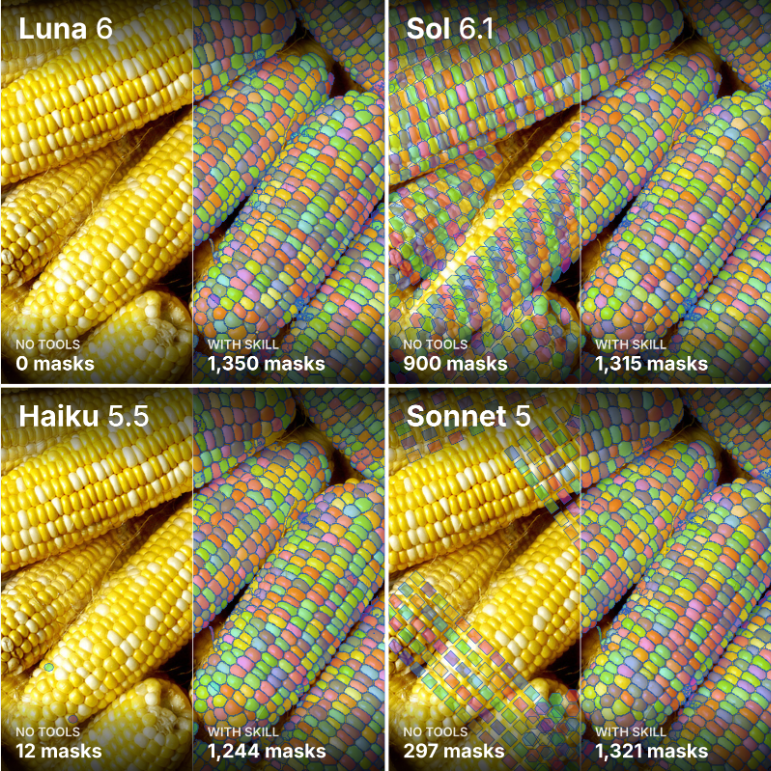
I was working on making a whole feedback flow to generate super high quality masks, but just decided to check how good Astra would be at winging it considering it's so good at vision.
The prompt was: "Generate segments of extremely high detail and quality. You have access to all of the local models on this machine, plus sub OpenAI agents. You can generate those through an iterative process, it does not have to be oneshot."
The local machine it works on has a GPU and bunch of small models ready to use. It decided to use SAM by itself, I didn't ask specifically.
It started by cropping the image in asking SAM for "corn kernel". It repeated it for smaller images crops. Using the proposed masks, it generated point prompts: one positive point at the center of the proposed mask and negative points on the surrounding masks. It used those point prompts to ask SAM for a mask again within an image crop. These refined masks were passed through a reviewer agent which proposed refinement or flagged missing kernels.
Pretty nice to see how models have improved on tasks like these! :)
We plugged Google Research’s Harness² into JEV 1.14.
Zero weights touched, yet driving massive gains on vision benchmarks round after round.
Under the hood, the system:
⚡️ Rewrites its own prompts
🛠️ Builds its own tools
🧠 Distills its own experience
JEV-Harness² repo drops soon. Stay tuned.
VidEoMT and PMT showed video segmentation can be made significantly more efficient without sacrificing much accuracy. LVMT shows it’s actually possible to boost accuracy a lot without sacrificing efficiency!
Runescape Bench talk now up on youtube!
Covers results from the benchmark, design of the harness, and economic swarm experiments I've been doing.
https://t.co/gkgXdAI3eZ
Thanks @recursecenter
Out of sight shouldn’t mean out of memory. 👀🧠
Meet LVMT: Video Mask Transformer for Long-term Video Segmentation, accepted at #WACV2027! 🎉
🏆 State-of-the-art video segmentation across six benchmarks
⚡ 10× faster than the prior state of the art
💻 https://t.co/CldcgNA8tP
CS academia is dead. So where does that leave AI PhDs like me?
Did my ICLR reviewer bidding today. Skimmed a few abstracts, and the methods are the exact same recipe I learned when I got into 3DV two years ago. Swap in a newer video gen base model and boom, new paper 🥲 Makes you wonder how many of the 60k submissions were actually thought up by AI. Meanwhile, World Labs' Atlas has basically solved 4D scenes. Academia is so far behind it's not even funny.
I still remember the day GPT-6 Astra dropped. My feed was flooded with GPT + Blender doing inverse graphics and GPT driving robot arms through manipulation tasks. The results were so good I literally had to sit down. A year ago, I was dead sure LLMs could never have spatial intelligence. A year later, Astra slapped that belief right out of me 💀
There's no doubt Astra was post-trained on tons of 3D and manipulation data, and it's only going to get bigger and faster. To me, that means any domain that can be represented symbolically, with clean benchmarks for RL, is going to get swallowed by LLMs. Next to real LLM intelligence, most academic papers that add a bit of inductive bias and tune their way to SOTA are just roadkill waiting to happen.
Sadly, these papers keep piling up and flooding every conference. It's inertia, plain and simple. We've been chasing SOTA for so long that it's hard to stop overnight. But make no mistake: the paradigms in a lot of areas converged long ago. What used to be research is now pure engineering, and the room for academics to add inductive biases is only going to shrink.
So as a PhD student, I see two paths left. One: if you can't beat them, join them. Clean data, build infra, then go to industry and train foundation models. Two: go back to real science. Stop caring about squeezing out another 0.1% on a benchmark, and start asking why this works and that doesn't, with foundation models themselves as the object of study. As a friend put it: AI research might end up looking more and more like biology, except the organisms are silicon-based 🤣 Beyond these two, it's hard to see anything that won't get eaten by LLMs.
Still, I'm pretty pessimistic. I can feel the value of human knowledge being eroded bit by bit. Everyone will get their own AlphaGo moment. What will academia even look like after this... 😭