Hey everyone!
Today is my friend's @_Jersey04_ birthday! He is a young Ukrainian whose one dream is for you to donate to Shahedoriz initiative by @sternenko
https://t.co/911aaRSlp7
I am starting with a fun round 2k hryvnia to contribute to saving lives.
Let's go?
@AlexDemSoc_161@Indgeus@Szabadsag1956 I could name you easily one Spanish nationalist party that can pass 5% with some deranged fascist. Or does it apply only to Ukraine (the country who sacrificed immensely for freedom, something that is impossibly for you, living a privilleged life of peace, to imagine)
I will never get tired of saying this: the narrative "Russian society is being held hostage by Putin and once he dies, there will be ponies and sunshine" is not just stupid, it is dangerous.
The notion that ending the Israeli apartheid against Palestinians would somehow equal throwing Jews into the sea is a typical ”liberal” Zionist projection that is used to justify the apartheid system.
Literally no different from how the whites in South Africa pushed the narrative that it would be a threat against the whites in South Africa if the blacks were their equals.
???
Вибачте, я люблю цю країну, тут найкращі люди, які найкраще мене розуміють (це навіть якщо опустити світові тенденції)
У нас є проблеми, але ці проблеми треба намагатись вирішувати, а не копати ями чи купувати квитки.
"Lenin good - Stalin bad" is probably one of the worst myth for the international Left, even pro-Ukrainian one. And then, even those who criticize Lenin, do it with Russian perspective, not looking at all the occupations of independent states, man-made famines, national discrimination and settler-colonialism
I am half blind because of Chornobyl, and I want more nuclear power.
On April 25, 1986, my mother crossed into the USSR on a two-week work trip. She was six months pregnant. The following day, reactor 4 of the Chornobyl nuclear power plant exploded, triggering the worst nuclear disaster in history.
The Soviet authorities acknowledged nothing. My mother travelled through Ukraine for two weeks, unaware. Three months later, I was born with congenital glaucoma. It is thanks to her stubbornness and a skilled doctor in Romania that I have any vision at all today, and was lucky enough to build a fulfilling life and a career in filmmaking.
Around the time I turned 30, I travelled to Ukraine and Belarus to make a film about people like me, others living with the legacy of Chornobyl. The trip changed my life and set the course for the following decade. That's where I met Helena, who became my co-director and creative partner on several projects that followed.
We met extraordinary people carrying that legacy. In Gomel, Belarus, I met an ophthalmologist who had been studying glaucoma since before the disaster. She told me that after 1986, congenital glaucoma cases rose tenfold. The Soviet authorities, and later the Belarusian government, suppressed her work, because her findings, alongside other studies linking illness to the disaster, pointed directly to an institutional responsibility they had no intention of accepting.
I also met Dima, a musician who had the same illness as me but lost his vision as a teenager because in late-1990s Belarus there was virtually no care available for those affected. Dima doesn't talk politics. In Belarus, you can't, not really. Instead he focuses on what he can control: his family, his music, the community that loves him deeply. He has a good heart and a full life, and he carries it all with a grace I genuinely admire. But I can't help thinking about how different his life might have been had he been born somewhere else, somewhere free, with the same chances I had. Same illness. Different country. Different outcome.
Helena and I made Everything Will Not Be Fine, a personal film about the legacy of Chornobyl and how people born under its shadow live today. Though the film is intimate in focus, we spent four years on research: travelling to the exclusion zone multiple times, speaking to doctors, scientists, and people involved in the cleanup.
What that research confirmed is this: Chornobyl wouldn't have happened in a free society. And even if it had, it should never have become the catastrophe it was.
The accident began with a flawed reactor design the Soviet system refused to acknowledge or correct. When the explosion happened, fear, the defining trait of totalitarian systems where no one wants to deliver bad news upward, delayed the disaster response for critical days. Then, once the scale became impossible to conceal, the authorities did everything they could to minimise and lie about the consequences. A 1991 international assessment, produced in close collaboration with Soviet authorities, concluded that health impacts were limited. That report has since been contested by numerous independent health experts who argue its methodology was shaped more by politics than science. The IAEA knew what it was working with. It went along anyway, because Western nuclear powers had their own industries to protect.
The people who paid for all of this were ordinary people. They always are.
Since Russia's full-scale invasion of Ukraine in 2022, the situation has taken on a darker dimension. Russian forces occupied the Chornobyl exclusion zone in the early weeks of the war, causing significant damage and destroying safety equipment. In 2024, a Russian drone struck the sarcophagus covering reactor 4. Russian attacks have also repeatedly hit electrical infrastructure in the zone, which is needed to keep monitoring and cooling systems operational. This is not incidental. It is a pattern.
It is also no accident that for years before the invasion, Russia aggressively lobbied Western governments to buy its oil and gas, and those governments obliged. The result is that some European countries are still funding this war through their energy bills.
And yet I am still for nuclear power. I believe it can be a safe and reliable energy source in a society that values truth and accountability. The lesson of Chornobyl is not that nuclear is dangerous. It's that authoritarianism is.
The tragedy of Chornobyl has shaped my life in ways I am still understanding. But it also led me to Ukraine, to lasting friendships, and to a sense of purpose, the belief that documenting these lives and keeping this history honest is worth doing, however small the contribution. You do what you can, with what you have, from where you stand.
40 years on, that still feels like enough of a reason.
(pictured, Helena and me, Pripyat and a couple of stills from our film - Everything will not be fine - 2020)
Here are some of your mistakes (I'll give you a respectful benefit of the doubt that these truly are mistakes and not conscious manipulations), which make @UkraineSol's reaction absolutely correct and justified. And when you're reading my reply, keep in mind that Iʼm Ukrainian and the leader of the only antineoliberal, pro wealth tax party in Ukraine.
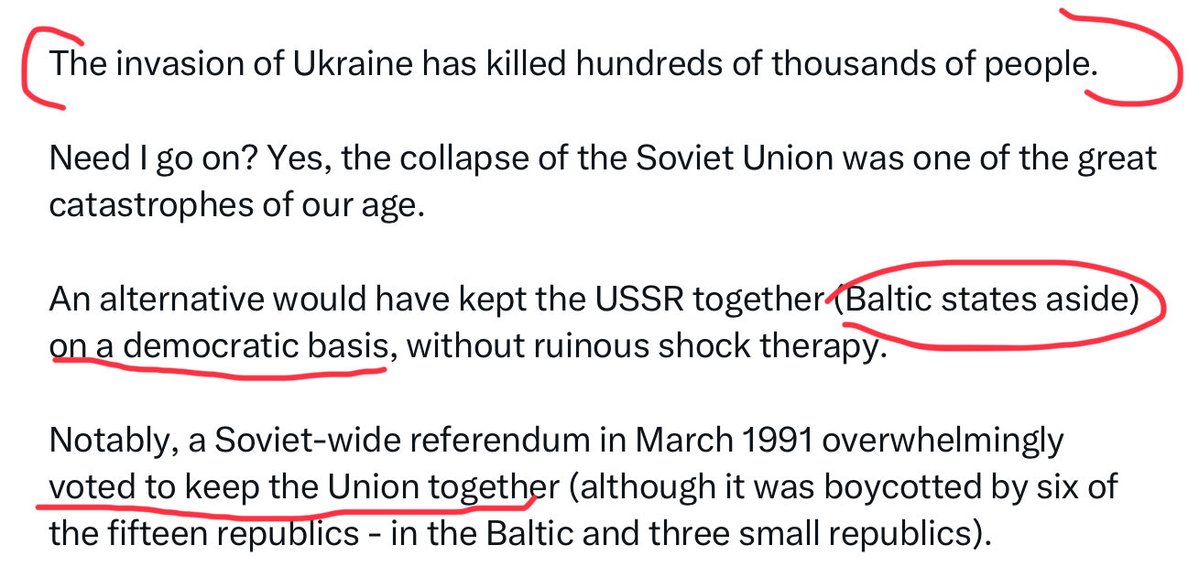
1. You talk about the collapse of the USSR causing the invasion that killed hundreds of thousands, yet you don't mention the intentional starving of Ukrainians caused by the Soviet regime, as well as other repressions that together killed MILLIONS and are actually some of the main reasons why the majority of Ukrainians wanted to leave the USSR.
2. You explicitly single out ONLY the Baltic states from your "new USSR". Why don't you give Ukraine, or Uzbekistan for that matter, the same privilege in your hypothetical?
3. What "democratic basis" are you talking about, if Ukrainians overwhelmingly voted to leave the USSR? And, no, that was not because of the coup attempt in Moscow. The coup forced the Ukrainian communist party elites to finally make the decision and hold the referendum, but where the referendum to be held before the coup, the result would've been very similar, because most of the reasons for leaving were primarily tied to no longer having an appetite for being dictated to by Moscow as to how we should live. REGARDLESS of the type of regime that would sit in the Kremlin.
4. No, there was no "overwhelming vote to keep the Union together", as the ballot paper intentionally did NOT have an independence option and the vote was essentially a typical Soviet propaganda exercise, which, unfortunately you are repeating in your post.
Furthermore, the whole premise of your post is factually incorrect. For some reason you equate "keeping the USSR but making it democratic" with an absence of criminal neoliberal "shock therapy". This is simply absurd. All of the newly independent republics that were democratic in the early 90-s (including the largest ones - Ukraine and Russia) went through various level of neoliberal "shock therapy". So if the parts of the whole did this, why would the whole, were it to survive, behave any differently? Obviously it wouldn't, and to suggest otherwise is simply a groundless fantasy.
Thus, to sum up: you have indeed unfortunately repeated many of the Russian imperialist lies/manipulations that have plagued our people for years, while your main "mitigating statement" is patently false.
19.10.1999 рік, початок карʼєри путіна: обстріл ракетами «точка у» ринка, мечеті і пологового будинку в Грозном. загинуло до 140 людей, сотні госпіталізовані. нічого у росії нема більш традиційного ніж геноцид
that is, what was already clear: "art beyond politics", when it comes to russians — is not some impenetrable cultural ideology, it is simply not a recognition of crimes as important, and ukrainians as people. When they experience these crimes firsthand, everything becomes clear
Соціальна Республіка - інтернет журнал соціал-демократичної і громадської направленості
Хочу знову презентувати інтернет-журнал, який я роблю разом зі своїми друзями, зокрема за допомоги @vikbutserious та Андрія Мельникова. Журнал 'Республіка' загалом розрахований на платформу, яка б поєднувала перспективи практичні, інтелектуальні і активістські.
В плані позиціювання це загалом соціал-демократичний журнал, а також націонал-демократичний, проте вибрана назва Республіка не випадково. Вона додає певну рамку і широкість - це журнал про громадянську владу і загальну справу - так що має доволі широку перспективу, ��о не обмежується названими ідейними баченнями.
Теми текстів можуть змусити журнал застрягти в одному напрямку - надтому інтелектуалізмі чи філософствуванні, економічному теоретизмі, чи практичності, злободенності, чи культурному дайджесті. Але при здоровому балансі я сподіваюсь, що журнал зможе надати справді багатогранну перспективу, все ще зосереджуюсь на своїй основі - загальній справі, соціальним реформам, інклюзивності.
Я закликаю друзів спробувати написати матеріали на сайт: розвідку, есеї, практичні проблеми ваших громад чи вас персонально. Особливо цікаво і зараз я підшукую авторів щодо культурологічної і літературної перспективи, і залученні художньої літератури в діалог про політику.
Одночасно, ми готуємо матеріали про егалітарні ідеї і антиколоніалізм Тараса Шевченка і братчиків, їх зв'язки з боротьбою проти рабства в США, та навіть міжрелігійну солідарність з мусульманським світом, яку проявляв глибоко християнський Шевченко; про ідеї Соціальної Європи, інтерв'ю з деякою авторкою дуже цікавого зіну, і це ще не все!
Сподіваюсь, з часом ми розширимо коло матеріалів, і також зможемо писати матеріали про стан трудового права і профспілок, соціальної економіки, ЛГБТК+ прав в Україні, бідності, тощо, доповнюючи наш ��ідхід щодо поєднання перспектив теоретичних, активістських і громадсько-практичних.
З цим я знову запрошую - якщо ви поділяєте соціально-орієнтовані позиції, і маєте що цікаве сказати - напишіть мені, запропонуйте матеріал, і ми з радістю обговоримо його і будемо допомогати щоб довести до публікації.
Також, ми завели соцмережі. Зокрема, твіттер! @ResPublicaUA
Прошу максимальний репост, так як проєкт новий, і розвивати його без грантів та інших засобів - особливо з армії, дуже складно. Але цілком можливо! Сподіваюсь це стане важливим кроком для створення цікавої платформи, що б доповнювала дискусії в Україні і розбудовувала громадську свідомість.
I was somewhat bored so I have addressed this in the long tweet below:
-
"States (and historical actors more broadly) don't have a 'nature', they act according to shifting interests and circumstances."
-
I disagree. They do have a nature, which is reflected in how they are legitimized and function, where ideology and founding ideas are critical in that aspect.
The notion that you can analyze state actors and political movements purely through a materialist perspective (where "interests" and "circumstances" are defined by material realities) removes critical nuances that cannot always be explained by a Marxist analysis.
It is just as important to take into account that non-materialist dimensions in the form of ideas and ideologies are not always based on materialist-centered thinking but on perceptions.
The nature of the Nazi movement and later the state of Germany under Nazi rule is an instance where the political ideology was a driving factor for the actions of the Nazis.
And here is also where you can make the argument that many Germans were claiming Jews were the cause of the deteriorating material conditions (which helped the Nazis to win the elections), and that it was used to reinforce these kinds of ideas.
But here is the thing: that was also the nature of that ideology. It's essense was centered on racial theories about white supremacy and genocidal beliefs towards people not considered human beings, which includes Jews who were used as scapegoats.
The Holocaust, from a materialist perspective, was economically dumb. For instance, instead of using the potential labor force that could lift the German economy, they murdered it.
Same can also be said about trying to get rid of the Jews through various waves of persecution; ideology triumphed over material conditions.
Now concerning political Zionism, while it is true that its roots stem from the antisemitism and persecutions of Jews in Europe, it would be very lazy to assume that the ideology (even in its many factions) had no political aim that was motivated by, for many Jews, compelling ideals that went beyond material conditions.
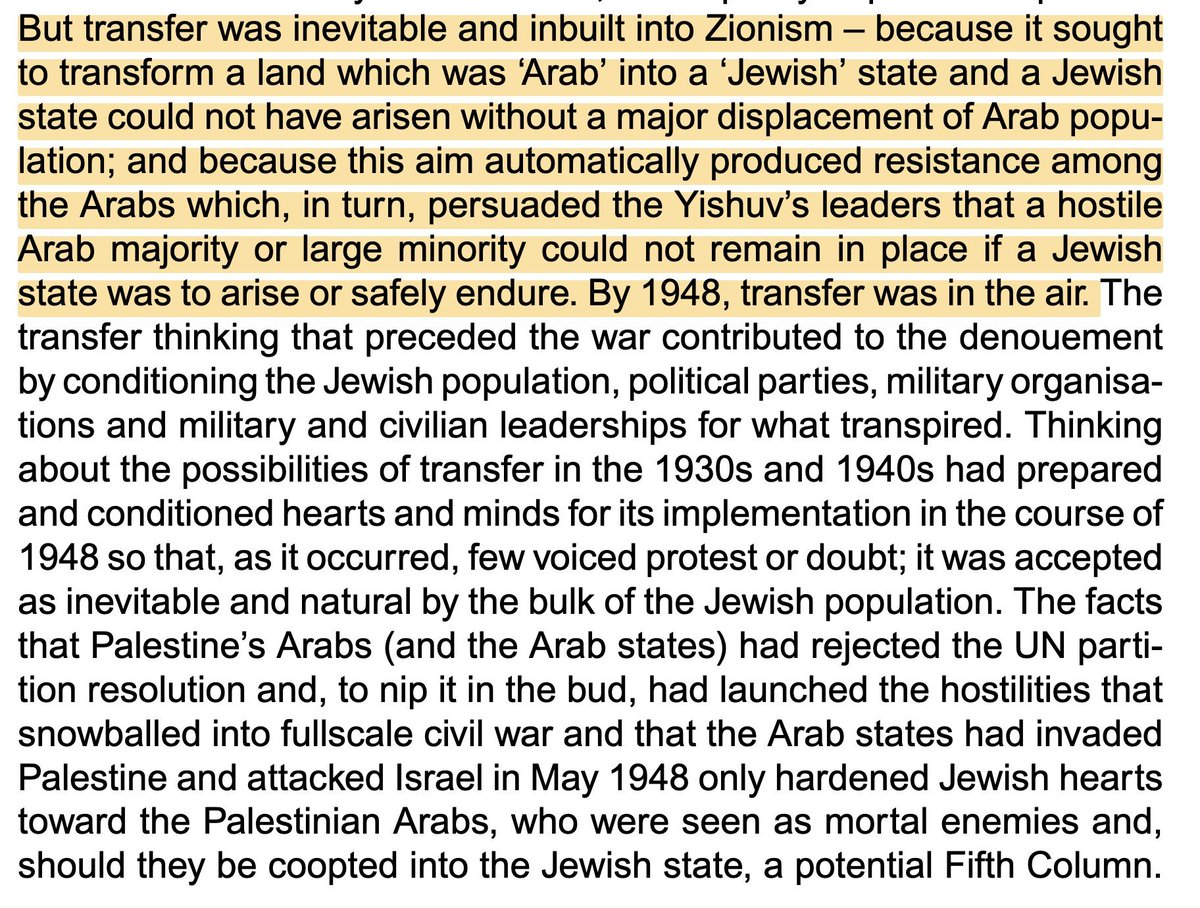
Most of its early proponents such as Herzl, Nordau, Jabotinsky, etc., and yes even Ben Gurion believed that a Jewish state in Palestine would require ethnic cleansing (or its euphemism, "population transfer") of the native Palestinian population.
This is also something Israeli Historian Benny Morris acknowledges in his book The Birth of the Palestinian Refugee Problem Revisited (p. 60).
You could not practically (or even ideologically) achieve the aims of the Zionist movement without settler colonialist plans, with both includes high Jewish immigration to Palestine and forcibly removing the natives.
Both were against the consent of the Palestinians, as they obviously were against giving up their lands to a newly migrated population that claimed their lands.
The notion that you could establish a Zionist Jewish state in Palestine, against the will of the majority population, without employing the settler colonial logic of elimination, is at best very naïve and at worst purely intellectually dishonest.
Zionism's goals were the exact opposite of the interests of the Palestinians, hence the Palestinians were constructed as the obstacle to the Zionist project in Palestine.
Once you construct a people as an obstacle to your visions and you frame it as an existential threat, you also will also do anything to get rid of them.
This is also present in the current Israeli discourse btw, Palestinian existence in Palestine is seen as an issue for most Israelis.
Zionism can not only be seen as a response to the persecutions of Jews over the centuries (which is terrible in its own accord) but also as a nationalist (and to some extent religious) ideological engine with goals that contradict the material as well as non-material interests of the Palestinians.
Thus, I don't buy that you should turn a blind eye to ideas and ideology to solely make an argument about structures, when in reality indeed ideas can emerge in specific circumstances.
But they also impact deep-sitting structures without necessarily materialist considerations.
Hence, ideas as a critical factor cannot be excluded from the equation because it doesn't fit into your narrative.
What is insane in that regard? I think this is the basis of a democracy itself — if not, how ever 51%, 70, 75% could define the direction of the country? How could parliament? What even could be the justification of voting and other collective forms of democracy if there is no society as a unit?
It seems that people, especially living in the west, is just so poisoned by unrestricted libertarianism, that it is harder and harder to get to any discussion about common good, responsibility, etc, but only to some extreme form of individualism.