Calling all writers, showrunners, storytellers 🚨
We’ve officially launched Netflix NextGen India Writers' Program 🚀
This is an opportunity for all early career writers with a maximum of 3 years of experience in screenwriting to bring your original ideas to life and develop them directly for Netflix. Your story deserves the biggest stage.
Apply now 👇
🔗 https://t.co/qWwZSyWP9Z
Earlier this morning I read a line that stood out to me, “A fresh start isn’t always a new place. It’s a mindset.”
Reading is one of the fastest ways to shift it. Simply pick up a book you’re curious about and move forward one page or lesson at a time. Read, reflect and repeat.
This paragraph by Haruki Murakami hits very hard:
“Once the storm is over, you won’t remember how you made it through, how you managed to survive. You won’t even be sure, whether the storm is really over. But one thing is certain. When you come out of the storm, you won’t be the same person who walked in. That’s what this storm’s all about.”
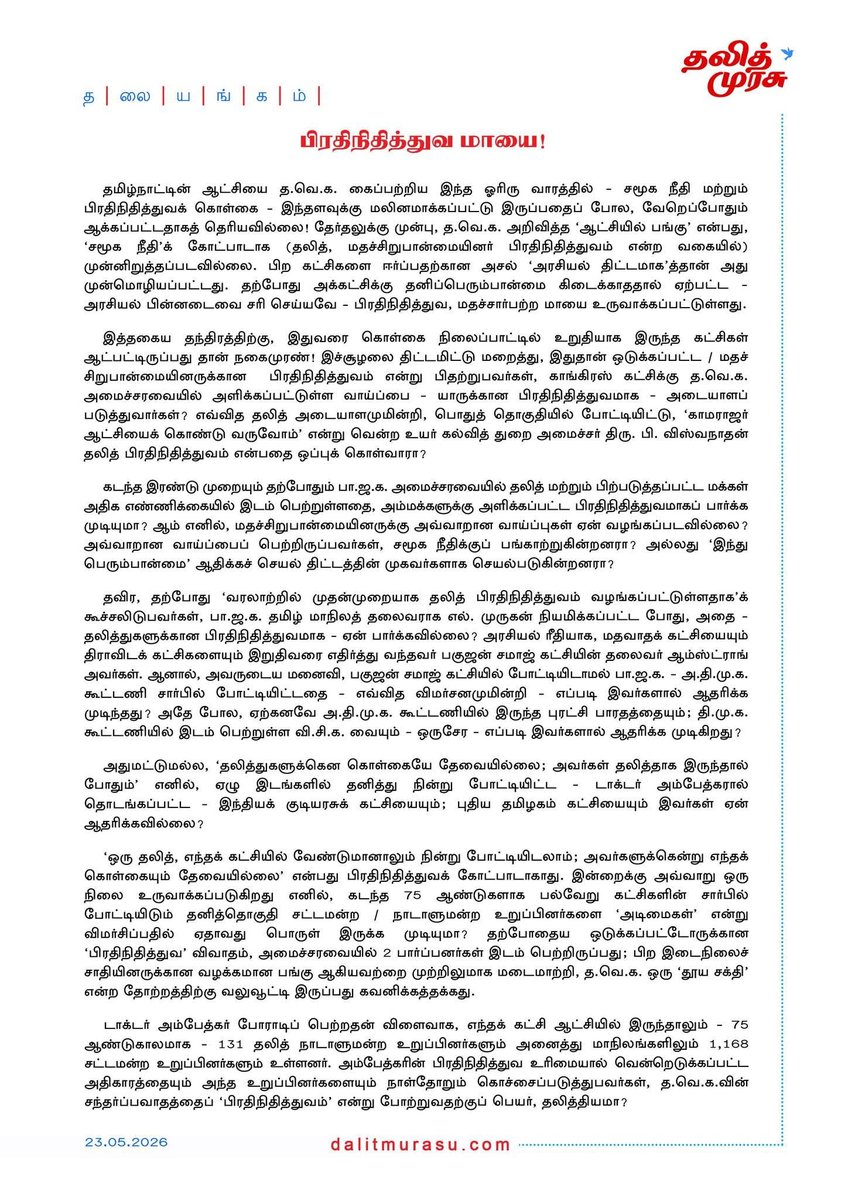
The editorial published by Dalit Murasu argues that the presence of a higher number of Dalit ministers in the Tamilaga Vettri Kazhagam (TVK) government cannot automatically be seen as genuine representation for Dalit people. It questions whether praising TVK’s political opportunism as “representation” can truly be called Dalit politics.
After reading the article in full, I feel it is essentially a response to what I see as the politically confused approach of the Neelam Cultural Centre @Neelam_Culture
Here are the 12 key points raised in the editorial:
1) In the few weeks since TVK came to power in Tamil Nadu, the principles of social justice and representation have been distorted and diluted like never before.
2) Since the party failed to secure an absolute majority, a “representation” and “secular” narrative is now being artificially created to compensate for that political setback. Ironically, parties that once claimed ideological clarity have fallen into this strategy.
3) Can Higher Education Minister P. Viswanathan — who contested from a general constituency without projecting any Dalit identity and campaigned under the slogan of bringing back “Kamaraj rule” — himself accept being labelled as Dalit representation?
4) Can the increased number of Dalits and backward-class individuals in BJP-led cabinets over the last two terms also be considered genuine representation for those communities?
5) Why are similar opportunities not extended to religious minorities? Are those who receive such positions actually contributing to social justice, or are they merely functioning as instruments of Hindu majoritarian politics?
6) Those celebrating this as the “first real Dalit representation” did not similarly celebrate when L. Murugan became the Tamil Nadu BJP president.
7) Why?
Armstrong of the Bahujan Samaj Party consistently opposed both Hindutva and Dravidian parties. Yet, why was there little criticism when his wife contested as part of the BJP–AIADMK alliance instead of through the BSP?
8) Likewise, how can the same people support both Puratchi Bharatham in the AIADMK alliance and VCK in the DMK alliance simultaneously?
9) If “being Dalit alone is enough” and ideology is irrelevant, then why did these groups not support the Republican Party of India founded by Dr. Ambedkar, or Puthiya Tamilagam, when they contested independently?
10) The current “representation” debate conveniently ignores the inclusion of two Brahmin ministers and the usual dominance of intermediate castes, while helping create an image of TVK as a “pure political force.”
11) Because of Dr. Ambedkar’s struggles, India has had — for 75 years — 131 Dalit Members of Parliament and 1,168 Dalit MLAs across states, regardless of which party ruled.
12) Those who regularly ridicule the constitutional representative rights won through Ambedkar’s struggles are now glorifying TVK’s political opportunism as “representation.” Can that truly be called Dalit politics?
Indeed! To conflate a Rasgulla with an Idli is not just a culinary error; it is a profound cosmological misunderstanding.
To begin with, the comparison is practically a biological impossibility. She is comparing chhena (the delicate, squeaky, pristine curd of milk) with a meticulously fermented batter of parboiled rice and black gram (urad dal). Their compositions are from entirely different kingdoms. One is an airy, spongy lattice designed to trap light sugar syrup; the other is a dense, wholesome, steamed matrix of complex carbohydrates and proteins. Their taste, consistency, structural integrity, and existential purpose share absolutely nothing in common.
But more important, her attempt to dismiss the Idli as merely a blank canvas for sugar syrup does a grave disservice to what is arguably one of the greatest engineering marvels of the culinary world.
The Idli is not a mere "bland cake." It is a masterclass in biotechnology. To achieve the perfect Idli is to balance the delicate microflora of wild fermentation over a cold night, resulting in a steamed cloud that is a triumph of gut health, lightness, and nutritional balance. It is a savoury monolith of South Indian culinary genius, perfectly engineered to absorb the sharp tang of a well-spiced sambar or the fiery depth of a molaga-podi (gunpowder) paste infused with cold-pressed sesame oil or nutritious melted ghee.
To suggest an Idli would even consent to being drowned in sugar syrup is to fundamentally misunderstand its dignity.
If this lady finds Rasgullas overrated, argue that on the merits of their sponginess or sweetness. But please, leave the noble, perfectly fermented, steamed majesty of the Idli out of your dessert-table polemics, ma'am!
According to Reporters Without Borders, Israel accounted for almost half of the world's journalist deaths this year. It says Israel has now been the deadliest country for journalists for three consecutive years.
American billionaire saying "India is a good laboratory", America's president saying "India is a hellhole", should raise many alarms but I've no expectations.
My "Roman Empire is the realization that my life is a lottery win. Somewhere in Sudan, Pålestine, iran, Afghanistan, Iraq or Congo, there is a boy smarter than me. He is more disciplined, more resilient, and holds more potential in his single finger than I do in my entire career.
The only difference? I am siting in a train and he is sting in the rubble of his dreams.
My "bad days" are his wildest dreams.
My "burnout" is a luxury he can't afford because his only job is staying alive.
It's geographical luck and it's a haunting injustice that we all refuse to acknowledge and look away
we live on a planet where trees warn each other of danger through underground networks. where octopuses dream. where elephants return to the bones of their dead and stand over them in silence. where bees communicate through dance, showing each other where to fly. where flowers bloom...where crows remember human faces -especially those who were cruel to them - and pass that memory on to their young. where ants build entire cities. where cats purr at a frequency that can help heal bones. where forests, after fires, grow flowers first.