Final call for this postdoc job in my lab @bbkpsychology!
We’re looking for a cognitive neuroscientist to join a four-year project, investigating how we learn from other people about the uncertainty in our own minds 🧠 💭
Any Qs feel free to email 📧
Deadline 25th Nov
New systematic review paper out today from me, @peskygnats, @_KevWalsh, and Caoimhe Doyle on adolescent experiences of ‘sexting’, and recommendations for professionals
https://t.co/NXMHSbJt1i
When Bayesian brain theories talk about 'precision', what precisely do they mean? In @CurrentBiology @cdfrith & I explain how precision has shaped thinking about perception, learning, metacognition & social interaction. But some key puzzles remain unsolved https://t.co/lYV6SvSilq
Interested in predictive coding? @drclbuckley, @anilkseth and I have put together a comprehensive new review covering both the core theory in an accessible way as well as many recent advances in the field.
Check it out at: https://t.co/fVfdu6ADYJ
Our brains predict the outcomes of our actions, shaping reality into what we expect. That’s why we see what we believe. From the archive: https://t.co/wJcfdRhCYu
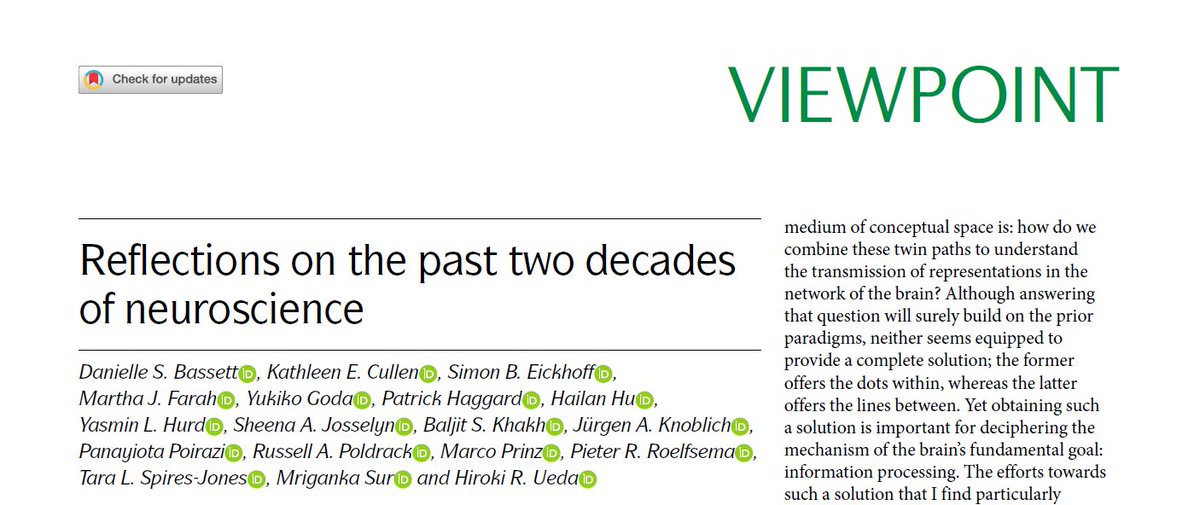
So what's new? i always hate that question. But when @NatRevNeurosci asks for my reflections on neuroscience to celebrate its 20th anniversary, I reflect. Here are said reflections from me and loads of wonderful neuroscientists. Interesting read!
https://t.co/ruVcELNNZK
Bayesian brain theories propose a fundamental shift in how we think about the mind, with goals and desires replaced by predictions and errors. In @NatureComms@CeliaHeyes, @ClarePress & I argue why we should resist this ‘desert landscape’ view of cognition https://t.co/xGzSlPGH4t
Visual mismatch responses (VMRs) index surprise in a *surprisingly* all-or-none way... Preprint now up for this study led by @DanFeuerriegel, with @HinzeHogendoorn and @DLabMelbourne
Are we surprised by things that are unusual, or bored by things that stay the same? Some cool work with @DanFeuerriegel @DLabMelbourne @DrQuekles and others shows that for the brain's visual mismatch response, it is the former more than the latter! Check it out:
How might we go from what Chalmers called “arbitrary” to “systematic” Neural Correlates of Consciousness, with more explanatory/predictive power? We suggest using a framework that is not itself (at first) a theory of consciousness. With @anilkseth https://t.co/rje21iblPs
And now for something completely different... my recent paper on pattern separation and expectation violation is finally out in #JNeurosci@SfNJournals https://t.co/B8V7odWOAQ
Are you a university student? We’ve made all 700 textbooks currently available in HTML format on our Cambridge Core platform free to access until the end of May, regardless of whether they were previously purchased: https://t.co/0sVpDxPmPX