Purtroppo non basta dire che 1 kWh solare costa la metà di 1 kWh nucleare. Bisogna almeno aggiungere che, per sostituire una fonte continua come il nucleare con una variabile e stagionale come il fotovoltaico più le batterie, in Nord Italia d'estate bisogna produrre 8 kWh per averne 2 da utilizzare d'inverno; e degli 8 estivi, 6 si buttano via, 1 si utilizza direttamente e 1 si usa per caricare la batteria che lo "trasferisce" a dopo il tramonto; idem per i 2 kWh invernali.
E bisogna conteggiare tutti i costi: il costo di tutti i kWh generati (inclusi i 6 buttati via) e il costo della batteria.
E quando si fanno bene i conti si scopre che l'energia così prodotta costa il doppio (non la metà) di quella nucleare. E tra pannelli e batterie emette 15 volte più CO2 di quella nucleare.
Caro professor Parisi, con questa dichiarazione (e non è la prima volta: ne ricordo di simili quando, insieme con Di Pietro, nel 2011 promuoveva il referendum contro il nucleare) si sta comportando come uno che si soffermasse sul volo di un passero "solitario", invece di studiare quello incredibile di centinaia di migliaia di storni che si muovono all'unisono.
La prima osservazione accese la fantasia del poeta; la seconda quella dello scienziato e produsse un premio Nobel per la fisica.
Mutatis mutandis, nell'energia la visione d'insieme, di sistema, è tutto!
Un caro saluto
Si chiama "riprocessamento del combustibile esaurito". In UE si fa solo in UK e Francia. Tutti i Paesi UE che scelgono l'opzione del riprocessamento spediscono lì il proprio comustibile esaurito. Non è che abbiamo mandato lì "le scorie".
Il 5% circa di quel combustibile esaurito rimane alla fine come rifiuto ad alta attività e lunga vita; il resto (uranio e plutonio) è riutilizzabile.
In base ai contratto sottoscritti, avremmo dovuto far rientrare quella piccola parte di rifiuti nel 2019 e 2025. Inglobati in vetro borosilicato e inseriti in robustissimi contenitori metallici schermati (cask). E dovremmo custodirli temporaneamente nel Deposito Nazionale.
Ma potremmo tranquillamente custodirli in uno dei siti delle nostre ex centrali e impianti nucleari. Come fanno in tutto il mondo.
Invece la politica , tutta la politica tranne pochissime eccezioni, non ha il cooraggio di spiegare ai cittadini che tutto questo non comporta alcun rischio, perchè ritiene più redditizio cavalcare le paure alimentate dalle fandonie raccontate da anni da pseudo ambientalisti da strapazzo. Così nel 2019 e 2025 si è preferito emendare i contratti attivando l'opzione (a pagamento) che consente di posticipare il rientro di quei pochissimi, sicurissimi rifiuti.
Finchè i cittadini non saranno stufi d'esser trattati da imbecilli, andrà così!
Ho spiegato tutto in questo pezzo. Leggetelo e se qualcosa non vi è chiaro chiedete
https://t.co/23sRVddYZm
Some of my perspective on where the @ethereumfndn is going.
First of all, this is only my own view. The board is not just me, and I have no extra special powers on the board that the other board members do not. @aerugoettinea is the one executing much of this transition. My input has been largely on technical questions. The board is in the process of expanding, and my own power within the org will continue to decrease, which is honestly what I want.
The 2025 era brought many important improvements to EF and its ability to execute. Many issues were resolved, and EF continues to benefit from its improved efficiency and greater focus on concrete goals to this day. And so with those problems resolved, early this year, the largest remaining hole that I perceived was something different nagging at me: I would regularly spot people saying things like "vitalik says these beautiful things about ethereum needing to be decentralized, and have privacy, and be a sanctuary technology, but why do the EF's actions not reflect that?"
Now, you may have been hearing something different. You may not have been sensing a feeling of crisis at all, and maybe were hearing people saying that finally we were taking execution and BD seriously and the main task for us is to keep going that way and be even better and faster. Then probably there is genuine difference between you and me, in what kinds of criticism I take most seriously, and what kinds of critics through their criticism are most able to make me feel pain.
As an analogy, let's briefly switch over to a different domain.
One belief you can have about Google is that it is a success story, and has brought a lot of good to humanity in organizing the world's information. Another belief you can have about Google is that they had a beautiful idealistic beginning, but at some point the corruption of mainstream corporate attitudes seeped in, and they slowly bit by bit completely abandoned the "don't be evil" slogan.
My belief on Google specifically is probably somewhere between the two. BUT, if you had taken me back in time to ~2008, and offered me a button to press to make Google one or two standard deviations more "dogmatic", eg. give Richard Stallman permanent veto power over some key policies, I would immediately press it.
Why? Because a choice for one company is not a choice for the world, or even one country. Google existed and exists in the context of a technology industry generally drifting away from early idealistic don't-be-evil roots and toward greed for financial gain, totalizing visions of accelerated superintelligence, infiltration by sociopaths, and craven capitulation to (or worse, active participation in) government pressure for ideological control, surveillance and war. And so *one company* doing something different, positioning itself to be what George Bernard Shaw calls the Unreasonable Man, resisting the trend of the times, would have been better for freedom, balance of power and stability of society as a whole, than *all* large companies bending to dominant trends. This is a part of my version of pluralism.
This line of thinking is not just mine, but I also is not too far off from what Aya and others had in mind with the Mandate.
Now how does this all get to the role of the EF?
EF is not a "center of Ethereum", rather EF is "one node, with a defined purpose, alongside other nodes". We've always said that the EF should be the latter, but many in the Ethereum ecosystem (and even within the EF) wanted us to be the former. Now, we are taking action to ensure that we will be the latter.
This is particularly important because EF is a limited organization, with limited resources and limited organizational capacity. The EF has only ~0.16% of all ETH (less than many other individual ETH holders), whereas among other blockchains it's common for "the central foundation" to have 10-50%. Fiscally, the EF was originally designed to fulfill a limited work scope defined in the token sale docs and other pre-launch materials (building the chain software; getting through Frontier, Homestead, Metropolis, Serenity), which was fully completed in 2022; it was not designed to be an eternal steward.
And so today, the EF is choosing to use its remaining resources to pursue longevity over breadth (yes, this means we sell less ETH). The EF focuses *specifically* on those activities critical to the success of ethereum as a censorship/capture-resistant, open, private and secure system, that would not happen otherwise. This means making hard choices, and in some cases even activities that we highly approve of and people that we highly respect becoming outside of the EF. People of great technical talent, public respect and even alignment with the mission and CROPS being outside of the EF is in fact necessary if we want important tasks to be able to attract outside capital. This also means the EF taking opinionated stands culturally.
This is all intended in cooperation with all other parts of ethereum. We recognize that many other parts of the ethereum world highly respect CROPS and related values. But highly respecting is not the same as choosing to specialize and totally dedicate to a domain (Compare in a different domain: I think reducing animal cruelty is important, and I like vegan food, but am not full unconditional vegan myself)
EF is still in a transition period, and we expect its new long-term form to stabilize over the next few months. What are the guiding principles of this new form? Again, I am only one person, but I can give my answer from a technical perspective (there are also critical non-technical aspects).
At the core, *Ethereum must be impressive*. We are living in an age of highly intelligent AI and all kinds of other technological acceleration. "Status quo EVM, with a hard fork or two a year to optimize for short-term needs of users" is not interesting.
To some, "impressive" means: 250ms latency and 1M TPS. I think Ethereum trying to go that route is a mistake. Being as fast and as scalable as possible, and only a small epsilon more decentralized than the others, is a route to mediocrity, and if we try it we will lose.
I think Ethereum should scale. But I think Ethereum should strive the hardest to be deeply impressive in a different dimension: the CROPS dimension. This means things like:
* Provably bug-free Ethereum. This is a goal that all cybersecurity researchers would have thought is absurd and impossible, up until roughly 6 months ago. Now, it's on the cusp of being possible, thanks to AI-assisted formal verification. So we should be frontrunners in doing this.
* Available chain consensus. Ethereum is, and with lean consensus will cotninue to be, the ONLY chain that has both (i) traditional-BFT style properties that it's safe under asynchrony up to a high level of fault tolerance, and (ii) the bitcoin PoW-style property that under synchrony it's safe up to 49% attackers. As far as I can tell, literally no other chain has this or is planning for it; bitcoin goes for (ii) only and most other chains go for (i) only. Some will remember I fought hard for this, Unreasonably insisting that it is not OK for ethereum to rely on social consensus and hard forks to rescue ethereum from 34% of nodes going offline. It's OK for chains like hyperledger, bnb, solana, tempo, etc. It's not OK for bitcoin or ethereum or eg. zcash.
* Intermediary minimization. The fact that smart contract wallets, protocols like railgun, etc have to send transactions through intermediaries to get included onchain is honestly embarrassing, and it's a constant point of fragility. Hence the work on FOCIL and EIP-8141 (and 7701 and years of work before) to make transaction sending intermediary-minimized with public mempool and strong inclusion properties, in a truly general-purpose way, that covers not just eg. secp256r1, but also privacy protocols and much more. Kohaku is pushing intermediary minimization at the user layer, pulling Ethereum away from the dystopian status quo world where our wallets don't even verify the chain, send our private data out to a dozen third-party servers, and toward a brighter CROPS future.
Some of these goals are Unreasonable - maybe Ethereum would be "fine" getting only 50% of the way - what if we depend on intermediaries, but make it easy to switch? But going 50% of the way would not make Ethereum Deeply Impressive in the CROPS way. So we push for 100%.
Fortunately all these goals are compatible with high TPS, this is a major focus of research (esp. on scaling the state). Well-designed L2s can also help, especially L2s optimized for specific applications (eg. high-volume trading, privacy...). These goals are even compatible with significantly lower slot times, thanks to Raul's work on erasure-coded P2P, and many other optimizations.
The most high-value "product" of the ethereum blockchain, financially speaking, is ETH the asset. Ethereum secures $250 billion of ETH. The types of properties of Ethereum that I mentioned above are very good for ETH the asset. Nearly 90% of my net worth is in ETH, and most of the remainder is ~$40m of onchain fiat of which every dollar has already been allocated for some open-source biotech or software or hardware initiative. That said, there are aspects of supporting ETH the asset - *necessary* aspects even - that are outside the scope of the EF. This is where we need other heroes (some of whom hold more ETH than the EF does) to step in and help. EF has been recently thinking more about how it will relate to other such organizations, and give them needed initial support.
EF will be a smaller ship than in previous years, a more opinionated one - in some cases more opinionated in ways that might be difficult to comprehend - but a longer-lasting one, and one suited to making sure that ethereum brings something meaningful to the world. We are grateful to all those inside and outside the EF who are helping to make this happen.
Prezzi dell'elettricità in bolletta - che, attenzione: NON includono solo il prezzo di mercato, ma tutti i costi di sistema.
La Germania, coi suoi 190 GW di rinnovabili, paga più di tutti ad eccezione dell'Irlanda.
La Francia paga meno della Spagna.
Ciaone.
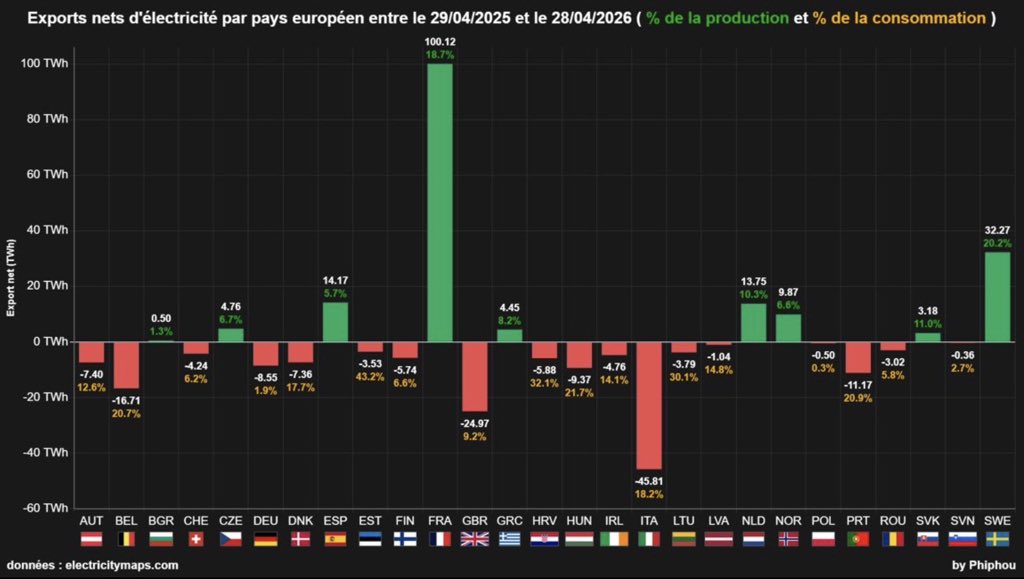
La Francia ha passato la soglia psicologica dei 100 TWh esportati negli ultimi 12 mesi (aprile 2025-aprile 2026). L’export francese vale oltre il 30% dell’intero consumo italiano.
Italia primo importatore netto per distacco.
Stell dir vor die Müllabfuhr zahlt dir jedes Mal eine fette Prämie, wenn sie deinen Dreck abholen kommt. Du bist total begeistert und produzierst immer mehr wertlosen Dreck, für den es immer mehr Geld gibt.
So funktioniert aktuell die Förderung von Solarstrom.
Denmark are ofte displayed as the worlds posterchild for wind-energy, and that Wind have replaced coal.
Sorry to be a renewables partypooper but this👆is completely false.
We have exchanged coal with biomasse/wood.👇
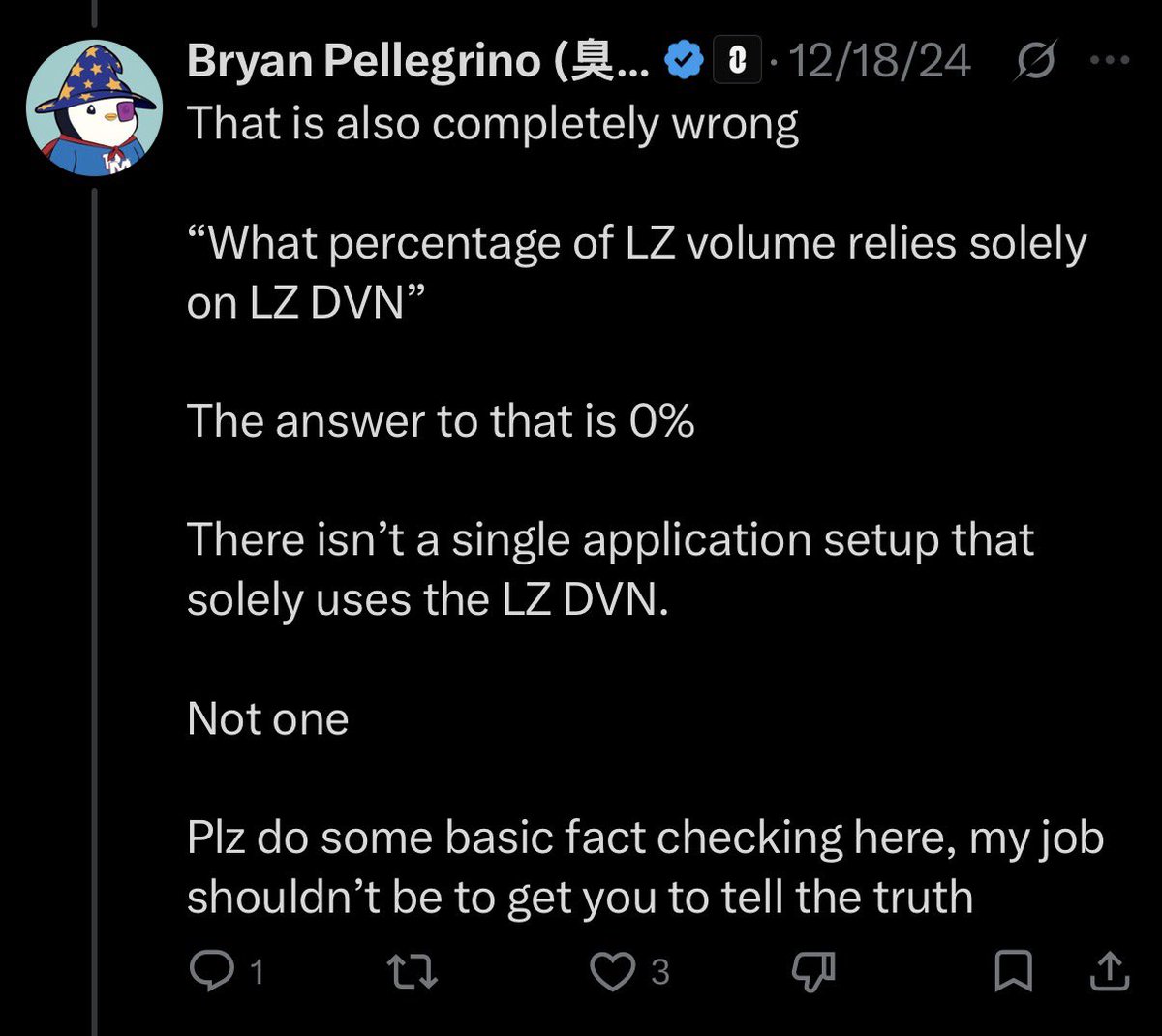
The reason why I am so critical of LayerZero
Beyond their terrible opsec (you have no idea) and centralized infra putting the entire industry at risk and causing a $292M bridge exploit
It’s that any time someone voices even remote criticism, they get relentlessly attacked and gaslit into oblivion by the team themselves
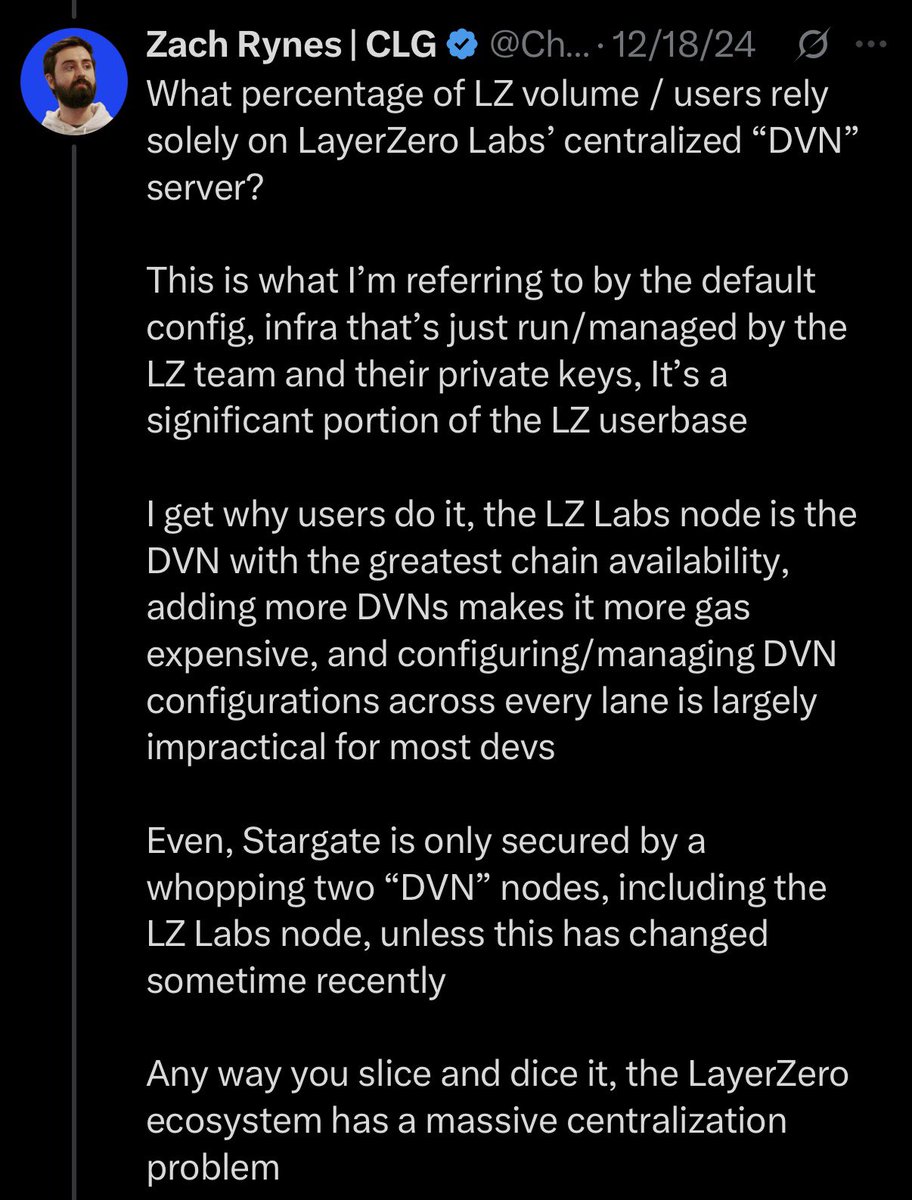
Attached is a snippet of a convo I had a few years back, seems relevant, I was pointing out the EXACT risk of what just happened to rsETH
I’m tired of pointing out the risks of centralized and insecure infra, only to see them later get inevitably hacked, destroying DeFi’s reputation
It’s not gravedancing to point out that this whole situation could’ve been entirely avoided if people just fucking listened to the warnings
@KelpDAO@ChainLinkGod Between a full socialization and having the loss entirely on L2 holders there is an infinite amount of weights you can use to calibrate the problem. Real numbers are dense.
Using an L2 has an higher risk, their users should share more losses. Curious to see how much more
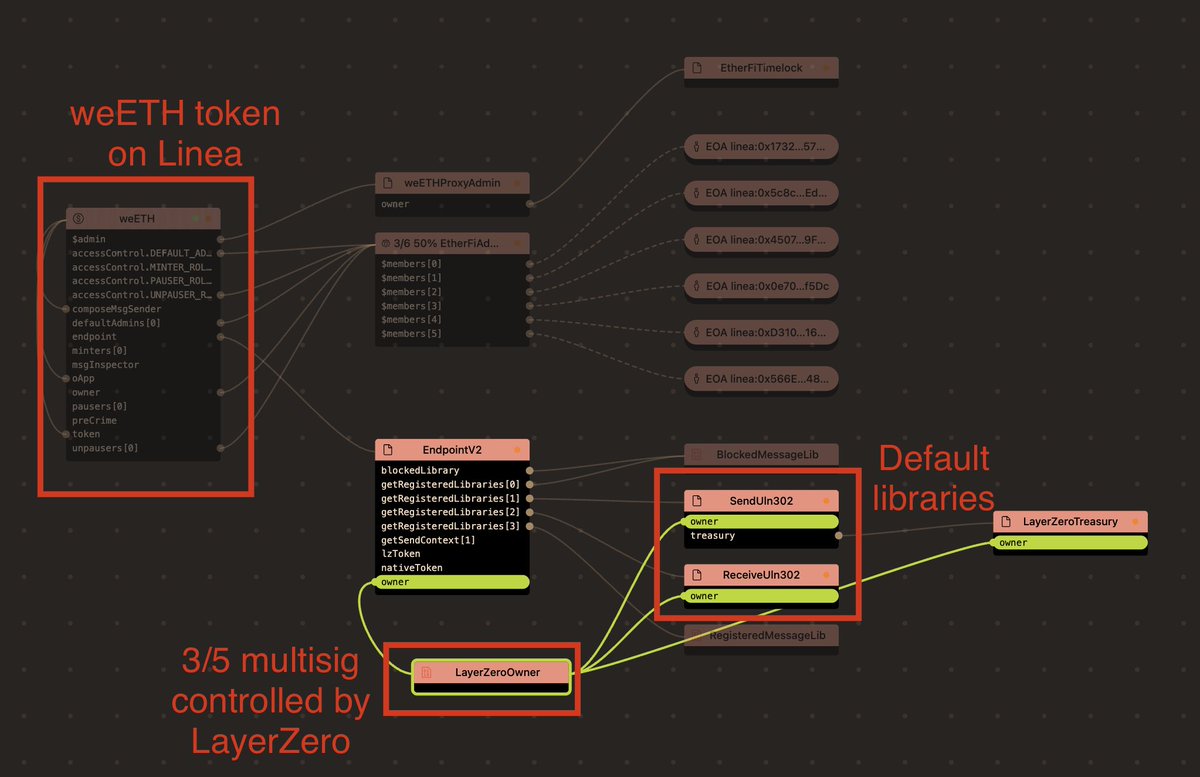
reminder that, regardless of *any* DVN setup, if an OFT (like weETH here) uses the default libraries, it can be rugged by a 3/5 msig controlled by LayerZero Labs alone. billions of $$ of tokens use default libraries. this is another huge hack just waiting to happen.
@0xLamps@donnoh_eth@ether_fi I've done some research, I trust at this point more a protocol that uses chain link. And even better, I'll make sure all my LSTs are on mainnet.
@ether_fi@ethdaily Not sure I'll trust layerzero anymore. Sorry. If security is a priority, I'll be back once you change security assumptions. Gonna stay away to anything that doesn't use a canonical bridge or zk
Nearly everyone working in interop knew about Layer Zero's 1/1 and 2/2 DVN configs and warned about them for years
But they got tired of being openly mocked and harassed by Bryan and the L0 army so they just.... stopped talking about it.
Lots of people vindicated this weekend.