How I think about incentives (current ramblings)
Summary:
- An incentive is one side of a coin, the other side is constraints which produces actions
- Definition of direct and indirect factors that incentivize or dis-incentivize
- Specific examples of direct or indirect factors that produce actions
I use a very broad definition for incentive: a direct factor (positive or negative incentives) or indirect factor (constraint) which is likely to cause a specific action
Direct factors are rewards and punishments that cause action or dis-action. This can be:
- Commissions incentivize sales people to sell more
- Lunch can incentivize employees to come into the office
- Higher pay generally attracts better talent
- Bonuses, promotions, and raises to incentivize employees to work hard
- Write-ups of employees for being late
The list goes on…
Indirect factors, which I like to call constraints, are structural features that are hard to move that can guide a firm or persons behaviour. This can be:
- Cultural norms that guide social interactions
- In business, some costs will be easy to change while other costs will be fixed or long term. This arrangement will guide cost cutting behaviour towards fungible costs, with second order effects
- Current legislation or government policy can hinder or promote innovation in a certain sector / business (e.g. the US dis-incentivizes the crypto industry, but promotes the EV industry)
Specific examples of direct factors:
- Consulting firms are notorious for the ‘up or out’ policy with talent. Employees are incentivized to stay with the firm through the carrot of ‘promotion’ or incentivized to leave when promotions are not granted
- In my old firm, public shaming was effective in making employees less likely to make a mistake again (but terrible for culture…)
- Establishing short term targets for employees will often create short term results (e.g., stock market focus on next quarter earnings lead to managers thinking short-term) - this applies to compensation structures as well (e.g. monthly / quarterly quotas)
- The four seasons allows every employee to vacation at their properties at heavily reduced rates, and they are treated just like the guests, creating a circular relationship to fulfill their mantra: treat people how you want to be treated
Specific examples of indirect factors (constraints):
- Current US legislation hinders crypto development and innovation, causing investors and entrepreneurs to look elsewhere
- A restaurant has three major cost bases: 1) people, 2) food, 3) rent. 2 and 3 are either fixed or already as low as possible and not fungible.. this leaves people as the fungible cost base (Not as ‘constrained’)
- Private equity is usually constrained by an 8 year fund window and a 5 year investment window, constraining their thinking to the short term for their portfolio companies
My thinking is evolving and I’m still landing on the right words to communicate this. But writing is a start.
Generally agree with this take.
However, would say there are many 'last frontiers' of investing still kicking around.
To name two:
- PE ultra niche (I once
- Microcap stocks (institutions can't buy-in, low liquidity)
- Stocks that get dragged down in braod narratives ("SaaSpocalypse" anyone?)
The last one speaks to both points IMO
Complete waste of time imo to do actual fundamental analysis now. You should be thinking about how these tools will cause others to make mistakes, flows, positioning etc. all your effort should go into the Keynesian beauty contest, the fundamental story can easily be digested in 5 minutes now with little juice left to squeeze by doing more work.
I've been thinking about what makes a great dealmaker. And realized there are more dealmakers out there besides just M&A and PE folks.
Often the person who is pulling all the pieces together to make a deal perfect / increase win chances could be a lawyer or consultant.
Typically it takes a deep and long-term relationship, but where I've seen reliance on service providers to make a deal happen for PE comes in the form of two things together:
- network access
- execution speed
Dealmakers seem to understand dimensions of a bid or process, map constraints, and more. And it shows up in much more than just M&A.
Seems to be that the ability to pull the right expertise together in a room and quickly mobilize & execute is a skill I probably underestimated until now.
So one "cool" thing I've seen in the last year is bundling LP stakes and selling as a portfolio.
Take a strip of 13 LP stakes you want to reduce exposure to
Lump them together
Bam - "resilient, diversified portfolio"
The one I am thinking of traded at 2.5% discount... Not bad
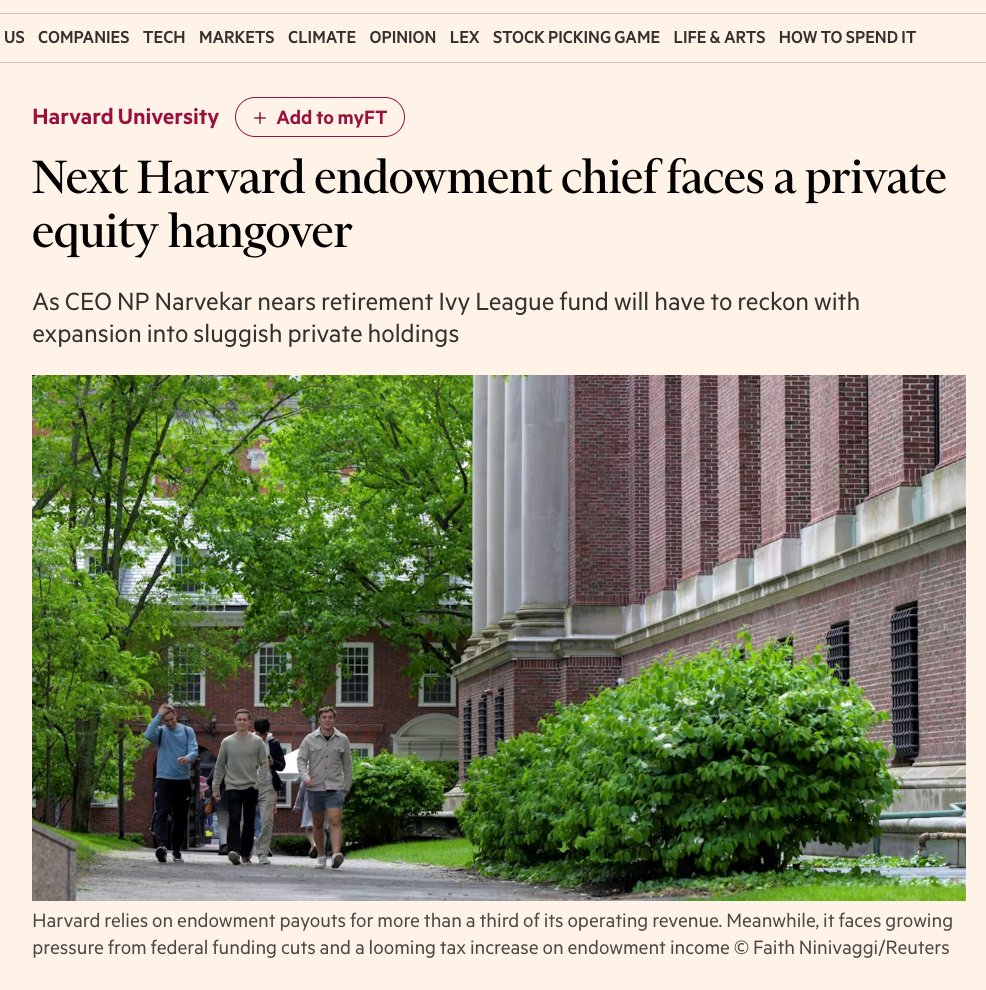
Harvard endowment:
2017: 16% allocation to private markets
2025: 41% allocation to private markets, $1.7B in cash against $7.9B in unfunded commitments, and no distributions in sight
And the real pickle: to raise cash, they can either
- sell LP stakes in the secondary market (at a discount, which will drag returns down)
- sell some liquid positions (which will increase private markets exposure due to the denominator effect) ..
.. neither of which is a great option
Full Text :
How $NOW grew revenue 245% with net dollar retention above 125% for 20 consecutive quarters.
What was the challenge?
By FY2018, ServiceNow generated approximately $2.6B in revenue, having established itself as the dominant IT Service Management (ITSM) platform with over 5,400 enterprise customers and approximately 80% market share in cloud ITSM. However, ITSM alone represented a ~$10B TAM that was maturing. Non-ITSM products represented less than 30% of new annual contract value. Net expansion rate was approximately 127%, but the majority of expansion came from additional ITSM seats rather than new product cross-sell.
What did they do?
Under CEO Bill McDermott (from 2019), ServiceNow executed a systematic product-led expansion: (1) Expanded from 4 major products to over 20 workflow products by FY2023, each targeting different enterprise buyers (CHRO, CSO, COO).
(2) Restructured sales around solution selling with industry-vertical solution consultants.
(3) Created Pro Plus and Enterprise pricing tiers encouraging multi-product adoption.
(4) Launched App Engine low-code tools creating platform lock-in — over 70% of top-100 customers using App Engine by FY2023.
(5) Launched Now Assist generative AI capabilities as premium add-on across all products.
What were the results?
Customers with 5+ products grew from approximately 400 (FY2019) to over 1,200 (FY2023), with 10+ product customers exceeding 300.
Non-ITSM products grew from ~30% to over 50% of new ACV. Free cash flow margin expanded from ~28% to ~31%.
Customers with ACV over $1M grew from ~700 to over 1,900 (171% increase). Timeframe: FY2018-FY2023.
What made it possible?
Single-platform architecture enabling data flow between products without integration. IT department as beachhead — CIOs who trusted ServiceNow for ITSM championed expansion. Enterprise pricing tiers created natural upsell pressure. App Engine custom workflow lock-in increased switching costs with each deployment.
@SleeveRollerBot That's a shame...
Seen this before in lower to lower-mid market but hasn't crossed my mind in a while.
Reminds me of 5% placement fees... To the founder / GP for doing nothing
Those who have done the move from
Tier 1 -> Tier 2 / 3 city
For lifestyle, family, or otherwise.
How do you find the investing / capital landscape?
Difficult to capital raise? Hire good people? Range of jobs available?
Yes I've seen this playbook more commonly. Find a super strong operator, typically for B2C businesses where you rapid buy or build a network (dental, pet care, vet).
But this one was really creating a new company from scratch, utilizing existing tech / IP for a completely different purpose.
Interesting stuff.. unexpected
Just had another PE firm say they are raising to create a company from scratch.
May or may not roll it into next fund, they'll decide later.
Does anyone have data on how common this is?
@Accrual_Reality In this case they are combing financial sponsors + corporate with the tech IP / specialty expertise + future customers all into a consortium
IMO, works well when a corporate can't or won't take risk against their base business so a consortium is a good option to maintain upside
I'm willing to draw a line in the sand.
SaaSpocalypse is largely overblown.
Especially in these industries:
- system of record
- cyber
- regulatory vertical / compliance / roll-up
Anyone who works in a large enterprise understands no one is ripping out critical software for their vibe coded version.
Servicenow
Salesforce
Crowdstrike (already back)
Constellation
Etc... going to be fine
Multiples have re-rated, sure. Will they re-rate back up? Maybe, maybe not.
But I do believe these companies, for the most part, will continue to grow as they have, and capture new tranches of revenue from AI.
I surprisingly know a thing or two about this...
AI attacks pretty much all consulting engagements types and models.
Most consulting in the world is actually 'doing something':
- technology implementations
- tax
- M&A DD
- and sure some strategy
The list goes on.
What we saw before AI was:
- offshore to india or South America
- nearshore to Canada / eastern Europe
Now these are still very effective.
Ever look at your south american customer success, implementation, or dev teams output-to-salary compared to US counterparts??
You can imagine the effect as niche consulting firms with offshore-first staffing models, or offshore quotas, start bidding on work.
Same thing is happening with AI but much much more accelerated.
AI native consulting firms:
- easy to create
- easy to deliver
- likely faster, better quality, and cheaper (for now)
Not only that but clients are in DIY mode. Pay for claude you better use it.
The bar for value generated is much higher.
So.. what are we seeing: a big push in the last five years to pay for outcomes, not time
Except this doesn't mean you necessarily get paid more for taking on the risk. Procing on an outcome is becoming table stakes, a lean-operayed niche firm will price 100% at risk for cheaper than Mckinsey.
So nothing is new, consulting firms are just feeling pressure to innovate faster
@NickNemo17@BigJohn043 I wouldn't quite say overpaid.
You can pay whatever you want but if the risk is real... Doesn't really matter what you pay
I guess I would push the analogy: Ever try to sell a business with revenue declining?
That's what GPs are weighing IMO. Even being able to exit at all
Private Equity GPs are being forced to think long-term.
One increasingly interesting, or worrying, trend on PE value creation (which @BigJohn043 alluded to in a recent post...)
I've seen many deals fail to close this year on both the PE buy and sell side.
For pretty much one reason:
- Buyers can't, with their usual degree of confidence, assess the impact of AI on the portco they are buying. Will they be disrupted? Will they disrupt?
So they don't bid, or sell-side fails to close and has to find an alternative for liquidity.
The question they all ask themselves is: Can I sell this to another PE firm / buyer 5-6 years?
Then they ask themselves: Can the next buyer be convinced they can sell this in 5-6 years?
And then again... and again..
In all likelihood, it results in a GP looking out 10-15 years.
There has been a dramatic change in the importance of long-term thinking in comparison to other questions a manager must ask.
It's industry-specific: The risk of AI disruption in some industries (SaaS, services, tech-enabled services) is resulting in a real slow-down in closed deals because everyone is asking themselves this question twice in relation to AI.