$FLUID is the bet on RWA adoption.
$FLUID is the bet on money markets.
$FLUID is the bet on DEXs.
$FLUID is the bet on stablecoins, leverage, and onchain liquidity.
Ultimately, $FLUID is a bet on the entire financial system moving onchain 🌊
🚨JUST IN: @JupiterExchange Lend overtakes @Kamino for the first time to become @Solana’s largest lending protocol by deposits, with deposits at an all-time high of $2.6B and total loans surpassing $1.08B.
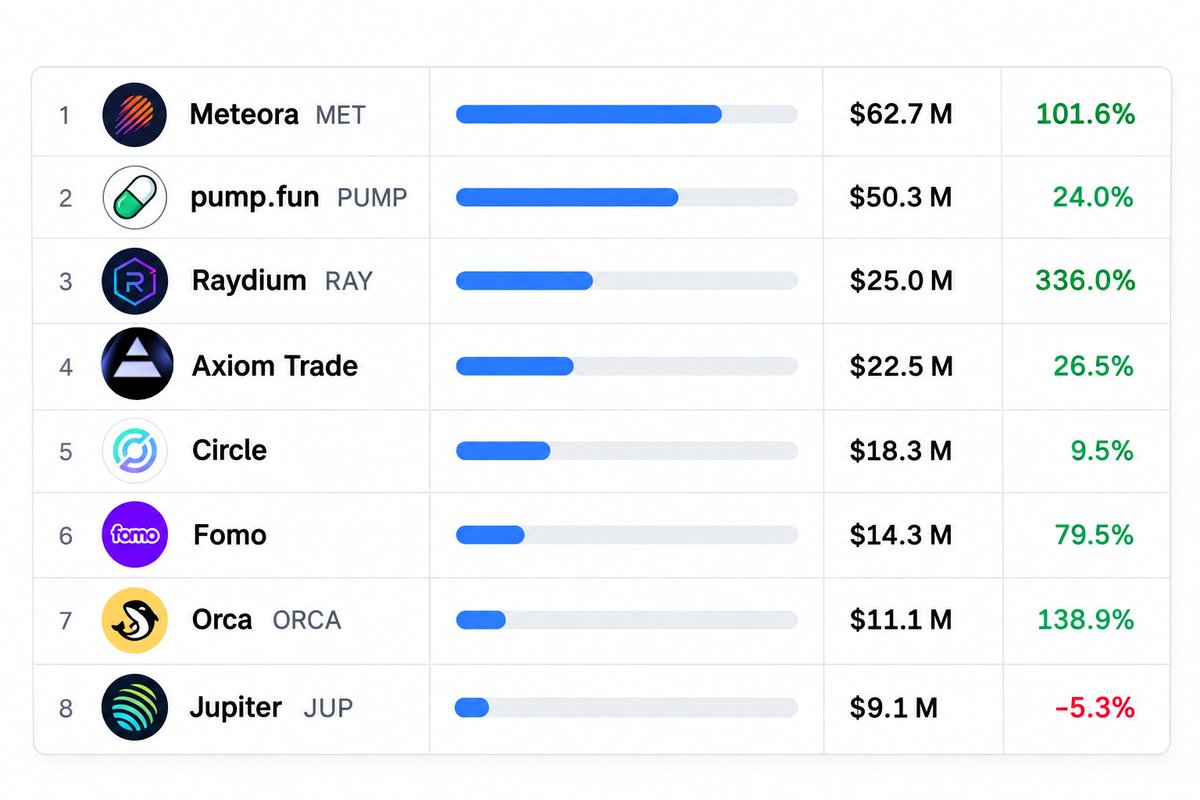
These are the top apps on solana by fees generated over the last 30 days
@MeteoraAG leads the way with $62.7M in fees, followed by @Pumpfun with $50.3M
This isn’t just about one app driving activity Trading, liquidity, stablecoins, memecoins and consumer apps are all contributing to real economic activity on Solana
And some of these apps are still accelerating:
Raydium: +336%
Orca: +138.9%
Meteora: +101.6%
Fomo: +79.5%
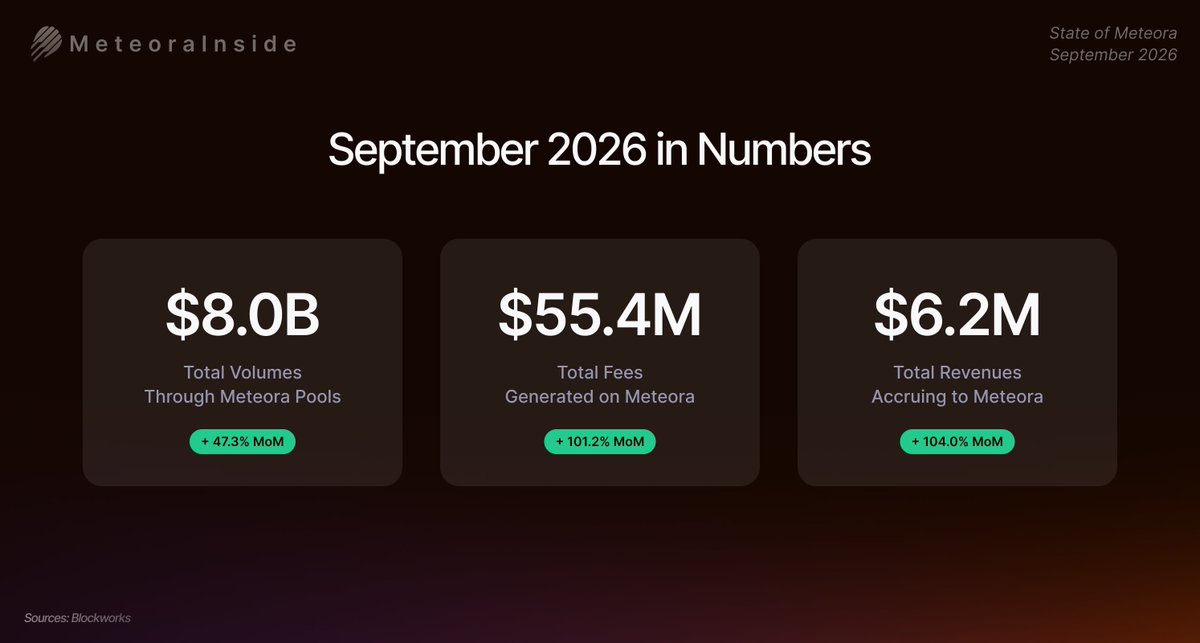
September in Numbers
- $8.0B total volumes (+47.3% MoM)
- $55.4M total fees (+101.2% MoM)
- $6.2M total revenues (+104.0% MoM)
Solana DEX volumes rose about 20% in September. Ours rose 47%, and our fees grew more than twice as fast as our volumes.
That gap is our dynamic fee engine at work. Busier markets mean higher fees per trade, and DLMM pools earned about 0.61% per dollar of volume in September, up from 0.45% in August. Memecoin pools led the way, with LP fees nearly doubling to $40.1M.
The strength held all month: the first and second halves of September each generated about $24M in LP fees.
I don't know how you can see this trend and not get excited of crypto.
The bullish foundations are forming and you better get ready because its going to get crazy.
Data from @Blockworks
A user moved 11,000 $ETH from Aave to Spark, and then from Spark to @0xfluid - all within 48 hours
Spark offered less volatile rates, and @0xfluid offered a lower liquidation price.
What led them to making these moves? Let's try to piece together this puzzle
i don't understand why people call this a bailout
a bailout is when government steps in and prints money to save banks or companies at a cost to the rest of society (devaluing everyone else's money)
this can create a moral hazard because if someone is protected from the consequences of their actions, they’re more likely to take bigger risks
this is not what's happening here
private companies are coming together and using their hard earned money to make users whole
this is the opposite of a moral hazard as they will 100% become *more* risk averse in the aftermath to avoid these costs in the future
The aWETH Redemption Protocol is now live on @Arbitrum and @Base.
After processing $400M+ in redemptions on Aave Ethereum, we're expanding to L2s.
This time, we’ll be opening up for all loopers to unwind while ETH lenders exit to LSTs.
How it works 🧵
Introducing aWETH Redemption Protocol
With ETH utilization at 100% on Aave, many lenders are currently unable to withdraw and face increasing risk if markets move.
aWETH Redemption Protocol allows ETH lenders to:
• Exit into wstETH or weETH
• Regain immediate liquidity
• Reduce exposure to liquidation risk
If you’re just lending ETH — you can fully exit.
If you have ETH collateral and another debt — your collateral is seamlessly swapped into wstETH or weETH while your debt remains the same.
We’re working alongside @LidoFinance , @ether_fi, @0xProject, @1inch,
@KyberNetwork, and other ecosystem partners to:
• Reduce systemic risk in DeFi
• Ease utilization pressure
• Support a healthier DeFi market
Our goal is simple: protect users while reinforcing the foundations of DeFi.
Capacity is initially limited to $1B in ETH.
https://t.co/VBIAT9FZyg
Testing out Plasma One by @Plasma for the past 2 weeks
• really good UX
• smooth and fast onboarding
• fx rates slightly better than etherfi
• instant deposits on Plasma
might capture sizable chunk of the payment market soon
thanks @river0x for inviting me
@letsgetonchain Good read!
One question:
In the case of Cross-Collateralization, does that mean the advantage of aggregated liquidation is gone in this mode?
Since every cross-collaterazation position can be quite different and probably hard to group them into tick-based liquidation buckets?
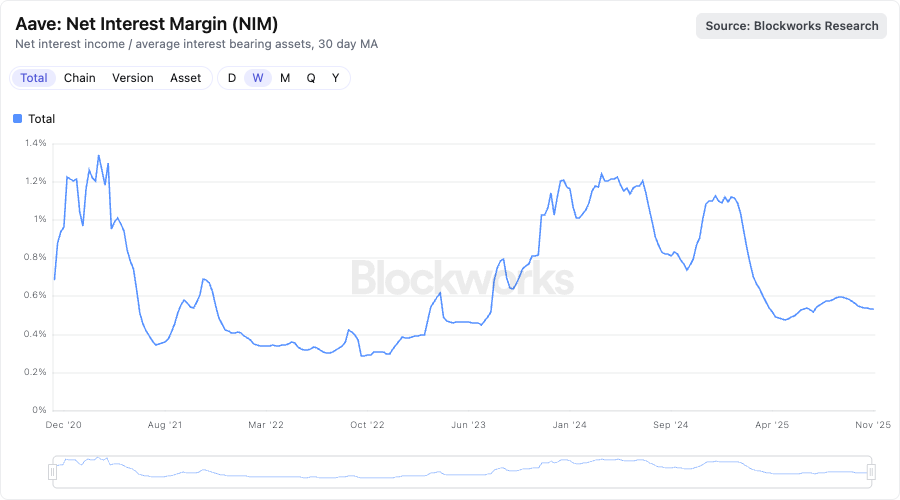
Aave and other DeFi lenders increasingly position themselves as viable alternatives to traditional banks.
One useful comparison is net interest margin (NIM) — the share of borrower interest kept by the platform.
Aave’s NIM has historically ranged from ~0.3% to 1.3%. Large U.S. banks typically operate with NIMs greater that 2%, and regional/community banks often exceed 3% (Fed St. Louis).
From a depositor’s perspective, a low NIM is exactly what you want — more of the lending spread flows to suppliers instead of being captured as platform margin.
That’s a fundamental structural advantage DeFi lending protocols like Aave have over traditional banks.
notice how every new chain wants fluid as launch partner?
there is no better way to bootstrap deep liquidity on stables and FX
welcome to the new paradigm
Now Gold collateral on Fluid is earning 6.3% APR while borrowing USDC is at 6.1%.
You are literally getting paid to borrow against your gold on Fluid!
Smart gold 🪙🌊
the EF is always a few steps behind!
they chose compound (a long-abandoned protocol) over fluid (one of the most innovative DeFi projects in recent years)
- ignored the fourth-largest lending protocol by active loans
- ignored the second-largest DEX on ethereum by daily volume