The hardest thing about transitioning from @Stata to #Rstats was giving up the incredible margins command. That's why @VincentAB's marginaleffects package is a godsend! But slight differences in terminology make it a bit confusing to nav. Here's a short thread comparing the two:
@BonerSamuel69 @MMGOLFSTUDIOS@LouStagner@panscan27 A +3 would beat a scratch player about 75% of the time on average — but agree this would vary by course difficulty and conditions. https://t.co/12SqqlRZRi
@LouStagner I will never understand why the rating/slope system isn’t based on actual scoring. Sure, it would be hard to pull off logistically and would come with many issues, but certainly could be better than current system. AND, it could be dynamic, adapting to possible changes in course
@LouStagner Yes! And that dynamic is even worse at super short, poorly conditioned courses. One summer I played most of my rounds at a crappy par 70 (~68 rating) from back tees. My handicap shot up. The assumption that birdies are as easy to get as bogey avoidance is, uh, flawed.
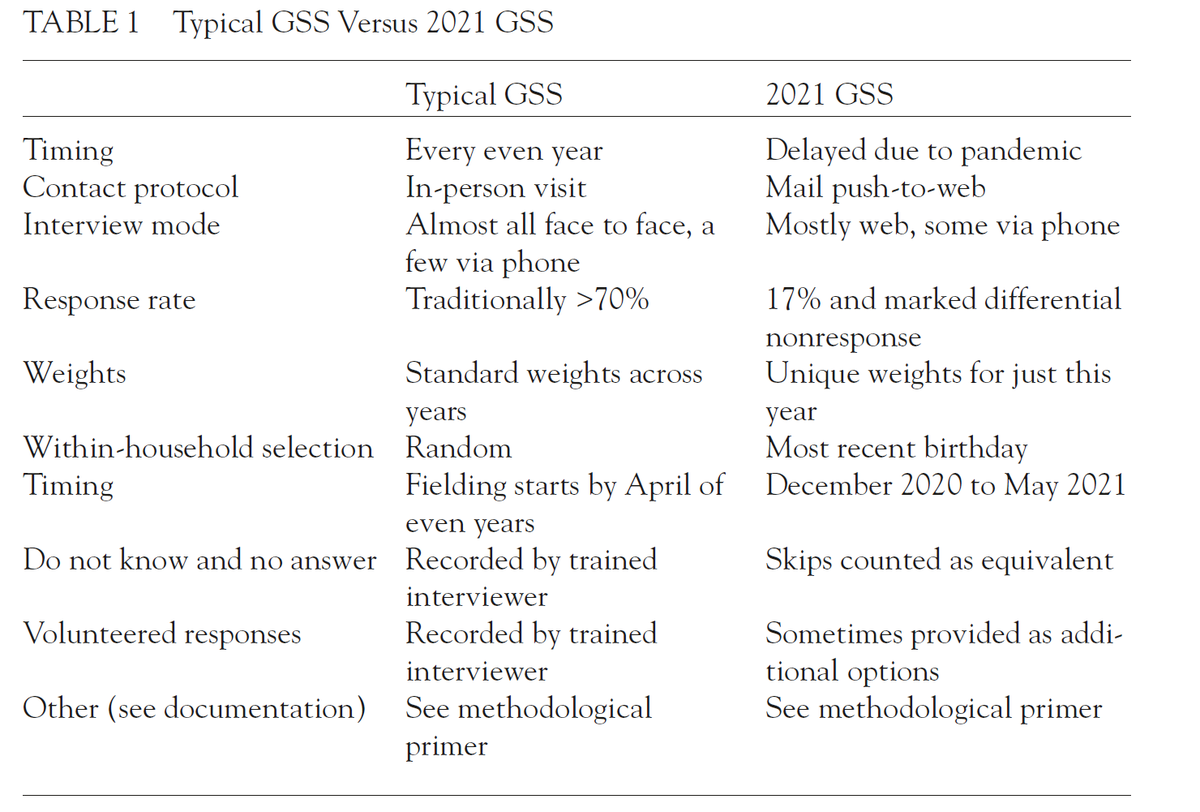
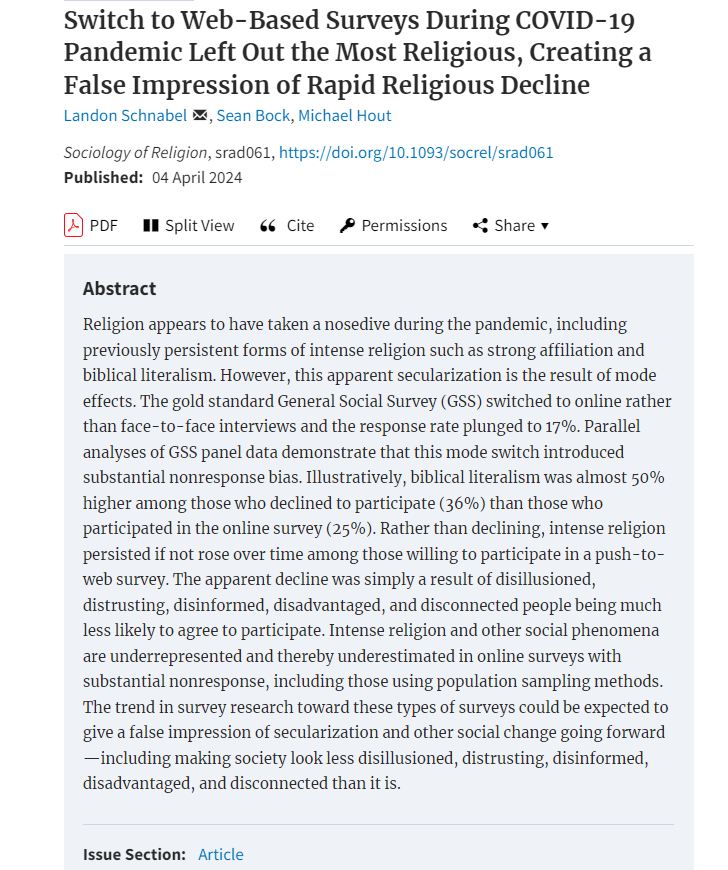
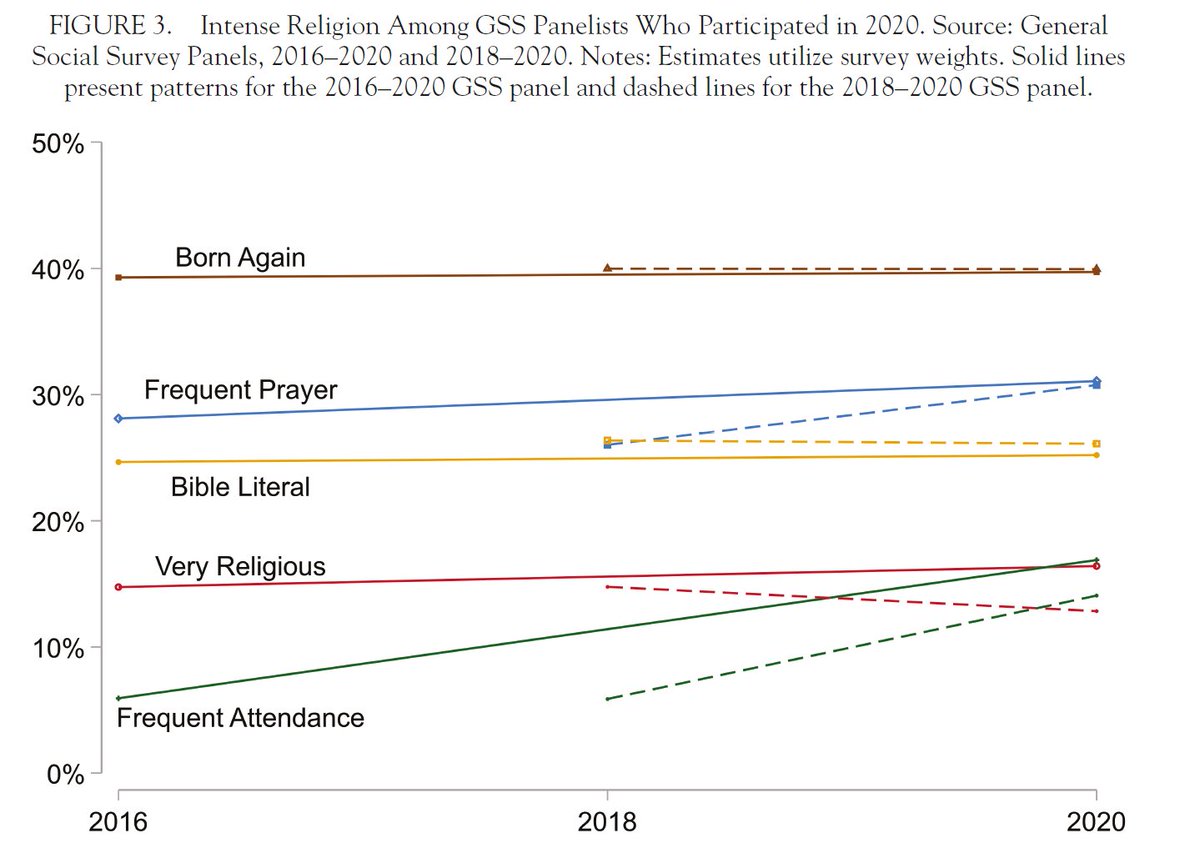
New article on what happened to religion, and the measurement of religion, during the pandemic: https://t.co/S3gf5AThQ0
We (@_SeanBock@MikeHoutNY) show the apparent decline in the highest levels of religiosity in the 2021 GSS, which moved online, was due to non-response bias.
@LouStagner A) Handicaps are SO dependent on what courses you’re playing and B) course ratings and slopes are unrealistically low at a lot of courses.
Does this pattern vary by handicap? I’m guessing it’s even more drastic for better players.
@minjaekim22 @profmcdonnell@LandonSchnabel When I was an undergrad, I went to a talk that argued that sociology should do more “pure description.” Didn’t fully understand what constitutes “pure description” then, and I still don’t. But this article is probably the best example I can think of: https://t.co/YyXIPN1WIc
My AJS article (link in thread below) on the partisan sorting of nationalist beliefs in the United States, co-authored with @YuvalFeinstein and @_SeanBock, was discussed in today’s @nytimes column by @Edsall. https://t.co/JRZQKvgB3X
@BanniganTim@LouStagner Absolutely a selection concern! This could simply be capturing the fact that long hitters have an advantage on short par-4s. All of these single hole strategy analyses really need to be assessed in a multivariable framework — but this never happens.
@DWSoriano @funnyparanoidR @LouStagner@BanniganTim Yes! Another way of looking at it is that the predicted outcome for a single golf shot has a ton of error associated with it — so much so that it may not be a reliable heuristic (or strategy). It kills me that this is left out of these discussions.
@mark_berlin2 Ha! Oh yes. The google scholar alerts for articles I might be interested terrified me for years. But it in cases where it seems like you’re being scooped — you almost never are. The few times this happened to me ended up in me rethinking and reframing my own work in helpful ways.
@ewzucker Yes! Often in football too. I’ve always been fascinated by how IQ worked its way into the sports lexicon. I remember playing one of the Madden football games years ago, and found it super strange that they asked for your parents’ IQs, which influenced your player’s “football IQ”.