CEO, CFO, COO, CIO, CMO, CRO:
Everyone hears the titles - few know what they mean.
Sharing a clear breakdown from Nicolas Boucher:
What each one really does.
+ The Top 100 KPIs they use:
https://t.co/DGQ9REXDA6
1. CEO - Strategy, growth, vision, investors, expansion
Leads the company.
Drives strategy, innovation, and global growth.
Defines corporate values and long-term direction.
Represents the business to investors and the public.
2. CFO - Financials, performance, risk, profitability
Ensures stability and discipline.
Owns the company’s financial health.
Reports results to the board and shareholders.
Sets financial benchmarks and drives profitability.
3. COO - Daily ops, resource planning, execution
Turns strategy into execution.
Runs the daily engine of the business.
Coordinates departments for efficiency.
Aligns operations with company goals and market expansion.
4. CIO - Tech stack, security, data
Owns IT budgeting (CAPEX & OPEX).
Aligns technology with business growth.
Leads tech strategy and IT infrastructure.
Oversees cybersecurity, data protection, and governance.
5. CMO - Brand, demand, customer journey, messaging
Executes campaigns for market growth.
Builds awareness and drives acquisition.
Shapes brand strategy and market presence.
Defines the brand voice and customer experience.
6. CRO - Revenue, monetization, customer value
Owns all revenue-generating functions.
Designs monetization and pricing strategies.
Builds scalable revenue models for expansion.
Sets targets, tracks performance, and reports to the board.
This visual makes it crystal clear who does what at the top.
Which C-level role do you work with most often?
♻️ Repost to help your network finally understand the C-suite.
Did you know that there are multiple levels of business strategy:
Corporate level, business level, functional level, and operational level strategies.
Every business leader needs to understand these different levels.
When founders and VCs think about pitching their co or fund, a lot of ppl get caught up in the design & the storytelling. They think improving that will get them funding.
While changing that can help, funding is largely determined *before* you create the pitch.
More >>
You need baseline prosperity to even attempt startups. Insiders know it, outsiders don’t.
Some observations in Silicon Valley :
- Many founders in Bay Area come from a sound financial background. A founder got viral for paying himself 0 salary in SF, his mom is a CEO of public company. Do some research.
- Dropout founder is an exception, not a norm. Most founders in Bay Area have studied from top universities.
- You’d be surprised to see how many founders grew up around startups. ‘My dad built a company in 1990 and exited for 400M’, ‘this top VC was my uncle’, ‘I grew up in Palo Alto and joined computer club when I was 5’. The advantages of growing up in a tech hub compound.
- The dropouts you see are from top universities. Also, they don’t drop out, they just defer their semesters.
- Dropping out from Stanford gives you credibility. Dropping out from an unknown college signals laziness. You’re judged on signals here, ask any founder.
- People who worked in big tech have saved a good chunk. Great way to start without worrying about burn! You’ll see many founders here with a big tech or startup experience.
- People have deep networks in Silicon Valley. If they don’t, they build it. Networking on internet is all fine but in-person relationships still rule.
- “What about YC, Thiel fellowship and others?” Many ppl drop out ‘after’ they get into these programs. The initial funding gives you runway to experiment. You can’t build if you’re constantly worried about burn.
- “I need to follow my passion” - do it surely. However, someone has to fund your passion. Either your users, family or investors. If you’ve the confidence to do it, figure out the finances. Jumping straight out of airplane without parachute or knowing how to build it will lead to a fatal outcome.
- Startups sound so fun from outside. 99% of time, you’re talking to users, fixing things, writing code. If someone made a documentary on startups, they’ll be shocked on how much work it is.
- It’s easy to change the world if you don’t have to worry about paying bills. That’s why money is called ‘runway’. Good to have an exit, bootstrapped venture that made you money or people who believe in you. Otherwise you will take funding at horrible terms that can break your startup.
- “VCs will fund me for my world changing idea” - nah. They fund founders with pedigree (good education/ work ex) and proof of work. Funding non-pedigree founders is an exception. Pick up portfolio of any VC and see background of founders, you’ll know.
- VC funded startups is a game of chasing unicorns. The big bets. The billion dollar outcomes. It’s an extreme game, built for extreme people. It’ll take all your energy, focus and time. You need some advantages to play it. Lack of education, network or resources isn’t an advantage, especially if you didn’t grow up in ecosystem.
“People in Silicon Valley drop out too, so should I to start up” - this thought has led to many bad outcomes. Be aware of what you’re signing up for and you can win the world! 🤟🤟
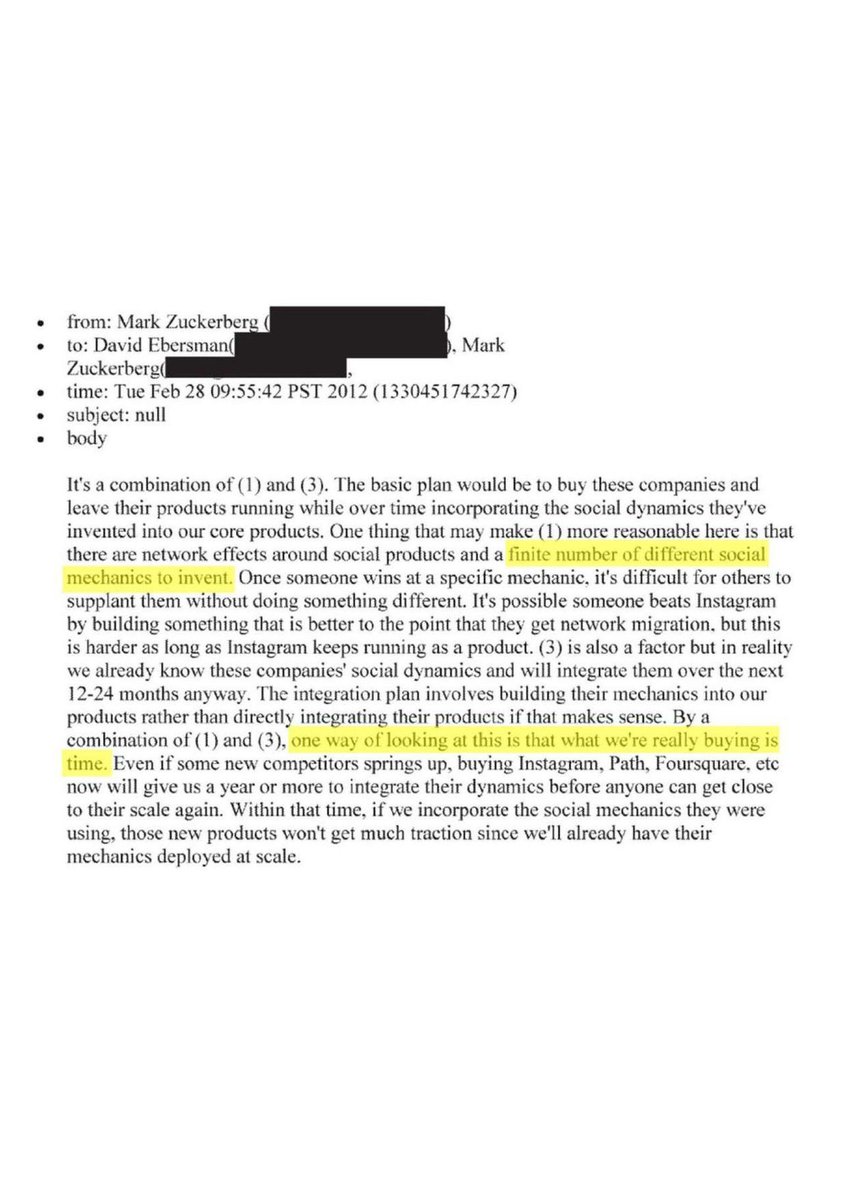
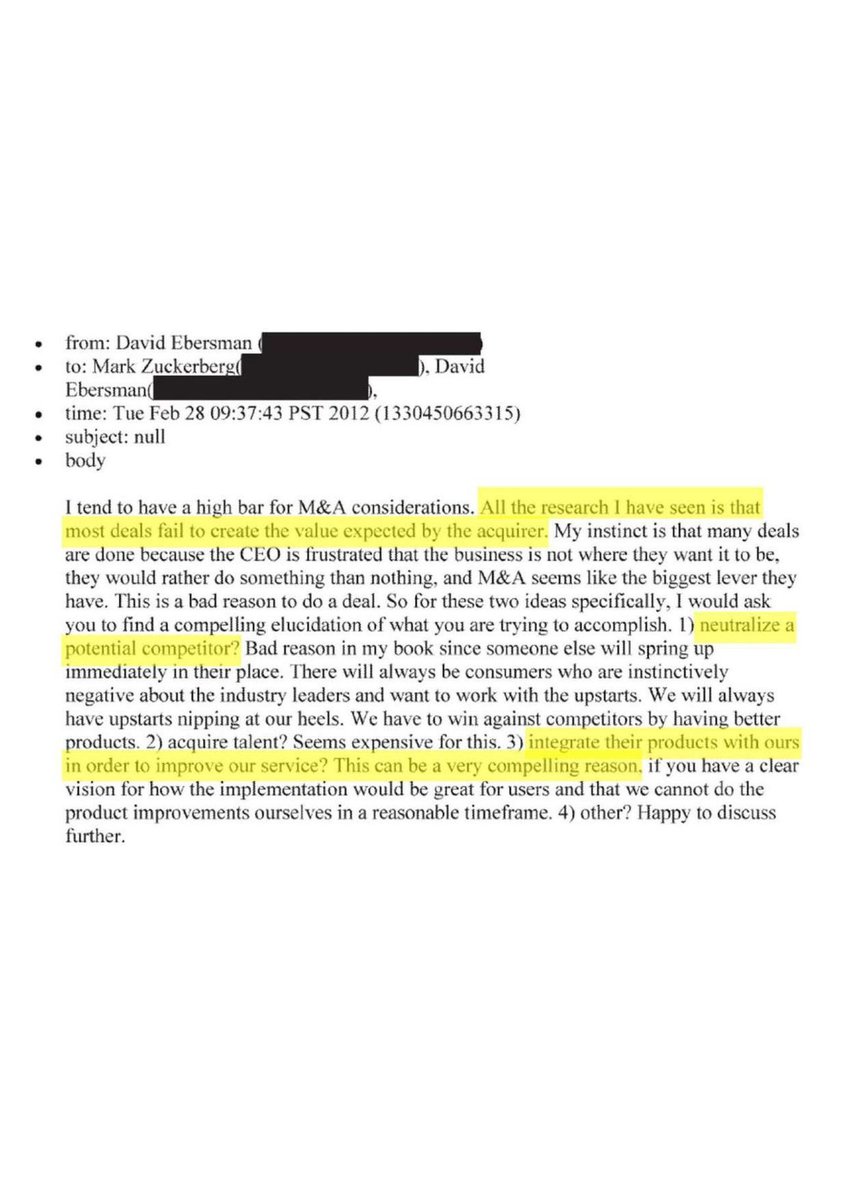
In 2012, Zuckerberg bought Instagram for $1B.
It's said to be one of the best acquisitions, ever.
His email discussion with his CFO on buying Instagram shows how adept his business mind is and teaches a small lesson in strategic decision-making.
Cheat sheet for Ndi Fintech
1. Do NOT borrow with interest to start your business. You start the business with your savings and assets, your family and friends. No interest loans
2. Capital held as cash is waste. Once you get capital it must be deployed. Keeping cash in the bank will make your return on Equity low. This different from your reserves in the balance sheet
3. There is a difference between Return on Investment ROI and Return on Equity ROE.
ROI= all funding
ROE= all non-debt funding
Finance theory says a company with a high degree of risk (startup) will have a higher cost of equity. In effect, you have to post higher returns ROI to attract investors
4. Equity is also how you raise money, not how you retain control. Don't hold 100% of 1, rather seek 10% of 100
5. Keep cash. Never pay cash on delivery, always pay cash 90 days out, and invest that cash in a Tbill. Never offer credit, discounts are ok but not credit, you are a start-up. CEO watch your cash, and get daily reports of cash in and out..note Daily
6. Any expense not keeping your business alive is a waste of money. Thus, do you need that big office? Or can you live in your office and deploy your rent to the business? Is that retreat in Dubai really necessary? Try Abeokuta
7. Once you run out of cash, it's over. Sales is not cash, profit is not cash, cash is cash
8. The first person you hire is your Finance officer, not your tech bros
9. Insurance is good, if your assets are mission-critical, insure them
10. The CEO must understand the relationship between the Income statement, balance sheet, and cash flow statement....note MUST
.@Linda_A_Hill, author of “Collective Genius: The Art and Practice of Leading Innovation” and a @HarvardHBS professor. #EmTechNext https://t.co/4G3lOLBvI3
One of my first mentors in private equity told me something I've never forgotten:
"You'd be better off learning negotiation than financial modeling. Business is less spreadsheets than words."
• Your price, my terms
If I could teach you ONE thing about business & investing, it's this:
Control the terms, & you control the deal.
If you CAN'T control terms, then you control price. Can't control either? No deal.