Bitcoin has totally lost its way. The purpose of Bitcoin "A Peer-to-Peer Electronic Cash System" as Satoshi Nakamoto designed it was for a stateless, decentralized, permissionless payment mechanism that was capable of scaling to VISA-level transactions that were cheap enough to support both sub-cent micro-payments as well as large payments. This is the true value proposition as widespread adoption of payments through this system would literally free people from both the banking system and some degree of government coercion while it's fixed scarcity would also limit the #inflationary monetary malfeasance common with central banks. Nowhere in the Bitcoin whitepaper is it mentioned that Bitcoin was intended to be HODLed by a very few in order to drive the price up so that then, financial con-artists like @saylor could bamboozal the world through reckless financial engineering. Nowhere in the whitepaper was it mentioned that it would be really great for Bitcoin to "go to the moon" after retail investors used @BlackRock ETFs to access only the price of Bitcoin without any possibility of custody of their own Satts. Nowhere in the whitepaper is it mentioned that there was no real way for it to scale (because of artificial block size limits) and therefore in order for Bitcoin to actually empower transactions for all, we would need some diminutive technology ignorant anarcho-gobblin like @jackmallers to come along and create a new layer that somehow, magically would make good on the promise of global cheap transactions at scale. All we are seeing today is a massive speculative orgy with almost no real adoption and certainly no hope for the true vision of Satoshi Nakamoto.
@harari_yuval Encryption is a "technology of distrust" and yet it's what allows us to trust websites and safely buy online.
Similarly, Bitcoin gives people more *choice* in who or what to trust, rather than them being beholden to whichever central bank monopoly they happen to be born under.
The average restaurant service worker earns $16 an hour.
He must WORK 35 MINUTES TO BUY A BIG MAC AND A GALLON OF GAS
With the CA bill raising the fast food minimum wage to $20/ hour, that would be 27 mn, the least in history
Larry Summers openly admitting a few weeks ago that if CPI were calculated as it were in the 1970s it would have peaked at 18% in 2023.
AFAIK this is the first time someone as establishment and mainstream as Larry Summers admitted such a thing?
https://t.co/cdTpJ320Hm
2⃣ “US equity market overtook the UK early in the 20th century and has since been the world’s dominant market, apart from a short interval at the end of the 1980s. This makes it dangerous to generalize from US asset returns since they exhibit “success bias.”
3/9
It's the edge cases. Like I was on a mountain road, as I approached the crest of the hill saw someone waving at my frantically on the side of the road. I instinctly slowed down quickly and sure enough I crested the hill and there was a multi-car pileup.
Now show me a computer program that can figure out the difference between someone waving at you to say hi and someone waving at you to alert you of a problem ahead.
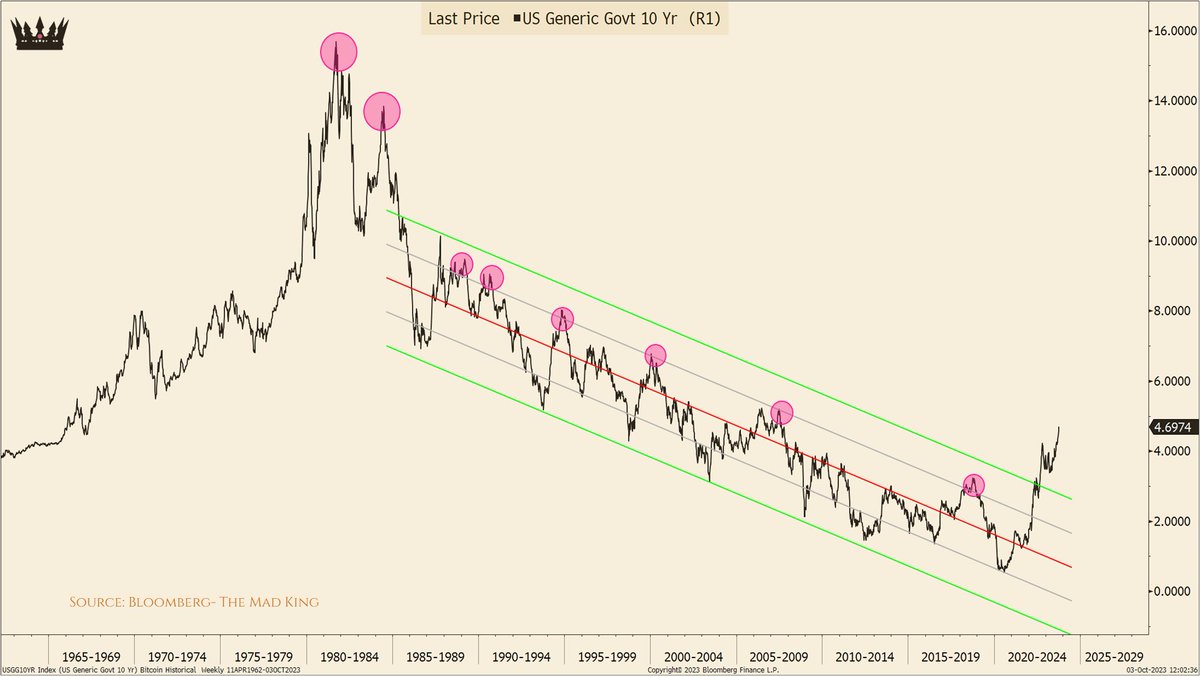
For finance professionals who commenced their careers after 1985 (including me), a continuous decline in rates has been the norm.
We've rarely encountered more than one standard deviation, and when we did we knew the Fed's next move.
Yet now we find ourselves approaching 4 standard deviations!
We are in uncharted territories, and expecting a soon Fed's pivot is almost delusional.
When it comes to investing in a new technology, the hard question is rarely whether that new technology will create incredible opportunities for society
Instead, the question is whether that opportunity will specifically accrue to the shareholder, or to the customer
This Monday will be the 150th anniversary of the Panic of 1873. Specifically, it reached its peak at 11 am when HC Fahnstock, the New York partner of Jay Cooke (one of the leading gold market participants), announced that Cooke’s office was closed. Cooke, in his Philadelphia office, admitted it was true, and the most prominent banker in the country was suddenly bankrupt.
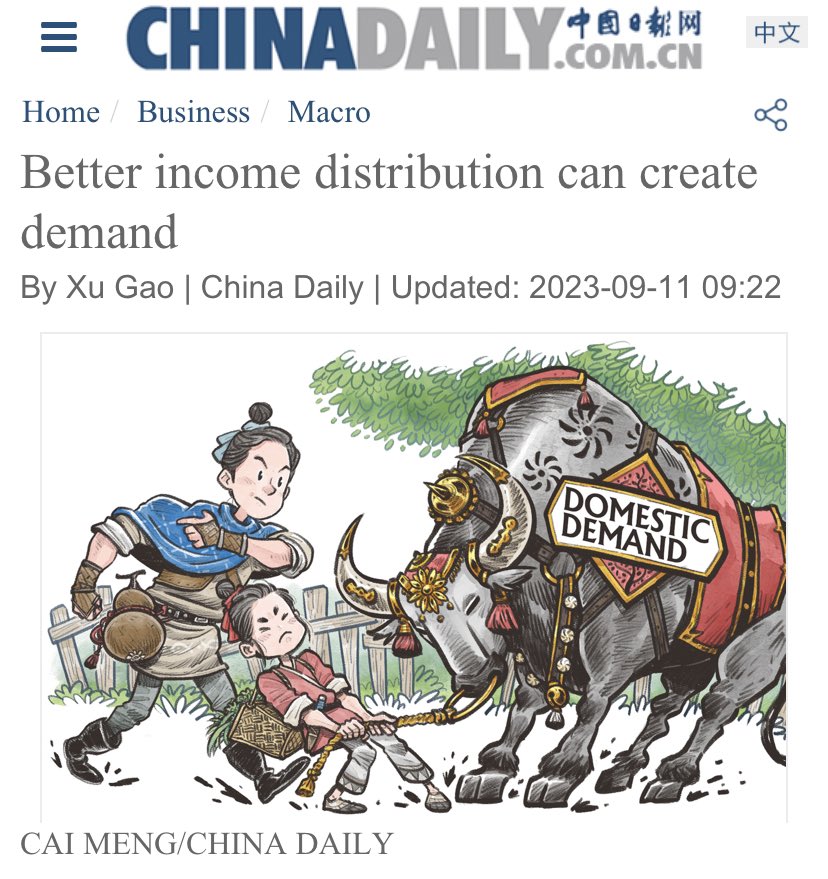
*China has a severe wealth inequality issue
And like we learned from Marriner Eccles (FDR’s Fed chair), mass production requires mass consumption
Take away income from the masses (bot-90%), take away demand
Debt can mask the inequality, but it’s temp.
PS it’s a Global issue
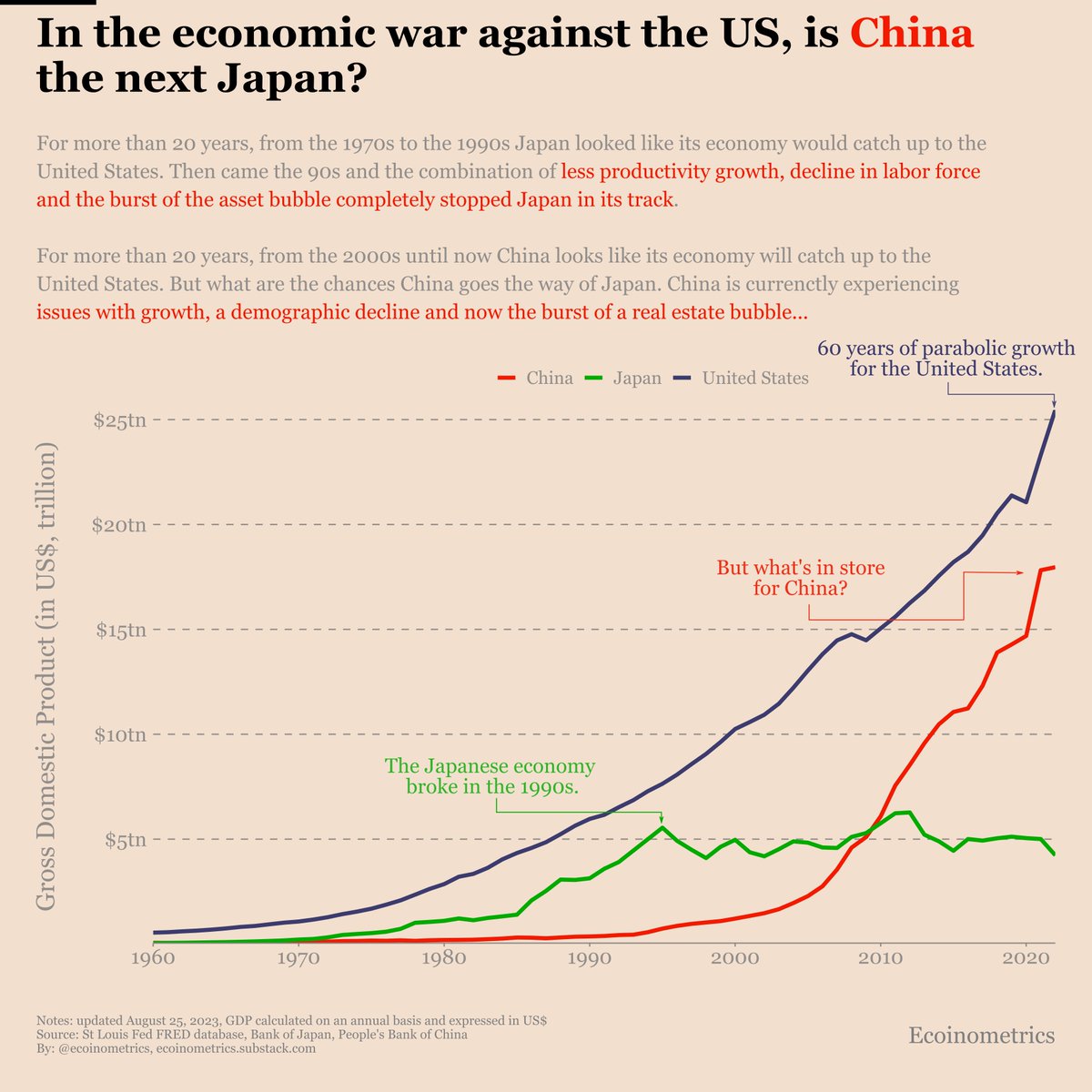
China has been the great economic rival of the United States over the past 20 years.
For some time it even looked like China could win.
But now things aren’t so clear, China might be in trouble.
And the funny thing is, if you replace China by Japan and the 2020s by the 1990s the (almost) exact same scenario already played out in the past.
For 20 years between the 1970s and 1990s Japan recovered from World War II and became an economic power house.
Now everything is Made in China, back in those days everything was Made in Japan.
During all those years the GDP of Japan was growing as fast as that of the United States and a lot of Americans feared the US would fall behind Japan.
Then suddenly in the 1990s it all stopped:
- Deflation gripped the country.
- Productivity hit a plateau.
- The labor force started to decline due to demography.
- Competition emerged from China and South East Asia.
- And on top of that the asset price bubble collapsed.
It has been 30 years and Japan still hasn’t recovered from that.
Compare that to the turning point China finds itself at right now:
- Its productivity growth is trending down.
- It has a massive demographic problem as a result of the one-child policy.
- Its financial system is fragile.
- Competition is emerging from India and South East Asia.
- And it is currently experiencing a burst of its real estate bubble.
That is an eerily similar situation which should make you think twice about the future of the Chinese economy and what it means for the global financial system.
That’s definitely something to keep an eye on.
Great description of private-equity, the swamp @jeromehpowell came from (and has richly rewarded.)
via @bethanymac12 & @JackFarley96 https://t.co/vDePZpgxdJ
The US government continues to operate as if it were facing another pandemic lockdown from a fiscal spending and debt growth perspective.
See below the issuance of long-maturity debt instruments continuing to rise at unsustainable levels.
Never mind that nearly half of the federal debt must be re-financed at substantially higher rates in the next 2 years.
In the end, the monetary authorities will bear the responsibility for this situation.
The Fed must either induce a deflationary shock to stimulate demand for Treasuries or assume the role of being the buyer of last resort of these instruments.
Repeat after me... "You do not compare household debt to GDP, you compare it to personal income... and even then you acknowledge the growing income inequality and unequal interest rate distributions." Household debt to personal income rising, not falling.
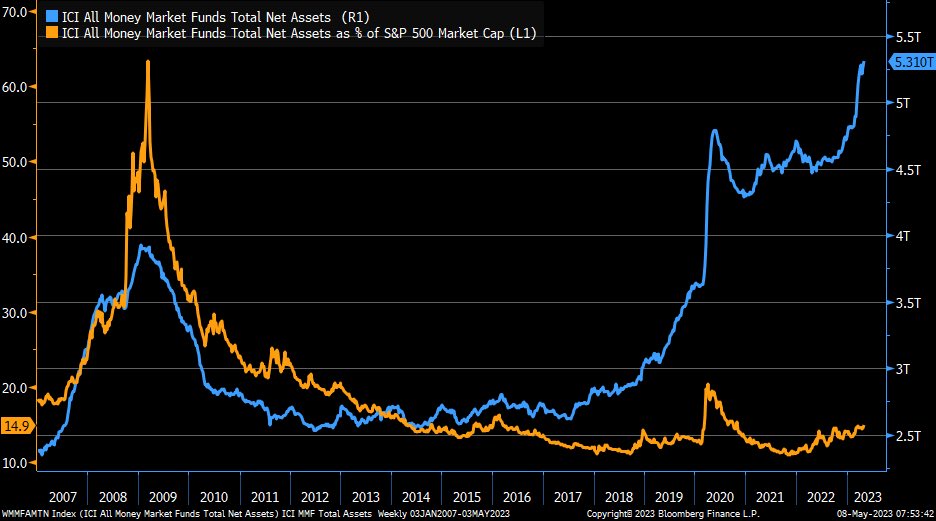
New high reached for total net assets in ICI money market funds (blue) but keep in mind different picture in terms of total relative to market cap of equities (orange)
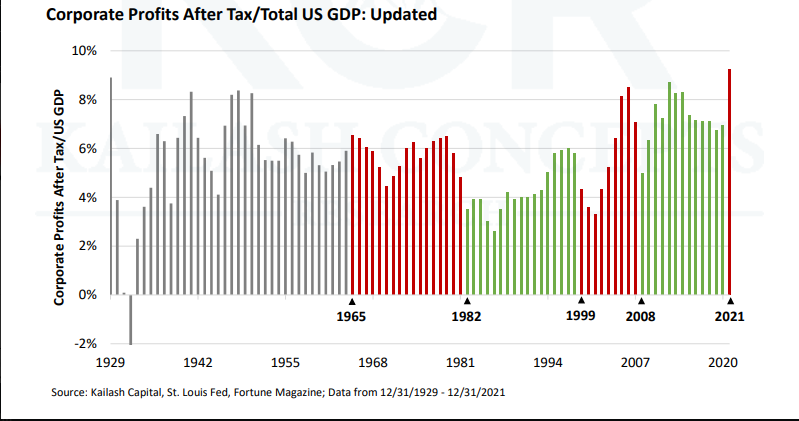
@fkronawitter1 "To expect the growth of a component factor to forever outpace the aggregate, you get into certain mathematical problems". "If corporate investors are going to eat an ever growing portion of the American economic pie, that would justify rise in political problems". -Warren Buffet