Today we are introducing Sarvam Extract, our API for extracting structured data from documents, powered by our latest model, Sarvam Vision 2.1.
On ExtractBench, Extract sits on the accuracy-cost Pareto frontier, delivering the highest accuracy at its price points, outperforming LlamaExtract Cost Effective and Gemini 3.8 Flash.
Never seen a model adhere to one design language stronger than 6.2 astra
No matter the harness it has learnt one way to make artefacts. But atleast it does that well.
Surprisingly it also far more token efficient than opus 5.5, like 2x more efficient.
♥️♥️
i hope it puts this whole orchestrated PR attack to rest, but pretty confident we will have something else to rant over very quickly. :/
nowhere else in the world will people complain about getting cheaper and faster access to OSS models.
personally I lived through the experience of bearing $$ cost for OSS chinese models to FAL, Fireworks etc and guess what... it sucked?!
so maybe lets just celebrate the fact that we might just have better cost margins, and build better businesses :)
Excited to announce that we are open sourcing the latest edition of Sarvam- 105B!!
My tldr: Scaling agentic RL is not for the faint hearted
Data generation, evals and hill climbing in non verifiable domains is a massive unlock, but there’s loads more to do still. Onwards to 1T!
Today we're releasing Sarvam-105B-1711, our new checkpoint of 105B model in the Flash-Lite category.
Averaged across instruction following, chat, tool calling and Indian languages, it sets a new Pareto frontier when compared with other popular Flash-Lite models.
If the Generalized Riemann Hypothesis (the stronger version of the Riemann Hypothesis) is proven, these become proven facts:
Algorithms that no longer need randomness
- Primality testing: Miller's fast test becomes proven correct with no randomness
- Square roots mod a prime: becomes solvable fast and with no coin flips (today that's an open problem)
- Cube roots and other roots mod a prime: same.
- Factoring polynomials over finite fields: almost fast (quasi-polynomial) with no randomness, instead of needing randomness
- Building finite fields: you can construct any finite field directly, with no random search
- Factoring vs. φ(n): factoring a number becomes provably as easy as computing φ(n), even without randomness
- Primes with a given remainder: a prime with any allowed remainder mod q exists that's at most about q², so searching for one is fast
Complexity theory
- Polynomial equations: "does this system of equations have a solution?" drops from PSPACE to a much lower class (AM)
- Algebraic P vs NP: Valiant's algebraic version of P vs NP gets tied to the normal P vs NP over the complex numbers
- Turing machines: a known 744-state Turing machine is proven to run forever
Number theory software
- Math libraries: PARI/GP and Magma results computed "assuming GRH" become fully proven
- Class groups: algorithms that compute these number-field structures get guaranteed running times
- Elliptic curve generation: the algorithms used to create curves for crypto get guaranteed running times
Cryptography (no new attacks, only proofs)
- Elliptic curves: proven that if discrete log is hard on one curve, it's hard on almost all similar curves
- Lattice crypto: known quantum attacks on some lattice schemes become proven to work
- Isogeny crypto: known quantum attacks on some isogeny schemes get proven speeds
- Code-based crypto: schemes like BIKE get the guarantee that the special primes they need exist
Prime gaps
- Next prime: there's always one within about √p·log p of p, so "find the next prime" has a guaranteed worst case
What it does NOT do
- It doesn't solve P vs NP
- It doesn't make factoring easy, so RSA and elliptic-curve crypto stay safe
- It doesn't make anything faster in practice, because randomized versions already work today
- Ramanujan graphs, expanders and AG codes are unaffected: they use a finite-field version of RH that was proven decades ago
The AI industry has a benchmarking problem.
We're letting random people on the internet decide which models are best
even for capabilities like design...
So we built something different.
Introducing The Frontier Design Benchmark from @contralabs
https://t.co/Eiw47GSxEk
Today, we are launching Sarvam Token Factory for everyone.
We host our own models, and the full range of best-in-class open-weight models, in India. We match leading inference providers on performance and reliability.
For enterprises, this means more models to choose from, and an AI stack they can own without lock-ins.
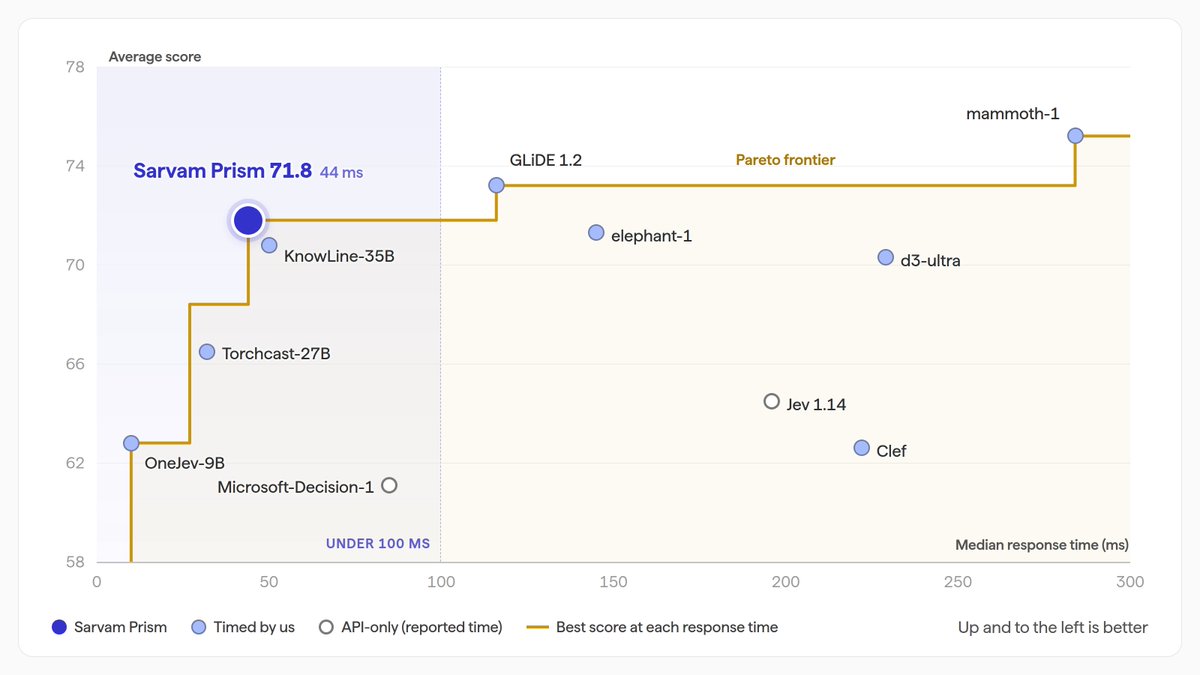
Today we’re releasing Sarvam Prism, a System One model built on Sarvam 105B for fast, accurate decisions across enterprise workflows.
It scores 71.8 with a median response time of 44 milliseconds, the highest average score among decision models that respond in under 100 milliseconds.
We scaled a robot model natively to 8,000 timesteps of context, 5 minutes worth of muscle memory, with constant inference cost. Robot policies used to live their lives a few frames at a time (< 0.1 sec), instantly forgetting what just happened. We pushed to 3 orders of magnitude beyond SOTA.
Introducing RoboTTT. Test-Time Training (“TTT”) carries a tiny model *inside* the model. Every incoming sensor reading triggers one gradient step on that tiny core, so the history keeps getting compressed into its weights. The hidden state has a fixed size (literally a small neural net), so the robot can “grok” arbitrarily long experience with little overhead. Learning continues indefinitely after deployment.
We can then put an entire video in context as prompt! RoboTTT enables one-shot in-context learning from human video: in circuit board assembly, a human demonstrates a never-seen configuration once, and the robot imitates it faithfully.
Humans drop things all the time, but we pick them up so fast that we don’t even notice. That reflex to fix is half of our physical competence. RoboTTT shows self-improvement on the fly: the robot is skilled at recovering from its own errors mid-episode, and each fix enters its context to inform the next move. The TTT core distills a general-purpose, failure-to-correction mapping from the training data.
One more thing. What excites me the most is a new Context Scaling Curve: from 128 to 8K timesteps, closed-loop performance hill-climbs steadily with no sign of saturation. 8K-context pretraining beats 1K by 62%. What LLM enjoys, robotics should too. Soon, even 1M context is not a fantasy.
Deep dive in thread:
Models keep improving at an exponential rate. So it baffles me, how do browser agents still suck so much.
I spent a few weeks digging into the problem and a made a talk sharing my insights
Ig the #AIEngineer folks liked it too.
https://t.co/86QIgef3bT