JUST IN: a Stanford CS student (who chose to remain anonymous) made the bold decision to not drop out and found a startup, instead opting for the unconventional path of pursuing a degree.
The student said he “turnt down” the YC funding to “grind for the grades,” citing the stability, resources, and community that the University provides.
"Growing up I’ve always been a bit contrarian.” the student says. “I know this isn’t the typical move to make, but I genuinely believe that getting a college degree instead of founding a startup is the best thing you can do when you're young."
The would-be founder said this decision was not easy. "I had to sit down with my family and have a hard conversation about why I'm choosing to not drop out. It’s a nerve wrecking decision but I believe I’m making the optimal choice, no matter how controversial it might be.”
extremely unprofessional. if kimi wants to make it as a frontier lab, they need to act like one: perhaps silently route people to worse models, and maybe write a blog post about the collapse of humanity
We keep saying LLMs "hallucinate." But what does that actually mean?
In our new position paper, we argue hallucination isn't just "wrong facts." It's inaccurate internal world modeling.
We formalize this precisely in a unified definition to appear at #ICML2026 (@icmlconf)👇
Introducing InfiniteDiffusion, my independent paper accepted to #SIGGRAPH2026!
I have one RTX 3090 Ti. No funding, advisors, or team. By day I'm a new grad SWE at Walmart.
The paper has two main contributions:
- InfiniteDiffusion: a new approach to infinite generation with diffusion models.
- Terrain Diffusion: the world’s first learned procedural terrain generator.
Here’s why this matters, and how they are connected. 🧵
This may be a controversial take, but I think it needs to be said: the gap between computer vision research in academia and industry is widening with every conference.
A huge fraction of @CVPR papers—especially those that boil down to "we tweaked/fine-tuned/RL'ed large-scale model X to improve on task Y"—will become obsolete with the next model release. That's not where academia creates lasting value. PIs should adapt much faster to this changing reality.
Academia should focus on fundamentally new ideas, new problem formulations, explaining emergent phenomenology, or uncovering blind spots that industry can later solve with scale, compute, and data.
@__mvp18__ and @toshi2k2 are still presenting our #CVPR2026 Findings paper "Name That Part: 3D Part Segmentation and Naming" from the very first 7 AM poster session. So stop by if you'd like to chat at Poster#175
Given a 3D object, our approach, ALIGN-Parts:
1) Performs fast one-shot feedforward 3D part segmentation and naming simultaneously
2) Aligns segmented parts to language using differentiable set-level matching
3) Uses affordance-aware descriptions for open-vocabulary part naming
4) Enables scalable annotation of named 3D parts
Come find us and say hello!
Paper: https://t.co/l9zn3YHeoK
Project: https://t.co/bqR8xFupQs
Code: https://t.co/Imd8MgMCcC
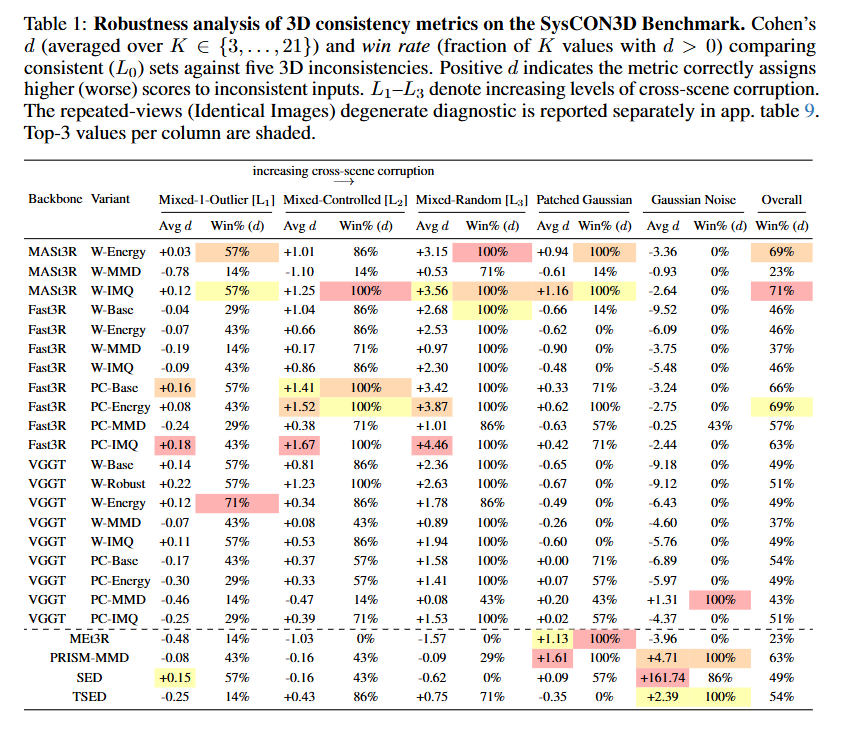
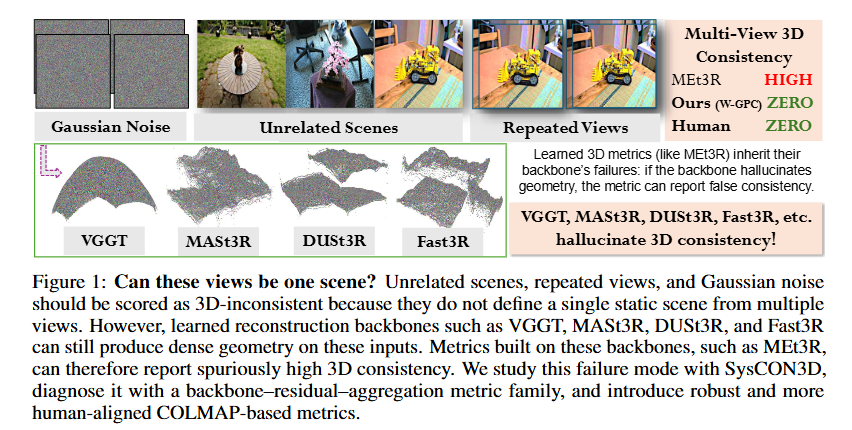
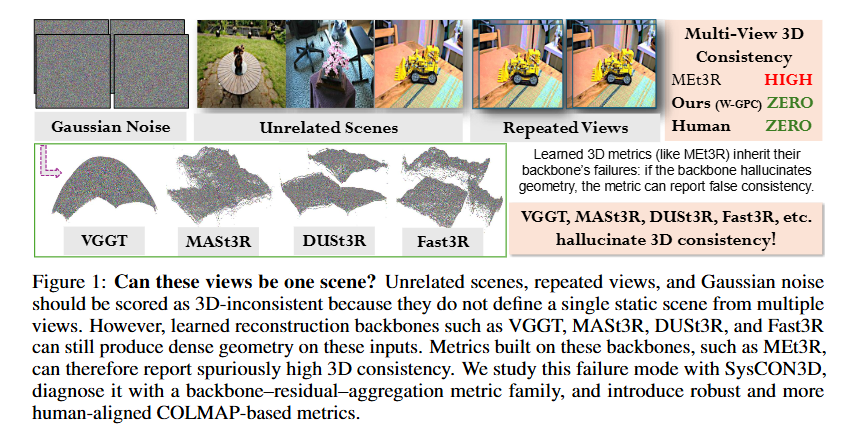
Paul and Kaushik et al., "Can These Views Be One Scene? Evaluating Multiview 3D Consistency when 3D Foundation Models Hallucinate"
Automated 3D consistency metrics based on "modern" models do NOT align with human evaluation, but COLMAP-based ones do. You can never escape COLMAP
Can These Views Be One Scene? Evaluating Multiview 3D Consistency when 3D Foundation Models Hallucinate
Soumava Paul, Prakhar Kaushik, @YuilleAlan
tl;dr: in title
https://t.co/UQIp1DfBSf
Nice paper from @__mvp18__ and @toshi2k2: feedforward 3D models (VGGT/MASt3R, etc.) confidently reconstruct 3D scenes from anywhere (multiple Gaussian noise and unrelated scenes). So any derived metrics will inherit the hallucinations. Colmap validation is better but has its own failure and the recommendation is to report it alongside a neural-derived metric.
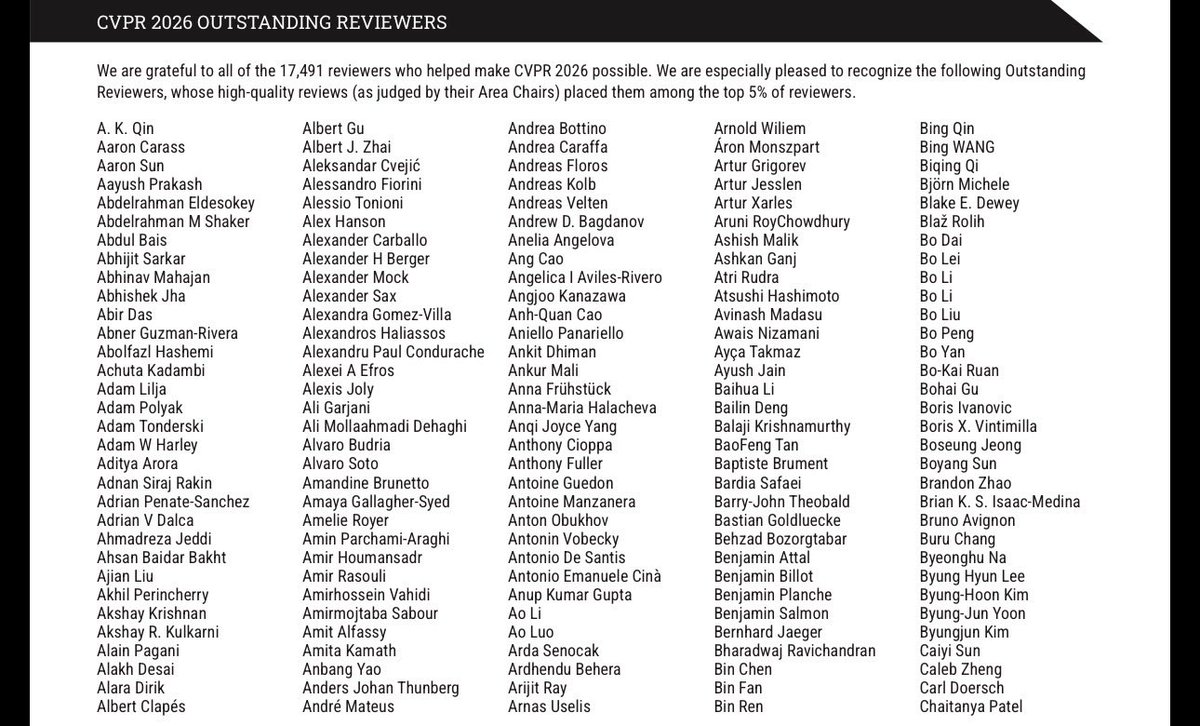
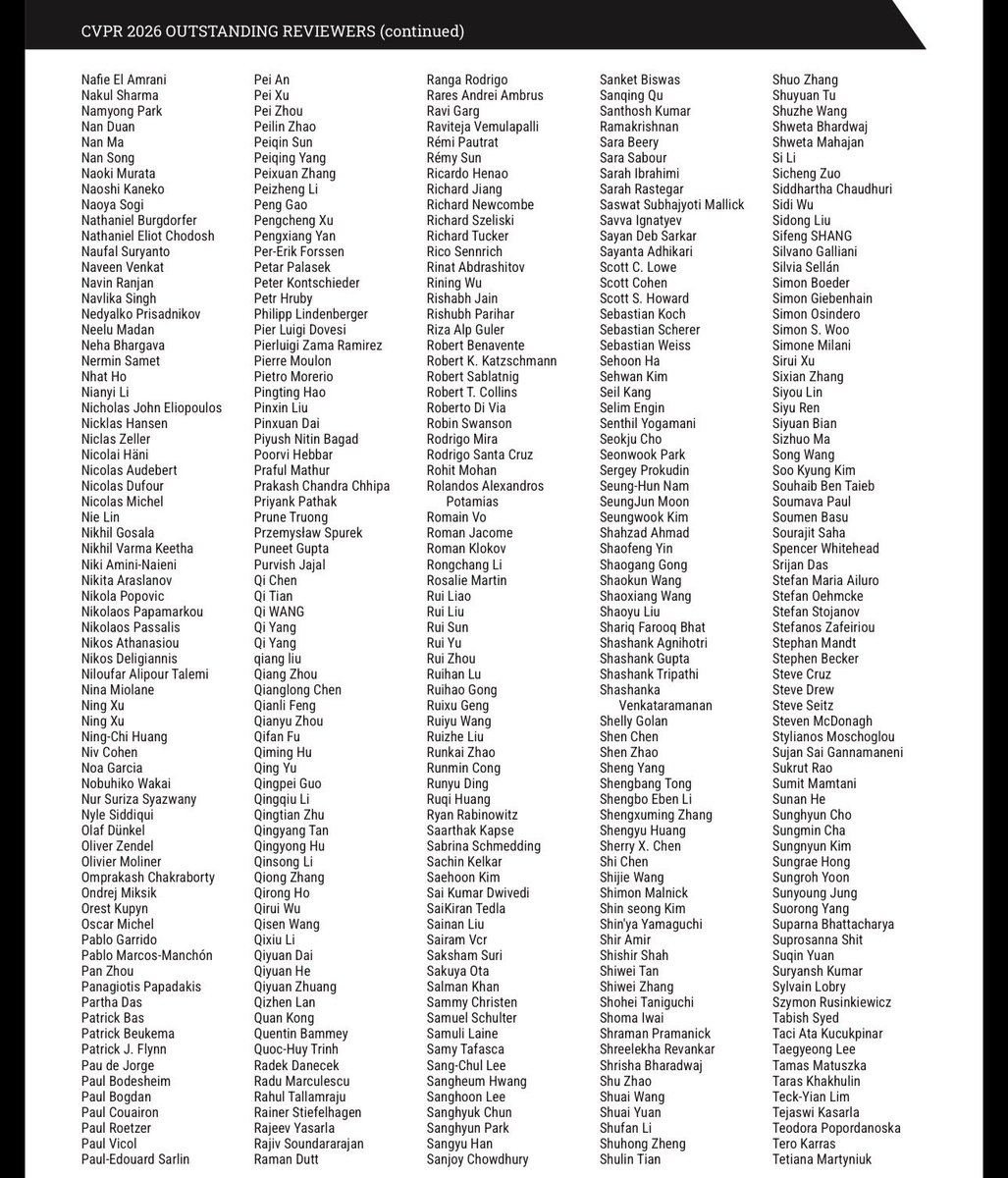
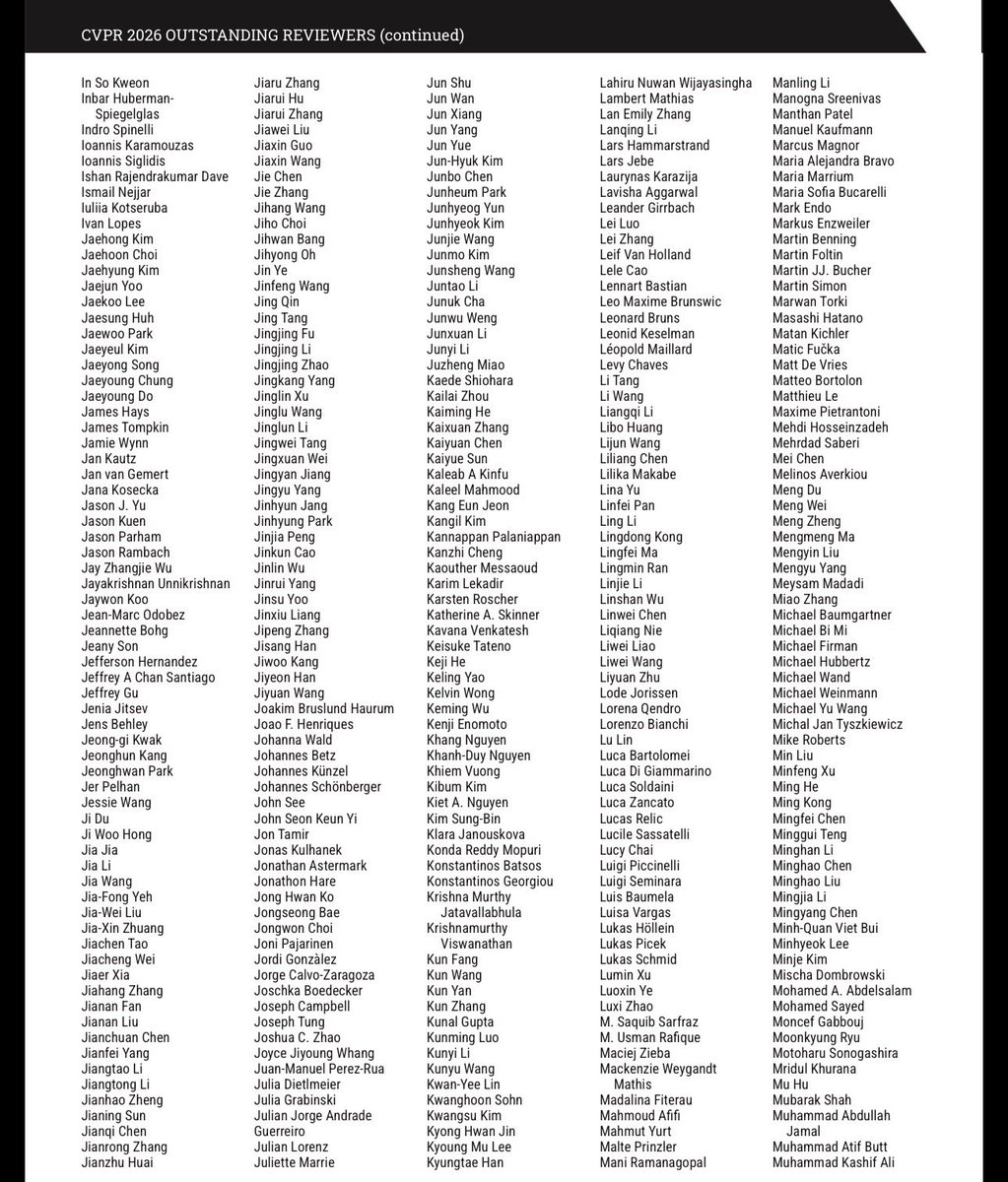
We are grateful to all of the 17,491 reviewers who helped make #CVPR2026 possible. We are especially pleased to recognize the following Outstanding Reviewers, whose high-quality reviews (as judged by their Area Chairs) placed them among the top 5% of reviewers.
wrote a guide on getting compute grants as a student, something I wish I did more at the beginning of my PhD. It's honestly one of the highest ROI things you can do as a student (we've gotten 100k+ gpu hrs for roughly 2 weeks of work writing).
https://t.co/U15nwau88a
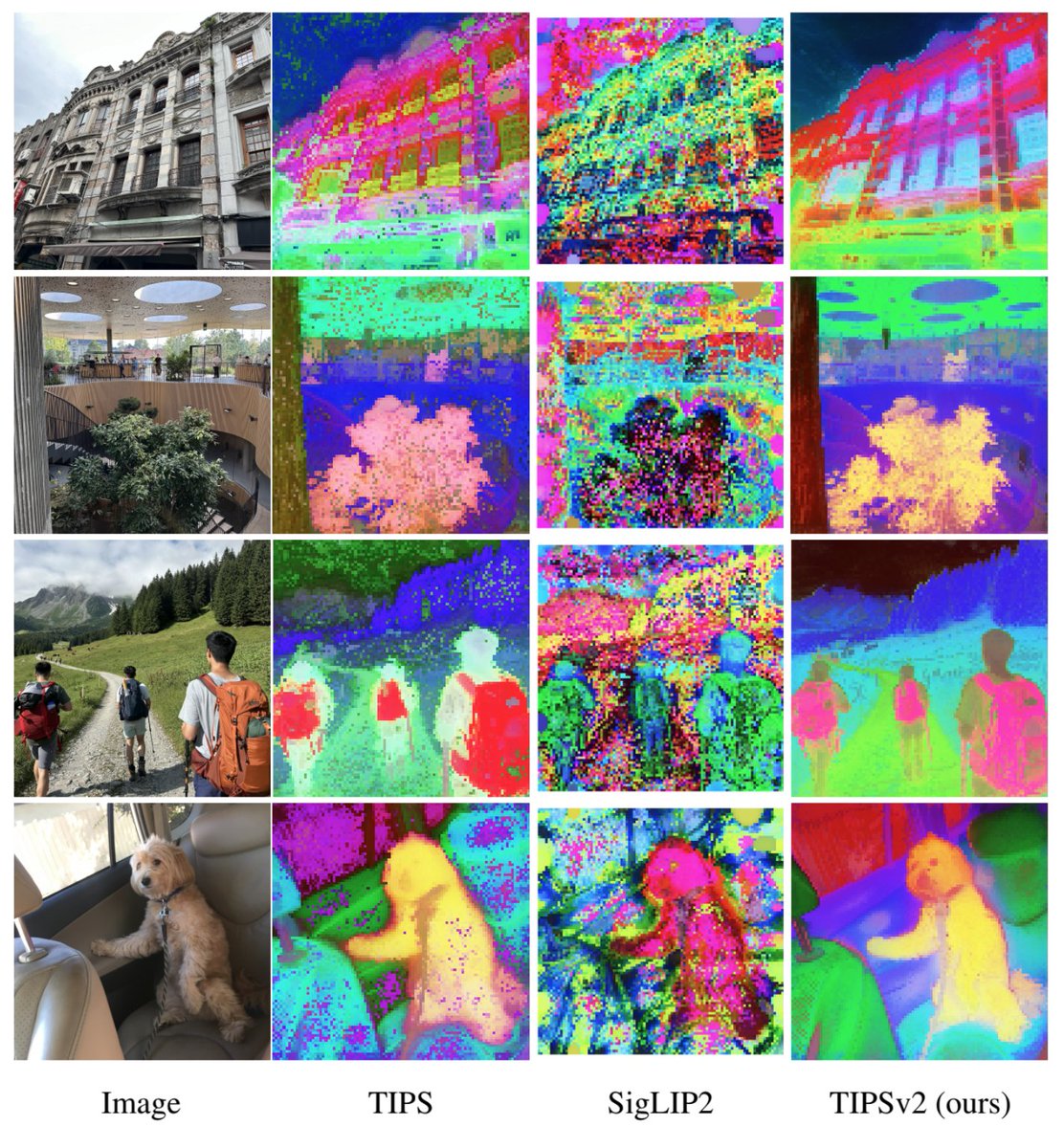
True multimodal AI needs to understand the world spatially 🎯
🚀 Excited to release #CVPR2026 TIPSv2 from @GoogleDeepMind, a foundational image-text encoder with spatial awareness, leading to strong overall results and massive gains on patch-text alignment. 🔥
1/N
1/ 🔥 New paper: Differentiable Vector Quantization (DiVeQ) 🔥
Vector quantization (VQ) is a key building block in modern AI. It links continuous data like images and audio to discrete representations (tokens) used by transformers.
The growing KV-cache of attention is the key component for the long-context understanding of LLMs, but what holds back long-term memory modules (e.g., Titans)? What if we could have the compression power of Titans but with a growing memory similar to Transformers?
Memory Caching: A class of architectures that compress the context into a slow growing memory (not as fast as Transformers, but not as static as RNNs), resulting in recurrent neural networks with non-fixed-sized memory (hidden states). Building on this formulation, we present Sparse Selective Caching, an architecture with growing effective memory (similar to attention) but with almost constant inference cost per token (similar to RNNs).
Judging by my tl there is a growing gap in understanding of AI capability.
The first issue I think is around recency and tier of use. I think a lot of people tried the free tier of ChatGPT somewhere last year and allowed it to inform their views on AI a little too much. This is a group of reactions laughing at various quirks of the models, hallucinations, etc. Yes I also saw the viral videos of OpenAI's Advanced Voice mode fumbling simple queries like "should I drive or walk to the carwash". The thing is that these free and old/deprecated models don't reflect the capability in the latest round of state of the art agentic models of this year, especially OpenAI Codex and Claude Code.
But that brings me to the second issue. Even if people paid $200/month to use the state of the art models, a lot of the capabilities are relatively "peaky" in highly technical areas. Typical queries around search, writing, advice, etc. are *not* the domain that has made the most noticeable and dramatic strides in capability. Partly, this is due to the technical details of reinforcement learning and its use of verifiable rewards. But partly, it's also because these use cases are not sufficiently prioritized by the companies in their hillclimbing because they don't lead to as much $$$ value. The goldmines are elsewhere, and the focus comes along.
So that brings me to the second group of people, who *both* 1) pay for and use the state of the art frontier agentic models (OpenAI Codex / Claude Code) and 2) do so professionally in technical domains like programming, math and research. This group of people is subject to the highest amount of "AI Psychosis" because the recent improvements in these domains as of this year have been nothing short of staggering. When you hand a computer terminal to one of these models, you can now watch them melt programming problems that you'd normally expect to take days/weeks of work. It's this second group of people that assigns a much greater gravity to the capabilities, their slope, and various cyber-related repercussions.
TLDR the people in these two groups are speaking past each other. It really is simultaneously the case that OpenAI's free and I think slightly orphaned (?) "Advanced Voice Mode" will fumble the dumbest questions in your Instagram's reels and *at the same time*, OpenAI's highest-tier and paid Codex model will go off for 1 hour to coherently restructure an entire code base, or find and exploit vulnerabilities in computer systems. This part really works and has made dramatic strides because 2 properties: 1) these domains offer explicit reward functions that are verifiable meaning they are easily amenable to reinforcement learning training (e.g. unit tests passed yes or no, in contrast to writing, which is much harder to explicitly judge), but also 2) they are a lot more valuable in b2b settings, meaning that the biggest fraction of the team is focused on improving them. So here we are.
LLM Knowledge Bases
Something I'm finding very useful recently: using LLMs to build personal knowledge bases for various topics of research interest. In this way, a large fraction of my recent token throughput is going less into manipulating code, and more into manipulating knowledge (stored as markdown and images). The latest LLMs are quite good at it. So:
Data ingest:
I index source documents (articles, papers, repos, datasets, images, etc.) into a raw/ directory, then I use an LLM to incrementally "compile" a wiki, which is just a collection of .md files in a directory structure. The wiki includes summaries of all the data in raw/, backlinks, and then it categorizes data into concepts, writes articles for them, and links them all. To convert web articles into .md files I like to use the Obsidian Web Clipper extension, and then I also use a hotkey to download all the related images to local so that my LLM can easily reference them.
IDE:
I use Obsidian as the IDE "frontend" where I can view the raw data, the the compiled wiki, and the derived visualizations. Important to note that the LLM writes and maintains all of the data of the wiki, I rarely touch it directly. I've played with a few Obsidian plugins to render and view data in other ways (e.g. Marp for slides).
Q&A:
Where things get interesting is that once your wiki is big enough (e.g. mine on some recent research is ~100 articles and ~400K words), you can ask your LLM agent all kinds of complex questions against the wiki, and it will go off, research the answers, etc. I thought I had to reach for fancy RAG, but the LLM has been pretty good about auto-maintaining index files and brief summaries of all the documents and it reads all the important related data fairly easily at this ~small scale.
Output:
Instead of getting answers in text/terminal, I like to have it render markdown files for me, or slide shows (Marp format), or matplotlib images, all of which I then view again in Obsidian. You can imagine many other visual output formats depending on the query. Often, I end up "filing" the outputs back into the wiki to enhance it for further queries. So my own explorations and queries always "add up" in the knowledge base.
Linting:
I've run some LLM "health checks" over the wiki to e.g. find inconsistent data, impute missing data (with web searchers), find interesting connections for new article candidates, etc., to incrementally clean up the wiki and enhance its overall data integrity. The LLMs are quite good at suggesting further questions to ask and look into.
Extra tools:
I find myself developing additional tools to process the data, e.g. I vibe coded a small and naive search engine over the wiki, which I both use directly (in a web ui), but more often I want to hand it off to an LLM via CLI as a tool for larger queries.
Further explorations:
As the repo grows, the natural desire is to also think about synthetic data generation + finetuning to have your LLM "know" the data in its weights instead of just context windows.
TLDR: raw data from a given number of sources is collected, then compiled by an LLM into a .md wiki, then operated on by various CLIs by the LLM to do Q&A and to incrementally enhance the wiki, and all of it viewable in Obsidian. You rarely ever write or edit the wiki manually, it's the domain of the LLM. I think there is room here for an incredible new product instead of a hacky collection of scripts.