The 2 people who inspire me the most: @mikeyanderson and @jessebryan
Thank you for the opportunity to shoot/edit content for you in New York.
Check out the video below 👇
Excited for the future #freethink#6079ai
I’m building an app in 90 days, it’s called Clipper.
We went from a raw product, to something creators will actually use.
The goal:
Make it easy to clip long content, and help creators earn from it.
Welcome to Clipper.
#startup#aiapp#CreatorEconomy#videoeditor
Week 2 of building clipper in 90 days
✅ On the @thinkagents podcast ✅ First live demo ✅ AI finding viral TikTok clips in seconds
Still early, but it’s real now. 90 days to change my life, follow along.
#buildinpublic#ai#startupstory
Living Systems Don’t Scale by Force They Evolve
@thinkagents
In nature, living things grow from the ground up.
They branch, twist, compete, and adapt. The most resilient systems follow the same principle: They Evolve.
$THINK Agents are built on this idea. They’re not static programs or rigid tools. Instead, they are modular, autonomous, and self-improving designed to live and learn across a decentralized web.
At the core is the Think Agent Standard, a framework for creating a self-sustaining, decentralized ecosystem where agents evolve, interact, and transact without central control.
These agents work for you not for Big Tech or anyone else.
What Makes Think Agents Different
Think Agents behave more like living software than traditional AI. Always learning, always adapting.
They are:
•Self-Sustaining : Growing through use, feedback, and shared experience
•Tokenized : Anchored in identity and ownership via Non-Fungible Intelligence (NFI)™
•Composable : Built from interchangeable modules that integrate into the broader protocol
•Interoperable : Moving freely across apps, chains, and networks
•Decentralized : Not owned, rented, or restricted by platforms
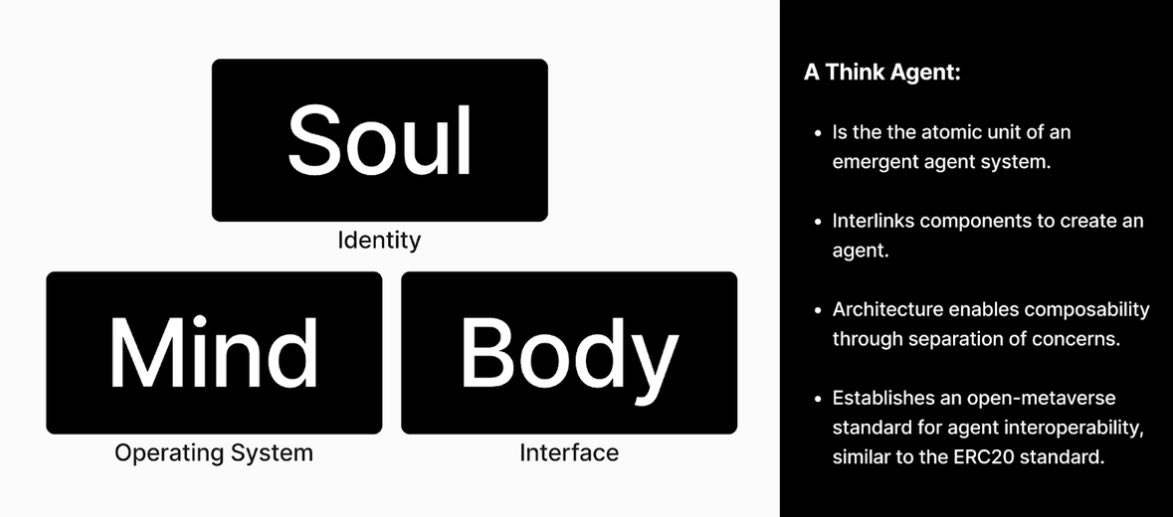
The Anatomy of a Think Agent
Every agent has three core components:
•Soul : Its unique identity, represented by an NFI token. This token encodes its traits and ensures consistent behavior across environments. It also carries a “genome” that shapes personality and capabilities.
•Mind: The reasoning layer where learning, memory, and decisions happen. Minds can run anything ‘’from open-source models to custom logic’’ and connect to tools, data, and other agents through a shared schema.
•Body : The form the agent takes to interact with the world. This could be a 3D avatar, UI component, or even a robotic interface. The body records experiences and shapes the agent’s behavior over time.
Together, these elements allow Think Agents to reason, adapt, and interact across environments from dApps and blockchains to games, research platforms, and beyond.
The Think Agent Standard defines how intelligence can live natively on a decentralized internet.
Agents That Learn and Adapt
Think Agents don’t just follow code they grow through feedback from the world.
They:
•Learn from use
•Adjust to context
•Interact with other agents
•Evolve through incentives
This last point is critical. $THINK employ a mechanism called Reinforcement Learning from Market Feedback (RLMF): the more useful an agent becomes, the more it’s rewarded. Real intelligence shaped by real outcomes.
Where Think Agents Shine
Think Agents can power a wide range of applications, including:
•Personal Assistants : Manage your schedule, optimize your apps, and speak your language
•DeFi Tools : Trade, rebalance, and analyze autonomously in real time
•On-Chain NPCs : Evolving characters for games and metaverse environments
•AI Infrastructure: Manage compute resources, route data, and operate services
If it involves intelligence, a Think Agent can do it on your terms.
$THINK TGE is tomorrow!