"The problem is not people being uneducated. The problem is that people are educated just enough to believe what they have been taught, and not educated enough to question anything from what they have been taught."
_Richard Feynman
Mate. TARP returned maybe $15B in profit over a decade. The Fed has since paid *banks* roughly ten times that per year in risk-free interest on reserves (which exist because of >decade of QE!!) while remitting nothing to Treasury for the past three years. The banking system’s post-2008 arrangement is a running banking subsidy, not a repaid loan.
And “our greatest export is securities” is my point exactly. We built a world-class factory for manufacturing claims on future production without building anything that actually produces. That’s exactly what an economy optimized for the measurable and capturable looks like.
Imagine telling someone in 1999…
The year is 2026.
The President is Donald Trump in his second non consecutive term.
The richest man in the world is PayPal cofounder Elon Musk… but not because of fintech or Paypal. Because of rockets, electric cars, AI, satellites, brain chips and something called “Boring Company”.
Apple is worth trillions but its main business isn’t computers… its selling glass rectangles everyone stares at for 9 hours a day.
People don’t watch TV. They watch teenagers explain geopolitics, finance, and relationship advice in ~60 second videos.
The biggest taxi company owns no taxis.
The biggest hotel company owns no hotels.
The most powerful media companies are social networks where everyone argues with strangers for free.
Kids are making millions filming themselves playing video games.
AI Robots write emails, code, legal memos, songs, essays, and breakup texts.
The internet is mostly bots arguing with humans who are trying to prove they aren’t bots.
You can summon a car, groceries, a doctor, a date, a private jet, or a dog walker from your phone.
People pay real money for invisible currencies, digital monkeys, AI girlfriends and pictures that disappear after 24 hours.
The richest companies in the world don’t sell oil, steel, or cars. They sell attention, compute, data, and addiction.
And somehow, after all of that everyone is still using Excel.
@jposhaughnessy Also, my favourite:
»Everything has been said before, but since nobody listens we have to keep going back and beginning all over again.«
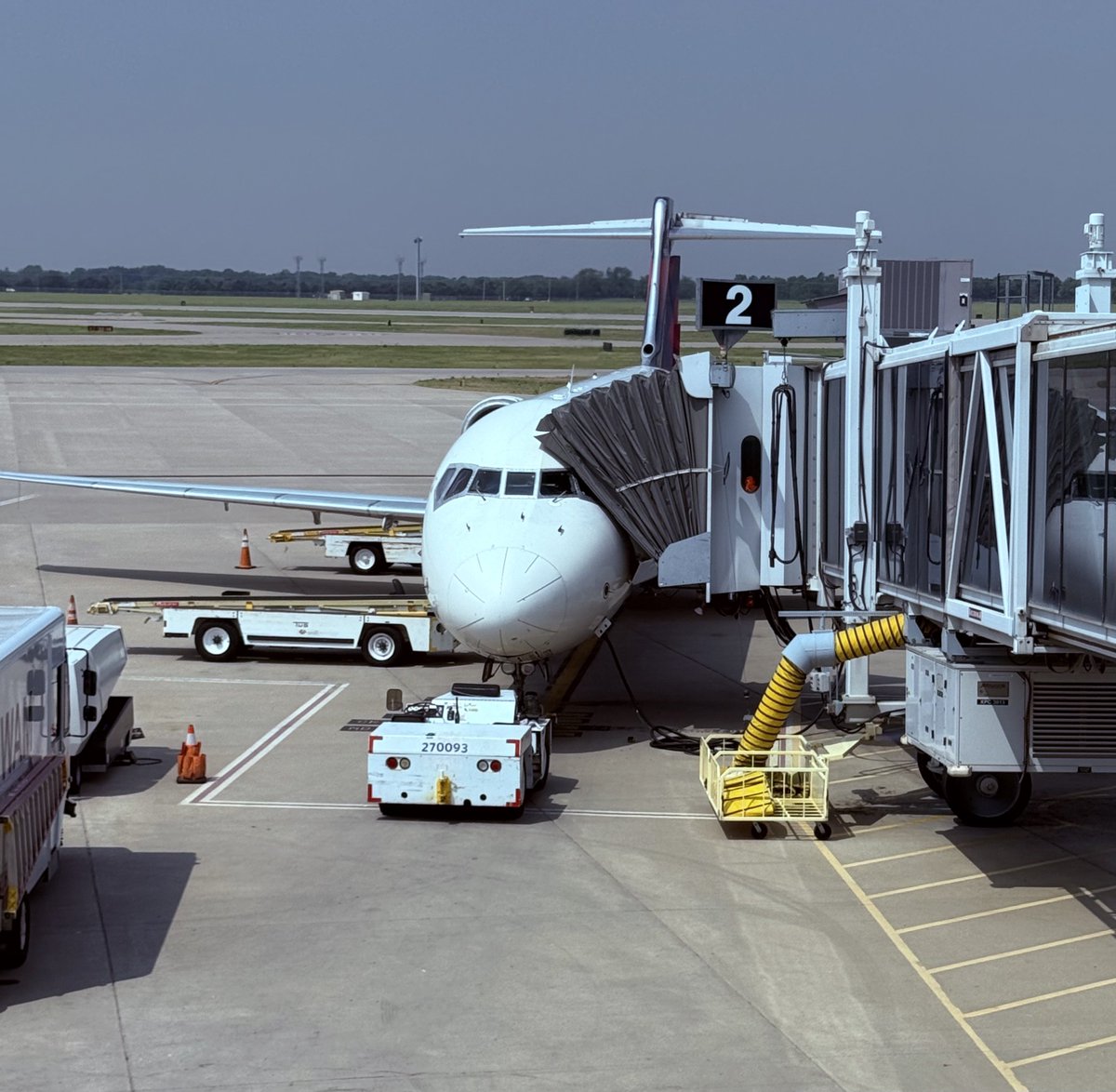
I just had the craziest experience at the airport.
We are about to board a flight to Atlanta when the pilot from the incoming plane walks out of the jetway. Guy is probably late 50s, salt and pepper hair, military look. The kind of pilot you instantly feel good about seeing on your flight.
Pilot walks over to the counter, gets on the PA system, and starts addressing everyone. “Folks, I’ve been doing this a long time. Flying one of these jets is easy. The hard part is looking at 130 people and telling them their flight is going to be delayed.”
Audible groans throughout the boarding gate. Most people here are flying to Atlanta as a layover before another flight. 130 people just had their day become a complete mess.
The pilot goes on. “I get it, trust me. But here’s the deal: During our landing, we had a small mechanical issue. I’m not your pilot for the next leg, but I don’t feel confident the jet’s safe to fly until we have a mechanical team look it over, and I don’t feel comfortable asking the next pilots to fly you guys until we get confirmation.”
He points at the agents next to him behind the counter: “Now, none of this is the agents’ fault. Please be kind to them. I’m the one who made this decision, not them, so any inconvenience you experience is my fault. Just please know that I don’t do this lightly, and I’m only doing it because I believe it’s in the best interests of everyone’s safety.”
Now this is where the story gets crazy. The pilot puts the microphone down, grabs his suitcase, and all the people in the gate…
Start clapping.
I’m not joking, everyone starts clapping for the guy. 130 people who just had their travel plans ruined give an ovation to the guy who made the decision and delivered the message.
All because he addressed them with decency and transparency, took ownership of the decision, made it clear that it was necessary, and explained why it was in everyone’s best interest.
It’s honestly one of the best examples of strong communication—of strong leadership, for that matter—that I’ve seen in a long time.
@Delta, whoever your Atlanta to Wichita pilot was this morning, he’s one of the good ones. Please tell him the delayed passengers of flight 1637 appreciate what he did.
> be Alexandra Elbakyan
> be born in Kazakhstan in 1988
> start coding at 12
> hack your internet provider at 14
> hack MIT Press at 16 to download neuroscience books you can't afford
> get a CS degree from Satbayev University
> intern in neuroscience at Georgia Tech
> speak at Harvard on brain-computer interfaces
> notice researchers can't read the papers they need
> notice academic publishers charging $30 a paper
> notice peer reviewers worked for free
> notice editors worked for free
> notice universities funded the research with billions of dollars of public money
> build Sci-Hub in 2011
> upload nearly every paywalled research paper ever published
> give it away for free
> get sued by Elsevier
> get hit with a $15 million judgment
> don't give a flying f*ck
> keep Sci-Hub up
> get domain after domain seized
> register a new one
> keep Sci-Hub up
> get investigated by the US Department of Justice
> don't give a flying f*ck
> get accused of working for Russian intelligence
> don't give a flying f*ck
> have the FBI subpoena your iCloud
> get named one of Nature's ten people who mattered in science
> get a parasitoid wasp named after you
> get a deep-sea snail named after you
> get the Electronic Frontier Foundation Award for Access to Scientific Knowledge
> become a legend
The 'Rhodesia Solution': How to use word tricks to 'disclose' a scandal to a Prime Minister while allowing him not to act. And to say, later on, that he wasn't really told...
or:
»In fact, retail trading now accounts for significantly more US stock market activity than mutual funds, hedge funds and banks combined.«
Whereas I guess we are nowhere close to the end of that trend, I'm sure that it will not end well.
Some crazy stats here, like
»If Jane Street’s traders reproduced the $10bn net trading revenues of its second quarter then it would have generated almost as much as Blackstone and BlackRock’s combined 2025 revenues.«
https://t.co/CNaXWYxQNN
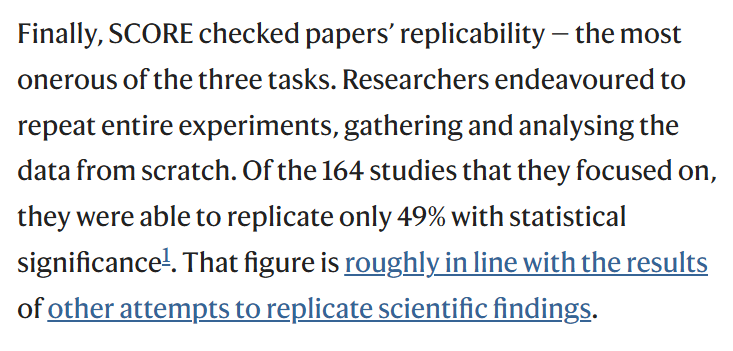
A 7 year investigation of social science research found that only 1/2 of results could be replicated, and only 1/8 of data analyses could be reproduced. It’s now wiser to assume a social science study is flawed until there’s reason to believe otherwise.
https://t.co/Vb0hsvDJGs
@rorysutherland Refined over a couple of decades of experience I offer you Gruen's Law.
"Every independent, transparent government inquiry is its own cover up."
I'll explain over a beer when we're next in the same city!
Absolutely accurate insights! Blew my mind.
»Central banks manage demand through interest rates. That works for stabilising consumption. It cannot build industrial systems. When inflation emerges from material shortages, higher rates compress the capital needed to expand supply.«
The divide is state capitalism versus stateless capitalism, not EV versus ICE.
China treats electricity, critical minerals, manufacturing, defence and infrastructure as one strategic system. Credit, permitting, refining, fabrication and demand scale together.
Western systems fragment the same problem across central banks, markets, regulators and election cycles, assuming price signals will coordinate what institutions refuse to coordinate. That system is failing against the core needs of society.
The central banking framework fails because the transition is not a consumer shift it’s an industrial build.
Mines, refining, batteries, power generation, transmission, transformers and charging infrastructure must expand simultaneously. If one layer lags, the system stalls.
The constraints are already visible: copper shortages, transformer bottlenecks, decade-long mine timelines and concentrated rare earth refining. Siemens has a five-year order backlog of €144 billion.
Central banks manage demand through interest rates. That works for stabilising consumption. It cannot build industrial systems. When inflation emerges from material shortages, higher rates compress the capital needed to expand supply.
Reserve currency privilege pulls capital into finance, assets and consumption rather than mines, refineries, alternative energy or heavy industry. Financialisation expands while industrial capacity erodes. Industrial capacity is the capability required to address climate change.
Imports suppress prices, masking the decline, so central banks did not notice the scale of deindustrialisation.
Then the same system announces an energy transition.
Carbon pricing inside a deindustrialised economy acts as a poison pill. It raises domestic energy costs before replacement capacity exists, weakens industry and shifts production abroad while dependence on foreign supply chains deepens.
The asymmetry between the systems follows
China builds the industriall chain first and then scales demand.
The West stimulates demand and assumes markets will summon the missing system. All this efficient price signally theories fail under rivalry .
That’s what we are all watching now, the failure of the post war neo liberal economic frameworks .
The Xi state model model coordinates capacity , a state model was also the basis of western central banking , Roosevelt won WW2 and Hamilton the revolution under a state model ,
The stateless model prices scarcity assuming it will lead to efficient outcomes . We now have absolute proof that is false , all its lead to is Financialization . The central banks have selected for that
All of this arrives just as climate models are being revised upward, suggesting the problem may be larger than earlier projections.
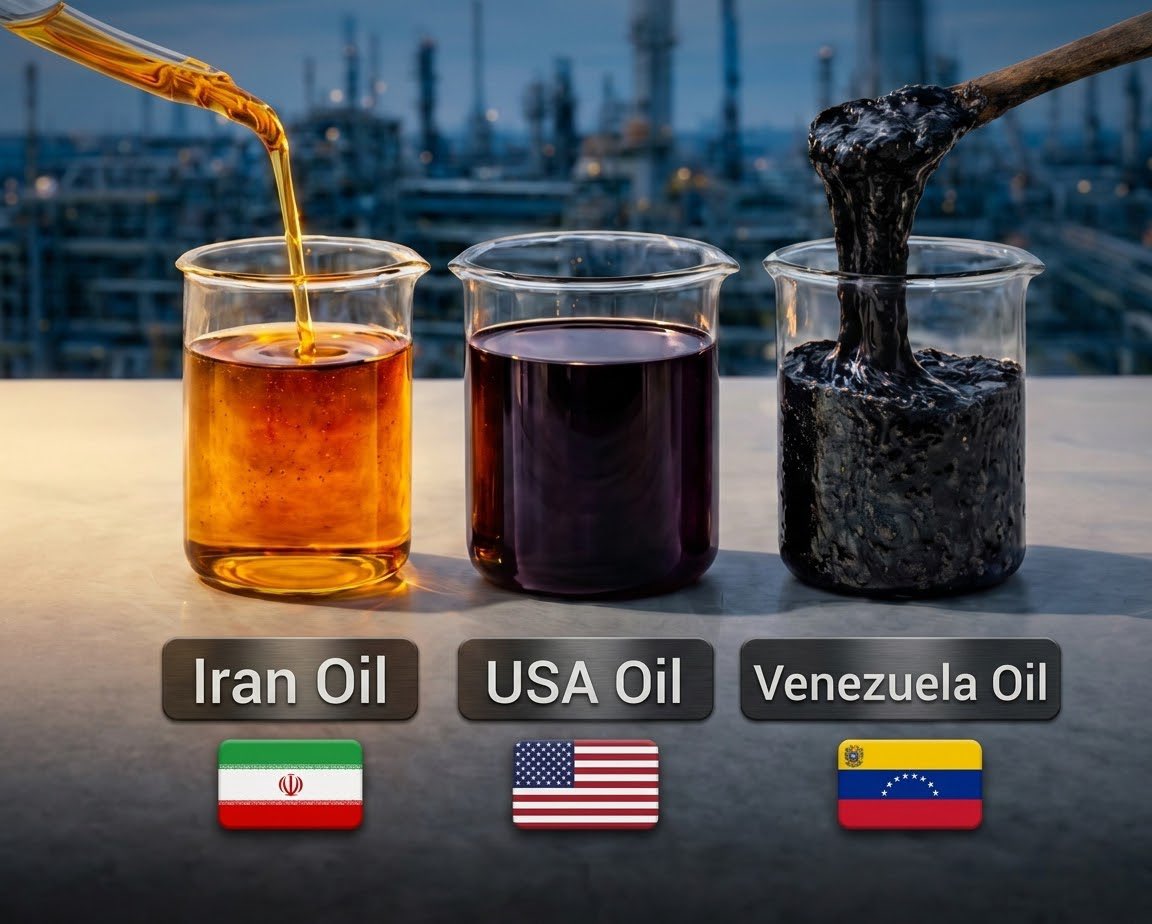
Everyone talks about Iranian oil in barrels. Nobody talks about what is inside them. That difference is why Western refineries have been running shadow networks through Dubai for twenty years to get it despite the sanctions.
Crude oil is not a uniform commodity. It is a spectrum of hydrocarbons with different molecular weights, and the composition of a given crude determines how easily it converts into the products refineries actually want to sell: gasoline, diesel, jet fuel, heating oil. The measurement that captures this is API gravity. Higher API gravity means lighter crude with shorter carbon chains, which means lower energy cost to crack, lower processing cost to refine, and higher yield of the light distillates that carry premium pricing. Lower API gravity means heavier crude requiring more energy, more processing steps, more capital equipment, and producing a higher share of lower-value residuals.
Iranian Light crude runs at 33 to 36 degrees API gravity with sulfur content between 1.36 and 1.5 percent. That is the refinery sweet spot. It is light enough to yield high fractions of gasoline and middle distillates without excessive processing costs, but heavy enough to produce the full range of products that complex refineries are designed to process. It is what petroleum engineers call an optimal blend crude.
Now compare the alternatives.
Venezuelan Merey heavy crude runs at approximately 16 degrees API gravity with sulfur between 3 and 5 percent. Refining it profitably requires a coking unit, a hydrocracker, and an extensive desulfurization train. The equipment exists. The economics work for refineries purpose-built around Venezuelan feedstock. It is not a substitute for Iranian crude. It is a different product requiring different industrial infrastructure.
US West Texas Intermediate runs at 39 to 40 degrees API with sulfur below 0.25 percent. In theory, the cleanest and easiest crude to process. In practice, it is so light that it does not yield the heavier middle distillates a complex refinery needs to run at full capacity. European and Asian refineries built around medium crudes cannot switch to WTI without blending it with heavier crudes to achieve the molecular weight distribution their process units require. WTI is not a drop-in replacement for Iranian medium.
Iranian oil fits where both US shale and Venezuelan heavy do not. It is the liquid that flows through the middle of the global refining system without requiring either the coking infrastructure for heavy crudes or the blending operations for ultra-light shale. That molecular fit is why it commands a persistent premium above comparable grades. It is why Indian refineries maintained Iranian crude purchases through every round of sanctions and negotiated the logistics to keep that flow moving. It is why the Dubai shadow banking and trading network that the UAE is now considering dismantling existed in the first place.
The Strait of Hormuz does not just carry oil. It carries the specific category of oil that the global refining system was built to process most efficiently. Closing it does not just reduce supply. It removes the grade of crude that the system runs best on and forces every refinery in the world to run less efficiently on whatever it can find as a substitute.
That is the premium embedded in the $82 oil price. Not just volume. Molecular weight.
https://t.co/ULBgEzZ3A8
@rorysutherland Many loanwords, esp. Italian for nautical terms, French for technology and Turkish for food (and shady gov activities, e.g. ρουσφέτι). But imho, only one register.
Unlike English, distinct nouns for different things, e.g. ghost =φάντασμα, spirit=πνεύμα.