1/ Come to the Bayesian nonparametrics workshop at #NeurIPS2018 on *Friday* in Room 517D! We have a great set of speakers, panelists, poster sessions, lunch+TensorFlow Probability tutorial!
Schedule: https://t.co/W4Sr3ubvgv
Accepted papers: https://t.co/x0SHKMbqKI
Highlights:
Bias laundering: when our biases no longer just live in our minds, but get baked into algorithms (e.g. via historically biased data), they become harder to acknowledge, and harder still to identify and fix.
@StatMLPapers TL;DR: There are two problems: The best Gaussian might still be a bad approximate posterior, and the recognition net might put the Gaussian in a bad place. It turns out the first problem isn't so bad, because the generator can adapt to it. Kudos to @_chriscremer and @lxuechen!
Estimate+predict Bayesianly. Use data efficiently; propagate error coherently; generate precise hypotheses.
Validate+falsify frequentist-ly (and frequently!). Run experiments that reject those hypotheses with high probability if they are wrong.
Learn both paradigms. Alternate.
I wrote a gentle INLA tutorial, if you've been wanting to learn the gist / get started with INLA, it might be a good place to begin. Happy holidays! #rstats#inla#bayes
https://t.co/4Gwuj8fG7R
Three challenges in our field
Hype -- Don't oversell. Talk about what you know.
Ethics -- Be aware of the potential for evil in applications of new tech. Do the right thing.
Science -- Empiricism is a valid way to produce new knowledge. So is theory. Hacks & obfuscation aren't.
Here’s the thing,
Sane person from Atlanta.
I know you don’t like Kasim.
It makes sense.
Duh.
But don’t let that make you so basic.
That you vote for @marynorwood.
Tomorrow:
Vote for @KeishaBottoms.
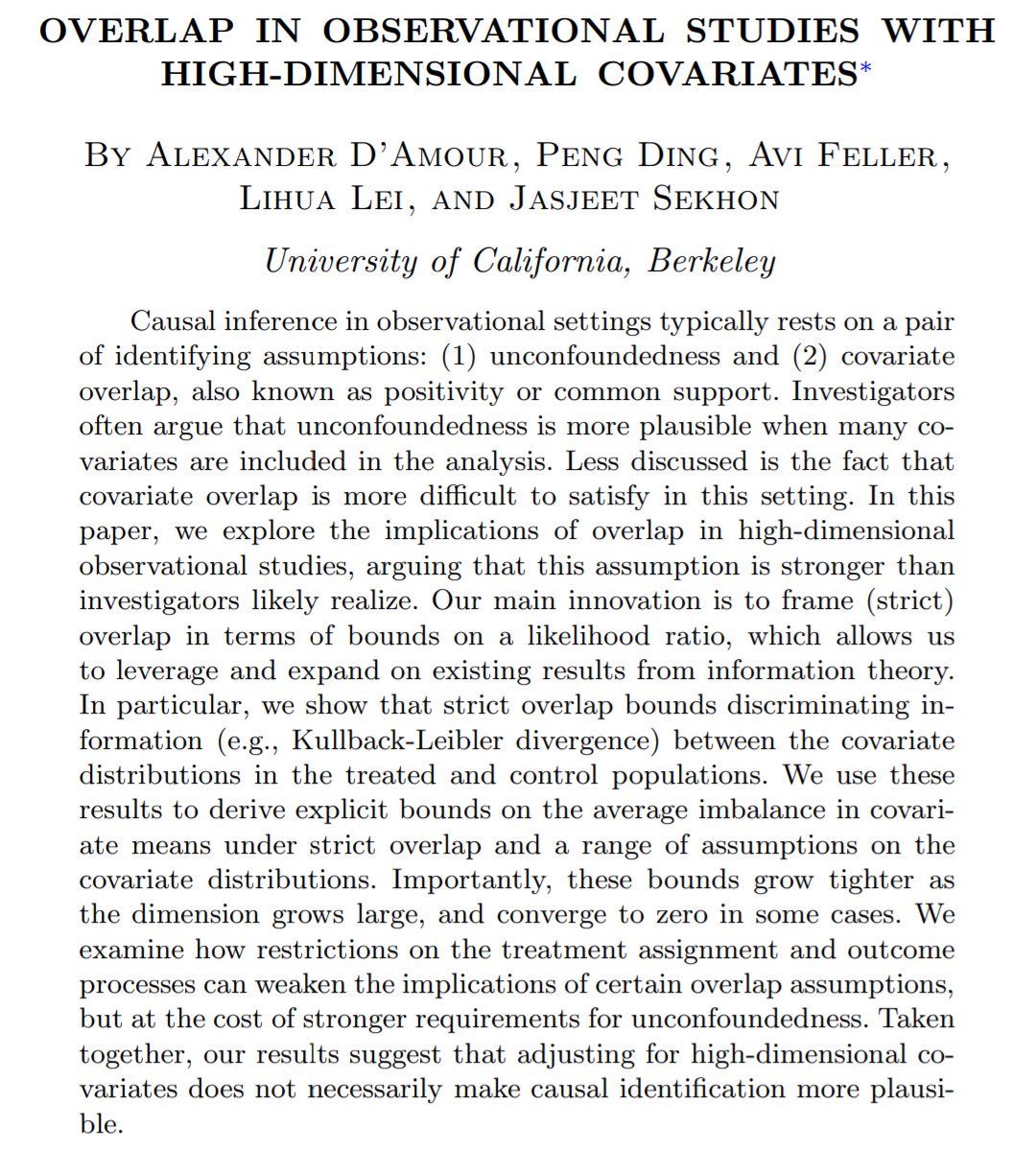
For folks who don't like clicking thru, here's the abstract. Overlap in Observational Studies with High-Dimensional Covariates.
https://t.co/dcA2py6roi.
When I tell my computer science colleagues that there are so many fairness definitions, they are often surprised and/or confused. [Thread] https://t.co/K8yY5c5KZS