Tutorial recordings are live! 🎬
Check out all sessions from our Language Generation tutorial at #COLT2025 on the website.
Thanks @_cpeale for the recording + editing magic!
Slides 🪧 from our language generation tutorial are now up!
Check them out at https://t.co/d3Id1HVbfT
Recorded sessions coming – meanwhile check out Jon's invited talk at ICML – https://t.co/1jPs8L3vQy !
If you are attending #EC2025 this week, today you can see @eminberker present our work on social choice functions that are robust against strategic nomination of candidates!
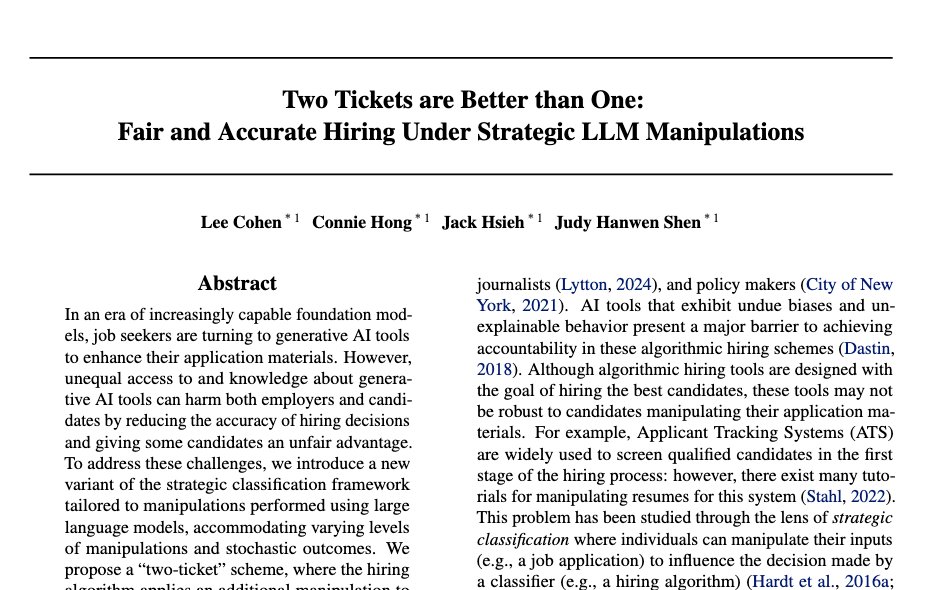
Job seekers are using LLMs to boost their resumes. Are companies interviewing the best candidates ... or just the candidates using the best LLM? 🧐
Our new ICML paper presents a fair and accurate hiring algorithm under stochastic manipulations:
📄 https://t.co/HXNKVuex2x
🧵 1/5
Come join us tomorrow at #COLT2025! 📍 Our tutorial on Language Generation covers the recently proposed "generation in the limit" framework of Kleinberg and Mullainathan and the exciting space of recent work building on it.
⏰ 9:30am - 12:00pm, Room C
🔗 https://t.co/OzpQ8Fv6Nf
Interested in formal approaches to language generation? Join our #COLT2025 tutorial on "generation in the limit" (Kleinberg & Mullainathan, 2024) — a theoretical framework for analyzing the capabilities and limitations of generative models.
🔗 https://t.co/viU44Lkeat
We are organizing tutorial on Language Generation at #COLT 2025!
Visit our website (link below) for references and materials; content is updated regularly, so check back for the latest.
Organizers: Moses Charikar, Me, Chirag Pabbaraju, @_cpeale, @gvelegkas
See you in Lyon!
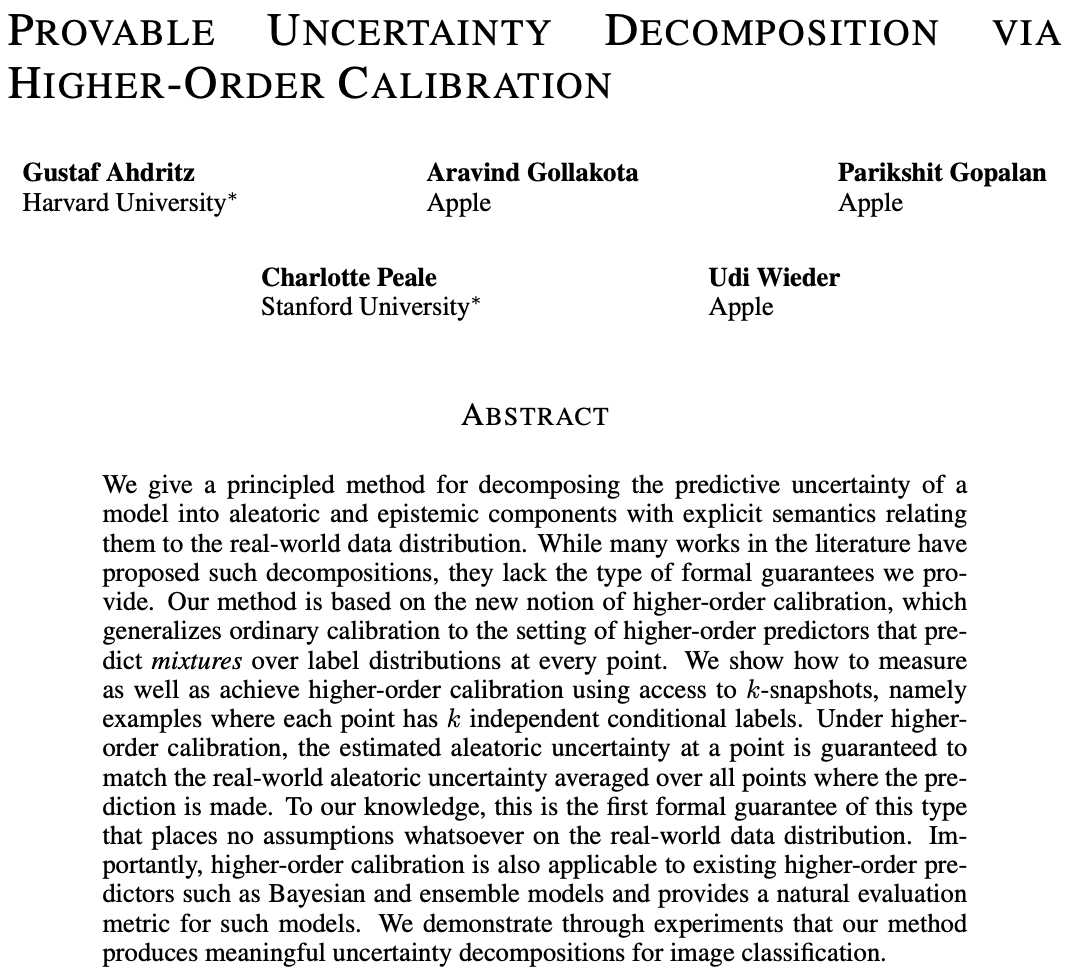
Excited to be presenting our spotlight paper on provable decompositions of predictive uncertainty today at #iclr2025! Come visit poster #501 from 3-5:30pm in Hall 3 + Hall 2B to learn more.
Why is your model uncertain? Is it just the model, or is the data ambigious?
In our ICLR 2025 spotlight w/ Aravind Gollakota, Parikshit Gopalan, Charlotte Peale, & Udi Wieder @Apple, we introduce a method for uncertainty decomposition with provable guaranteees!
A thread (1/n):