The financial world has drifted from the people it should serve
Layers of complexity, hidden fees, and institutions sit between us and our own money
It’s the system we inherited - and for a long time, we had no choice
Now we finally have the tools to build something different
An update on the Gnosis Pay incident. As of now, the issue is fully contained.
We expect to begin enabling operations in batches on Wednesday evening (GMT+2), with the goal of restoring normal card usage progressively after that. 🧵
Hackathons in the age of AI are incredibly fun. I just submitted my own project to the Circles Garage, alongside many others. If you’ve got an idea, build a mini-app for Circles or the Gnosis App and give it a shot!
Ethereum has entered its Gandhi era: Be the chain you want to see in the world.
Vitalik and I will walk through the zoo of networks we expect to see in the EEZ.
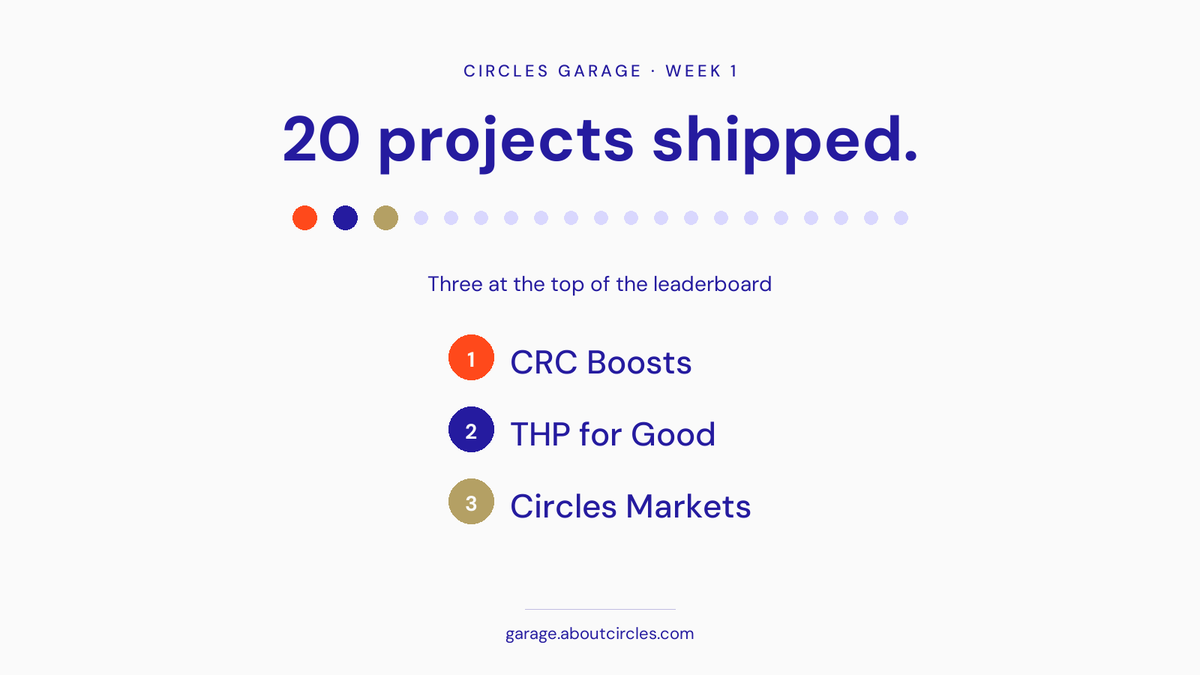
Week one of Circles Garage. 20 projects shipped on Circles in seven days. Here are the three at the top of the leaderboard.
🥇 CRC Boosts
🥈 THP for Good
🥉 Circles Markets
What each one does, in the thread.
Six weeks ⏱️
Six weekly prizes💰
One grand trophy and eternal glory 🏆
Circles Garage invites anyone who wants to build something useful on top of community money. Marketplaces, voting tools, mutual-aid apps, loyalty programmes, whatever the protocol gives you the right primitive for. You name it.
#CirclesGarage is open 🛠️ Go and build your own Future of Money: https://t.co/jk2nbSIlMx 💪
Let's kick-off Give & Earn Season with Gnosis App!
Invite a friend. You both get €10.
That's the floor. Up to €40 per friend at the top tier.
Live NOW, open until June 30th⏱️.
Learn more: https://t.co/tpVTVZhCPR
In 1932, a small Austrian town called Wörgl had 30% unemployment and a mayor who decided to print his own currency. Each note lost a little value every month if you held onto it, which sounds like an absurd thing to design until you notice what happened: people stopped holding it. They spent it. Within a year unemployment had fallen by a quarter and the bridges were getting built again.
The Austrian central bank shut the experiment down. It's a story worth keeping, partly because the experiment worked, and partly because of who decided that it shouldn't.
From @_paulboes_ at ETH Prague, on the question we hear most often: who is Circles for?
Worth keeping. Each of the four properties describes a community that's already minting its own currency, in one form or another. The protocol is what gives that practice a place to settle.
Our own @_paulboes_ at @EthPrague, on turning a community into an economy.
Four small portraits, four use cases:
⭕️ Tenants' union in Berlin.
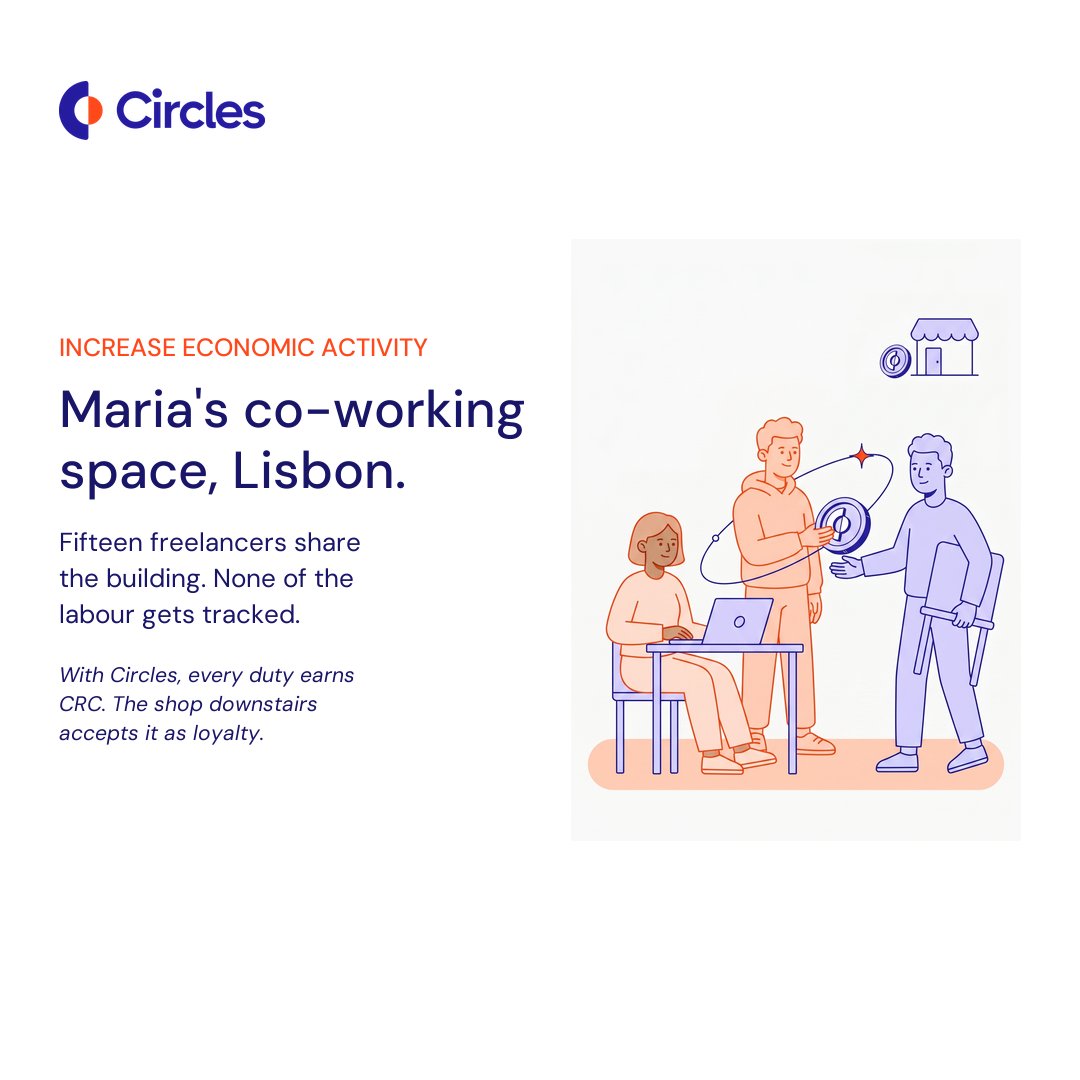
⭕️ Co-working space in Lisbon.
⭕️ Telegram furniture group.
⭕️ Town watching its economic life leak out to Amazon.
From privacy breakthroughs to AI agents and institutional rails, the Ethereum ecosystem keeps shipping.
Here are 22 things the ecosystem delivered over the past few weeks.
0/ @gnosis_ and partners introduced The Ethereum Economic Zone (@etheconomiczone), a framework to unify the L1 and L2s into a more composable system with better interoperability.
1/ @aztecnetwork Alpha went live, a feature-complete privacy stack built natively on Ethereum.
2/ @aave V4 was released with a new hub-and-spoke architecture with support for over 20 assets across three initial liquidity hubs.
3/ @PrivacyEthereum released Social Recovery SDK, a wallet recovery model where trusted guardians can help restore access if the owner loses their private key, replacing seed-phrase backups with programmable onchain policy.
4/ Post-quantum wallets launched on @Starknet. A path to quantum resistance without address changes or hard forks.
5/ The @ethereumfndn's Board released the EF Mandate. This document, which was first intended for EF members, reaffirms the promise of Ethereum, and the role of EF within this ecosystem.
6/ Private transfers are live on @Scroll_ZKP. You can now send funds privately onchain, advancing default user protections and confidentiality.
7/ @base introduced Batches Cohort 003. 12 teams were selected from 1,100+ building across AI, DeFi, payments, and prediction markets, pushing forward OnchainApps.
8/ @ethereumfndn launched pq.ethereum (dot) org. Supporting coordination and research in post-quantum cryptography. Two breakthrough papers progressing research on PQ, with input from Ethereum researchers, were also released.
9/ Stablecoins on Ethereum hit a new ATH. Supply surpasses $180B, up 150% in 3 years, with ~60% market share globally, reinforcing Ethereum’s role in stablecoins and DeFi.
10/ @Morpho launched Morpho Agents (beta), allowing users to integrate lending into apps via natural language using AI agents and accelerating the convergence of DeFi and AI.
11/ @thedaofund deployed $1M+ via an Ethereum Security quadratic funding round hosted by @Giveth, funding work to strengthen security across the ecosystem.
12/ Deposit time from L1 to L2s and exchanges can now be as low as 13 seconds due to the new Fast Confirmation Rule (FCR). This new industry standard can be adopted by the ecosystem over the next few months.
13/ @hinkal_protocol launched Hinkal Pay, end-to-end confidential payments where sender, receiver, and amounts remain private.
14/ @peerxyz launched Peer Verify, allowing users to prove their identity, in a privacy-preserving way via ZK proofs.
15/ @ensdomains integrated with PayPal, allowing users to send funds cross-border using ENS names instead of addresses.
16/ @AskVenice shipped verifiable end-to-end encrypted AI, introducing privacy systems that can be externally audited and proven.
17/ @safe released Safenet (beta), a pre-execution security layer for Safe wallets that runs before transactions execute onchain.
18/ @SiloFinance launched Silo V3 for safer lending markets in DeFi. The team rebuilt core assumption behind lending so collateral does not need to be sold to keep markets solvent.
19/ @coinbase announced x402, an initiative to establish the x402 protocol as a universal standard for AI-driven payments, is moving under the Linux Foundation to ensure vendor-neutral, community-governed oversight of the protocol.
20/ @zksync introduced The Cari Network, a new platform to bring tokenized deposits onchain, developed alongside five regional banks and powered by ZKsync’s Prividium.
21/ @EthCC completed their 9th annual event in Cannes with attendees from across the industry. @ETHGlobal hit a milestone with their 300th event following ETHCC, continuing to support builders across the global ecosystem.
LIVE NOW - Will The Ethereum Economic Zone (EEZ) Rebuild $ETH Dominance?
@koeppelmann and @tw_tter from @gnosis_ explain how real-time proving and the Ethereum Economic Zone (@etheconomiczone) could:
- reconnect fragmented rollups,
- unify liquidity,
- and give specialized chains seamless access to @ethereum's settlement and security.
Enjoy the episode.
--------------
TIMESTAMPS
0:00 Intro
0:18 Fixing Fragmentation
7:49 Ethereum Economic Zone Explained
26:19 EEZ Thin Layer
30:30 Block Builders
33:06 The Bull Case
35:18 Ethereum Reorg
42:56 Layer2 EEZ Adoption
50:47 A New Age for Builders
55:54 How to Get Involved
57:42 EEZ Rollout
1:00:51 Closing & Disclaimers
Imagine interacting with any rollup and with Ethereum itself as though it was all one chain.
What would become possible?
Thank you @Bankless for hosting this convo. 🎙️
🕰️ Every universe has a big bang. For the Circles economy, it happened on Oct 15, 2020, 00:00:00 UTC. Today marks day 2,000 since then.
That instant is “time zero,” the heartbeat of our V2 contracts.
Why does this exact timestamp matter? 🧵👇
That’s a wrap on #ETHCC! 🇫🇷 The numbers speak for themselves: a ton of items sold, powered by $CRC for smooth, seamless onsite purchases.
One standout takeaway: ETHCC attendees love to gamble. Huge thanks to everyone who jumped into our game and brought the energy.
Not sure I have ever been as productive in my life as in the last ~10 weeks:
An extremely challenging yet worthwhile goal.
The crazy progress of AI coding and heavy use of it.
A very small team, world-class skills, and now the ability to multiply output thanks to AI.
The result is @etheconomiczone — with a live devnet already: https://t.co/QdcOZEycLu.
What is this? It will be:
a) A new rollup that is fully composable with Ethereum.
This means you can do either cheap transactions on this chain that only interact with contracts on this rollup, or more expensive transactions (similar to L1 costs) that can interact in a fully composable way between L1 and L2. So, for example, if you trade on this rollup, the routing can dynamically decide to use only L2 liquidity for a small trade, or for a larger trade — where the extra gas costs are worth it — to use both L2 and L1 liquidity.
b) A whole framework that will allow new rollups, as well as existing L2s and sidechains (yes @gnosischain!!) to integrate into this “(Ethereum) economic zone.”
Imagine: one could make a trade today simultaneously using Ethereum liquidity, but also Arbitrum, Base, or all the other L2s. This is what EEZ will allow.
Now, let’s talk about the tech:
Essentially, there are two core concepts that make all of this possible:
1) Proxy contracts
2) Real-time proving
1) Proxy contracts are basically a way to overcome the challenge that ~99% of all contracts are written in a way that only deals with addresses from a single chain. For example, a token or an NFT can be sent to an address, but not to an address on a specific other chain. Proxy contracts fix this.
An address “A” on chain “n” will get a deterministic proxy representation, “A*”, on all other chains. So now, if, for example, A is a DAO on Ethereum and it should control, say, a fee switch in contract D (a DEX) on another chain, this can easily be done by setting A* as the owner of D. A (the DAO), on the other hand, can now call D* (the proxy representation of the DEX contract D) on Ethereum. All the cross-chain message passing in between is abstracted away — the contracts just call another contract and do not realize it is actually on another chain.
2) Real-time proving
The proxy design already addresses the problem that there is no widely supported cross-chain message-passing standard in EVM land. So it alone would already be helpful for asynchronous calls, or better, calls that do not expect or require a return value. However, this would still not quite bring us to “synchronous composability.”
Imagine a DEX trade: you do the first part of the trade on L1 and the second part on L2. You want to know the result of the second part — and if it did not get you the expected amount, you want to be able to revert the first part. This requires the call that triggers the DEX trade on L2 to have a return value.
This was long assumed to be impossible - but with real-time proving, it no longer is. Basically, because Ethereum blocks are only produced every 12 seconds (and this would still work with, say, 6 seconds), that is now long enough to build and prove the L2 block that contains, for example, this L1→L2 DEX trade.
If you want to learn more, don’t miss the talk by @tw_tter and @jbaylina on Tuesday at @EthCC!
Let’s make Ethereum ONE again!
Welcome to the Ethereum Economic Zone (EEZ), a framework for synchronously composable rollups.
What does that mean?
One deployment. Shared liquidity. Single transactions across L1 & L2. Identity verified anywhere. Smart wallets connected everywhere. No additional trust assumptions.
This means L2s that are as credibly neutral, economically aligned, and publicly governed as the base layer itself.
EEZ furthers Ethereum as the leading decentralized economy.