Elon Musk explains his 5-step algorithm for solving any problem:
"The most common mistake of smart engineers is to optimize a thing that should not exist."
"I have this very basic first principles algorithm that I run as a mantra."
Elon breaks it down:
Step 1: Question the requirements.
"Make the requirements less dumb. The requirements are always dumb to some degree, no matter how smart the person who gave you those requirements. You have to start there, because otherwise you could get the perfect answer to the wrong question."
Step 2: Try to delete it.
"Try to delete the part or the process step entirely. If you're not forced to put back at least 10% of what you delete, you're not deleting enough. Most people feel like they've succeeded if they haven't been forced to put things back in. But actually they haven't, they've been overly conservative and left things in that shouldn't be there."
Step 3: Optimize or simplify.
"The most common mistake of smart engineers is to optimize a thing that should not exist. So you don't optimize until after you've tried to delete."
Step 4: Speed it up.
"Any given thing can be done faster than you think. But you shouldn't speed things up until you've tried to delete it and optimize it otherwise, you're speeding up something that shouldn't exist."
Step 5: Automate.
"And then the fifth thing is to automate it."
Elon explains why the order matters:
"I've gone backwards so many times where I've automated something, sped it up, simplified it, and then deleted it. I got tired of doing that. So that's why I have this mantra."
A Chinese developer just explained the shift from Loop Engineering to Graph Engineering better than anyone.
most people are still building agents the way that's about to be obsolete.
> why single-agent loops break and go "goal blind"
> the 4 parts of a graph: nodes, edges, state, policy
> 3 topologies that run everything: diamond, supervisor, pipeline
> Anthropic's 5 official workflow patterns
the punchline: it's not how many agents you run. it's the determinism you build with verifiers, code fallbacks, and reality anchors.
I broke the same architecture down with Kimi K3. Full A-Z guide below.
this is insane. i genuinely don't understand why ambitious people aren't shown this lecture before their careers start consuming their entire lives.
clayton christensen spent his career studying why successful companies collapse. in his final class, he asked students to apply the theory to themselves: if you keep allocating your time the same way, what life are you actually building?
he had already seen the answer in his own harvard mba class. everyone looked successful at the fifth reunion; by the 10th, 15th, 20th, and 25th, many were unhappy, divorced, and living far from their children.
work shows you the score immediately. close a sale, ship a product, finish a presentation, earn a promotion, get paid.
an hour with your child may produce nothing you can measure today; it may take 20 years to understand what that hour built. so the next free hour goes back to work, one rational decision at a time.
this is how people build lives they never planned: through hundreds of right decisions that lead in the wrong direction, day after day.
money, titles, and headcount are easy to count. christensen believed a life should be measured by the people who became better because you were there.
he died in 2020.
one question remains: if someone saw only where your time, energy, and attention went this year, what would they think actually mattered to you?
the full 19-minute lecture is in the video below.
Google dropped a free 2 hour course on full graph engineering, taking you from a single prompt to a hundred agents wired into loops and graphs
17:44 – Building your first agent
39:30 – Loop engineering, iterate, check, break
1:12:38 – Graph engineering
1:34:26 – Agents that throttle themselves
1:55:05 – Full graph for multi agentic systems
Most people build a single agent and stop there. This course shows the full system, where agents wire themselves into a graph on their own
Watch it today, then check out the graph engineering playbook below for a deeper breakdown
Tony Robbins charges up to $1 million for a single speech. Decades ago, someone filmed him giving away the entire technique for free
This is skill arbitrage in its purest form - the gap between what you know and what someone else doesn't, sold directly
Robbins built an empire on exactly one gap: reading what makes a person say yes, and closing that gap in real time
By 1991, his company was already doing $50 million a year. Presidents, billionaires, hedge fund managers - Paul Tudor Jones among them - paid for private time with him
None of that came from a script. It came from a specific, teachable read: find what someone is already leaning toward, and anchor the offer to that feeling instead of fighting it
This footage catches him teaching the raw mechanics, not the stage show - no seminar lighting, no crowd, just the technique itself
That kind of footage doesn't usually survive.
Most of it stays inside $10,000-a-ticket seminars or rooms billed at six figures an hour
The skill was never secret. Access to watching it explained plainly was
Andrew Ng just released a 2-hour course on full Graph Engineering.
How to go from one prompt to 100 agents that loop, rewrite themselves, and run without you:
09:14 - Build your first AI agent
33:11 - Run agents with loop engineering
1:02:46 - Turn agent loops into graphs
1:30:15 - Build agents that rewrite themselves
1:49:05 - Run the full graph system without you
Most people are still building one agent and calling it done.
Andrew Ng is already teaching everything after:
Prompt → Agents → Loops → Graphs → Self-Improving Systems
Single agents are the old workflow.
Systems that improve and run without you are the new one.
This 2-hour watch is worth more than most $500 agent engineering courses.
Bookmark and watch it before everyone catches up.
Then read how to run 1,000 agents from one prompt below ↓
Anthropic engineer:
“90% of our engineers were using self‑improving loops. Now everyone shifted to building agentic Graphs"
“No more prompting.”
In just 10 minutes, she builds her entire Claude Code setup and workflow live from a blank terminal.
This is more valuable than most $1000 agentic courses.
Watch this video, Then save the article below if you want to become a graph architect before everyone else catches up.
Human prompting might die but bot prompting will be part of the loop. Getting bots to write good prompts like good code will accelerate things, make more efficient and save tokens
Google Brain founder, Andrew Ng:
"Prompting will die in 6 months.
Loops and Graphs are what's replacing it."
In 2 hours, he shows exactly what the best engineers already build instead, and how to start building it yourself.
The missing piece most people skip: how to connect those loops into a graph that compounds every time it runs.
Watch it, then read the full guide on loops and graphs below.
Google Brain founder, Andrew Ng:
"Prompting will die in 6 months.
Loops and Graphs are what's replacing it."
In 2 hours, he shows exactly what the best engineers already build instead, and how to start building it yourself.
The missing piece most people skip: how to connect those loops into a graph that compounds every time it runs.
Watch it, then read the full guide on loops and graphs below.
this is f*cking gold
How to build your first AI agent (Full guide)
if I had this a year ago, I would've shipped my first agent in a day instead of 2 weeks
in the right hands, this changes everything:
In 2008, Malcolm Gladwell explained why some people succeed and some don't in a single 1-hour talk.
This will permanently change the way you think about talent, effort, and success.
Bookmark & watch today, no matter what.
I never run out of content to post anymore.
Built an automation that monitors 50+ news sources, scores articles for relevance, and writes social posts automatically.
It finds trending topics in my niche before they explode everywhere else.
Saves me 15-20 hours monthly and keeps me ahead of every trend.
Comment "NEWS" and I'll DM it to you (must be following)
I started my X account 43 weeks ago. Easiest algorithm to crack by a country mile.
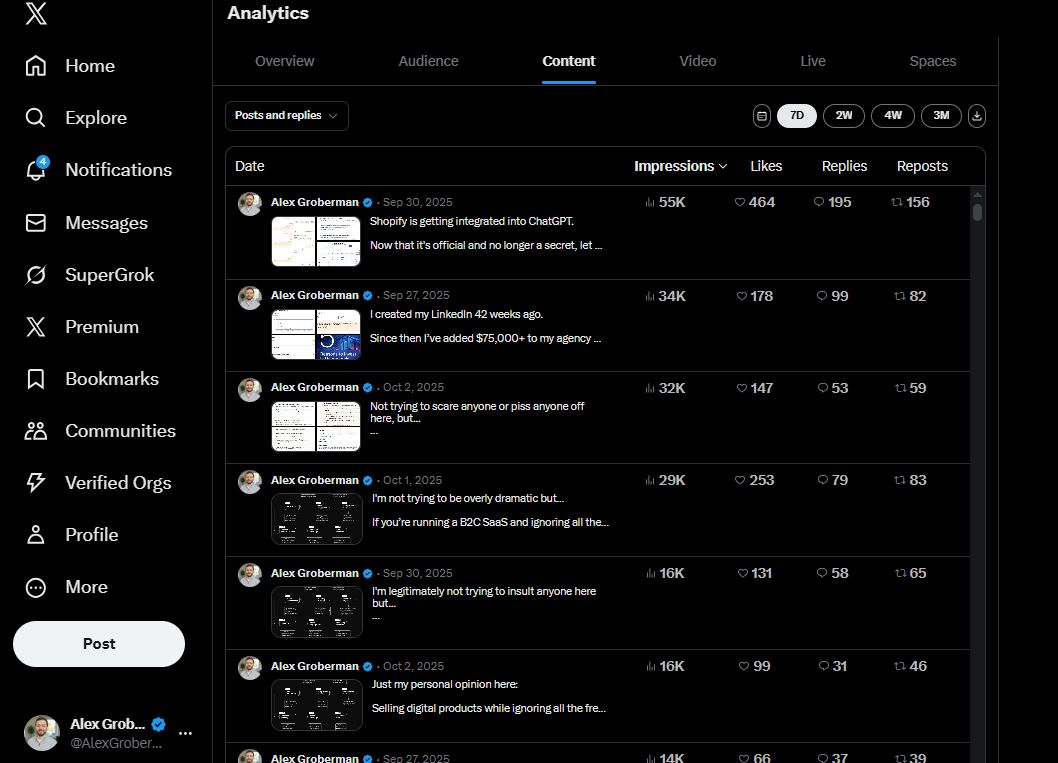
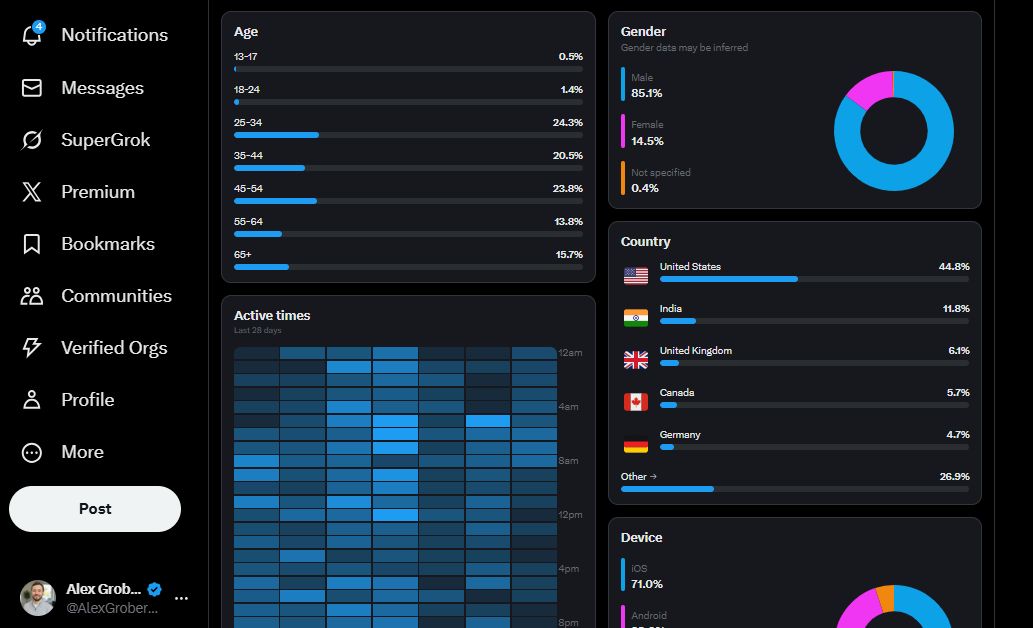
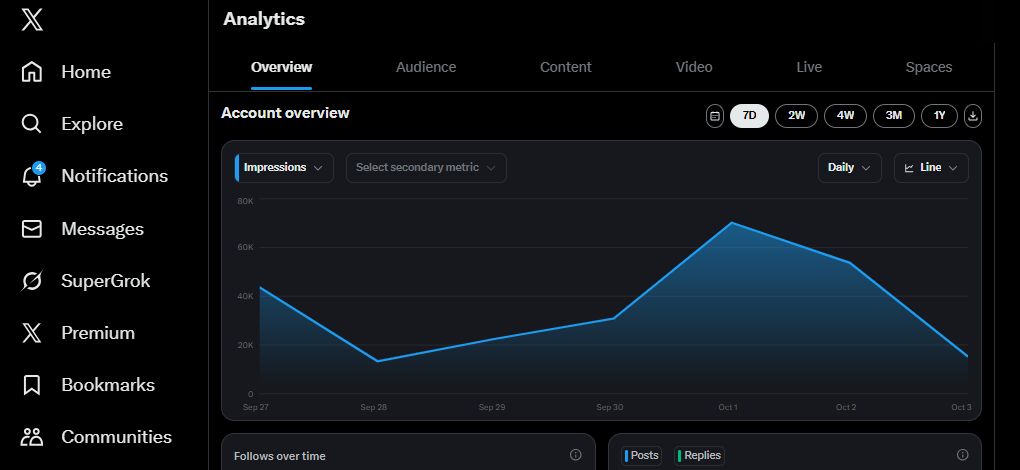
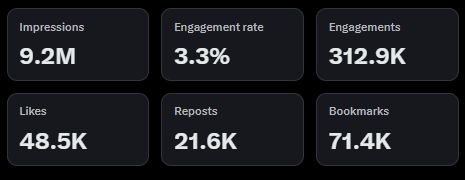
Since then I’ve collected almost $100,000 in direct revenue, logged 9.2M impressions & this month alone drove ~$12,000 to SEO Stuff.
Use my system before Elon closes the loopholes.
And if you want my full cheat sheet including engagement groups, DM workflows, and posting strategies:
Follow me
Repost this
Comment “X growth guide 2025”
You must do all 3 to get the DM.
Alright, let's start with the posting routine.
I post 2–3 times per day, 7 days per week.
Morning: Proof post or strong POV single tweet
Afternoon: Mini-thread (3–5 tweets with screenshots or frameworks)
Evening: Repost with CTA or a quick observation to spark replies
If I stop for even 48 hours, reach craters ASAP.
When I travel and can't post as frequently, I feel the pain quick.
What works best right now:
Compact threads (3–6 tweets)
Visual, skimmable, and outcome-driven.
Long threads are underperforming unless every tweet is actionable.
Multi-image posts
2–4 slides. First slide = bold headline. Middle slides = framework, teardown, or swipe. Last slide = CTA.
Proof-first content
Revenue breakdowns, dashboards, prompts, and analytics.
Real data outperforms theory every time.
Copy-paste frameworks
Posts that readers can use immediately (DM templates, ChatGPT prompts, SOPs) triple engagement and saves.
Timely commentary + receipts
Industry updates, platform changes, or niche news combined with proof or your own results extend reach.
Reposting top performers
A strong post run again after 2–3 weeks with a fresh hook often performs just as well the second time.
What is underperforming (for me at least):
Single-line takes with no proof or context
Threads over 8 tweets that bury the main point
AI-written filler with no perspective or experience
Recycled frameworks without receipts or real outcomes
Engagement strategy
Reply early and with receipts on viral posts in your niche. Add context or a contrarian take.
Quote tweet daily with POV or teardown analysis.
Repost your strongest replies so they surface to your audience.
Small creator circles still work.
5–10 peers engaging in the first 15–30 minutes sparks velocity.
X is heavily weighting comment threads.
Posts that spark conversations inside the comments stay alive and get resurfaced for multiple days.
DM strategy:
I generate inbound leads weekly without cold-pitching.
Step 1: Track who engages with my posts
Step 2: DM them something useful (template, swipe, framework)
Step 3: If they reply, open a loop (“Want the rest of the system?”)
Step 4: If yes, send the offer (SEO Stuff, consulting, growth playbook)
Context first, offer second.
Retention > reach
The real funnel is Profile visit to Follow to DM to Client.
How I optimize:
Bio is specific and value-focused
Pinned tweet = proof + offer
Rotate pinned tweet every 2 weeks based on CTR
Reply to every DM with real value
Metrics that matter now:
Link clicks per post
Follower growth per post
DM replies per offer
Depth of comment threads and repeat engagers
Impressions are just surface numbers whereas conversions live in clicks, conversations, and relationships.
30-day X growth playbook:
Post 2–3x/day with at least one proof post
Reply to 5+ posts/day in your vertical
Quote tweet 1–2 times/day with POV
Repost top performers every 2–3 weeks
DM 10+ new engagers weekly with free value
Track clicks, DMs, conversions, and comment thread depth weekly
Test hooks, visuals, and formats constantly
This account has generated almost $100,000 in 43 weeks and still compounds daily.
Run this playbook for 30 days.
Screenshot your Day 31 results.
Tag me when the inbound starts.
And if you want my full cheat sheet with engagement groups, DM workflows, and posting strategies:
Follow me
Repost this
Comment “X growth guide 2025”
You must do all 3 for the DM.
The algorithm will be purely AI by November, with significant progress along the way.
We will open source the algorithm every two weeks or so.
By November or certainly December, you will be able to adjust your feed dynamically just by asking Grok.