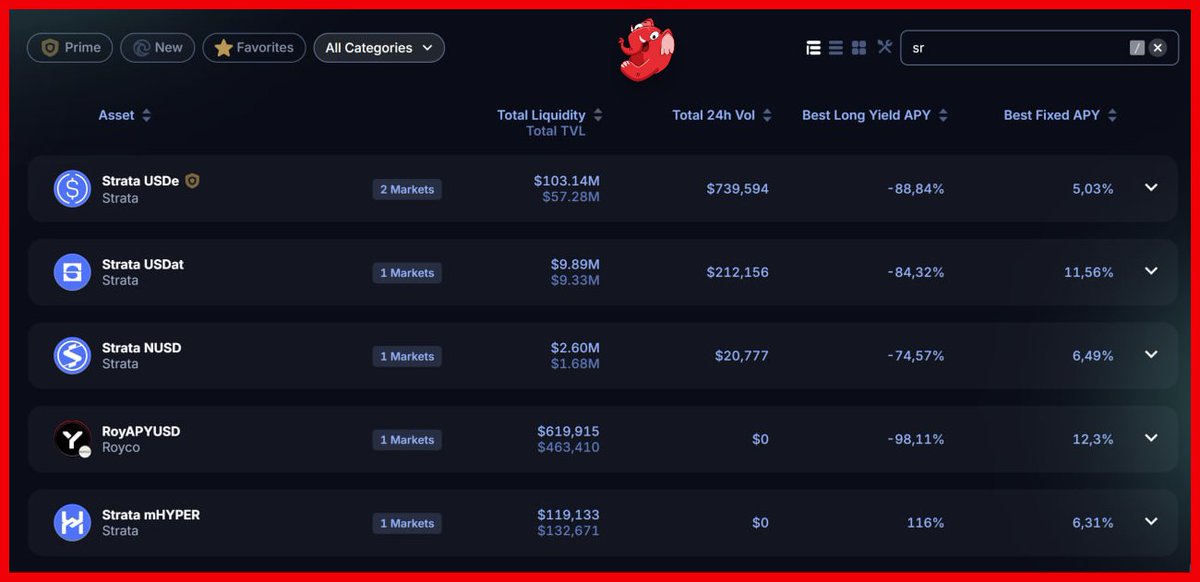
Pendle just listed 2 new maturities for @ethena_xyz's USDe yield, risk-tranched by @strata_markets
these markets existed before tho, users just roll over to the new one... but here's the part i only noticed:
almost every time Strata lists a new asset, 2 markets show up on Pendle shortly after, not a rule but it keeps happening
----------
To be specific:
1 tranched asset = 2 new Pendle markets, on top of the base market already live... so 1 asset = 3 markets, same yield source, same TVL bucket... but 3 separate fee lanes
Pendle's cost to host this basically zero and it gets better... the issuers themselves send extra rewards to push flow toward @pendle_fi
Neutrl x Strata
~ YT-srNUSD: 6.44% APY + 40x Neutrl Points + 60x Strata Points
~ LP-srNUSD: 5.77% APY + 40x Neutrl Points + 60x Strata Points
~ YT-jrNUSD: 8.2% APY + 10x Neutrl Points + 20x Strata Points
~ LP-jrNUSD: 7.91% APY + 10x Neutrl Points + 20x Strata Points
Ethena x Strata
~ YT- & LP-srUSDe: underlying yield + 60x Strata + 35x Ethena
~ YT- & LP-jrUSDe: underlying yield + 20x Strata
----------
But tranching just re-slices existing yield and TVL, what's so special? fair point but it's only half the picture
capital does get split, fees dont... every market runs its own fee meter
that's why more ppl are watching Pendle rev lately, not just TVL... every maturity spawns a fresh market, like a subscription loop
srUSDe is the live case... literally where this post started
beyond Strata, @roycoprotocol runs the same playbook on apyUSD and Pendle already opened the srRoyAPYUSD market
one protocol is a niche, two starts looking like a category... especially when these tranching protocols keep expanding into tokenized deposits n other yield bearing assets
----------
zoom out, every yield source can be sliced into different risk profiles
➥ that's tranching-as-a-service
Strata already got a eal stress test with $STRC n $USDat ... the structure did what it was supposed to do
infras validation matters way more than yield marketing bc when institutions look at this space, they're gonna ask one thing:
did the risk segmentation actually work when things got ugly?
----------
If that thesis plays out, Pendle's tranching partners become its supply chain
someone else launches the product
someone else pays the incentives
Pendle gets another revenue line, not a bad setup tbh
New maturities for @strata_markets x @ethena pools:
🔹srUSDe (Oct 2026)
🔹jrUSDe (Oct 2026)
srUSDe for downside protection on sUSDe yields, jrUSDe to earn a risk premium as the insurance pool
Speculate, trade and fix their yields with Pendle
DEX Wars update:
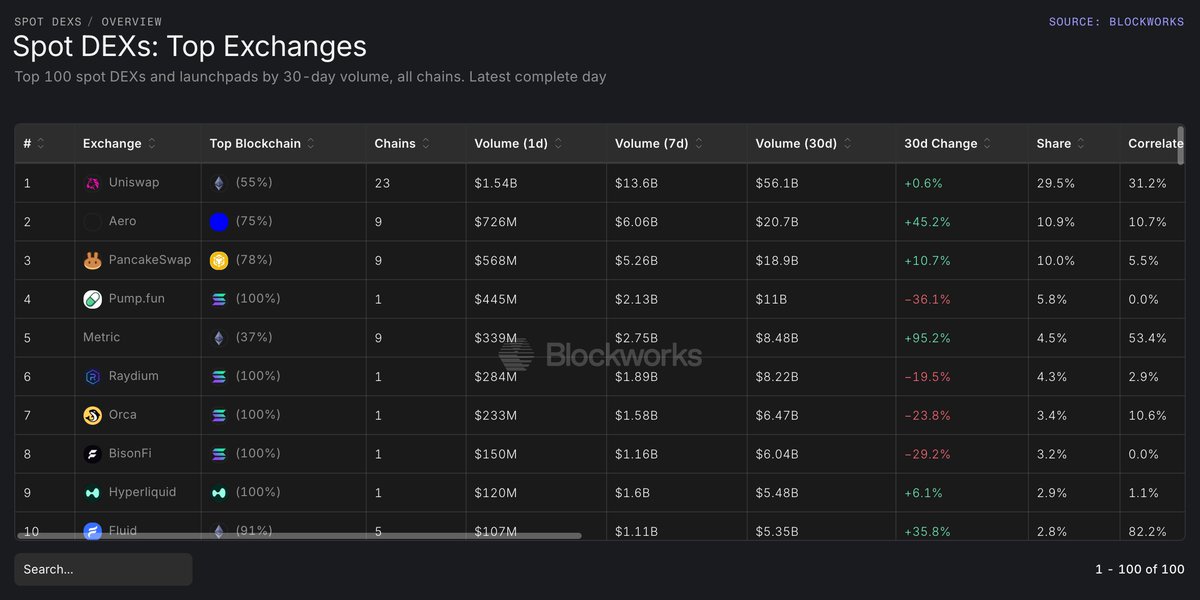
Yesterday @aeroxyz processed 18% of all DEX spot volume, its highest daily share ever.
Uniswap: 23%
Aero: 18%
Pancake Swap: 12%
Raydium: 5%
Pump: 5%
Aero is currently the fastest growing DEX in terms of volume, and it seems like predictive allocation is playing a major role by concentrating liquidity in L1/L2 token pairs and tokenized equities ahead of catalysts.
These two segments are key, as they represented a combined 52% market share of spot DEX volume in October.
Deeper liquidity attracts more trading volume, which strengthens Aero's position against competing DEXs.
It's easy to get caught up in the market's short-term price action and overlook the structural developments taking place behind the scenes.
As TradFi continues converging w/ onchain capital markets is that oracle infra will become increasingly sophisticated + specialised.
@redstone_defi is positioning itself particularly well for this transition and its edge is increasingly sharpened.
As more traditional financial assets move onchain, we're no longer dealing exclusively w/ liquid crypto assets that have readily observable market prices.
We're talking about tokenised treasuries, private credit, institutional funds + eventually a much broader universe of complex financial instruments.
Each comes w/ its own pricing methodologies, liquidity constraints, settlement mechanics + regulatory requirements.
Simply delivering an accurate price feed is no longer sufficient.
The infrastructure also needs to account for how that price is accessed, verified + utilised across different financial workflows.
RedStone's latest CAPS initiative on @CantonNetwork is a pretty good example of this evolution.
Canton already enables private txs between institutions, but conventional oracle models introduce an interesting tradeoff.
🔸Push-based feeds can expose information about who's accessing prices + when, potentially revealing sensitive trading activity.
🔸Pull-based feeds preserve more privacy, but counterparties requesting prices at different moments may end up with different valid quotes.
CAPS is designed to address both problems.
Through its root + derived capsule architecture, institutions can reference a common, verifiable price while privately applying it to their own transactions, collateral arrangements + settlement terms.
The oracle provides the underlying price without needing visibility into the individual deals built around it.
This is where the broader opportunity for RedStone lies perfectly imo.
The competitive advantage of an oracle provider increasingly extends beyond the accuracy of its data, towards its ability to solve asset-specific + institution-specific infrastructure challenges.
From NAV pricing for tokenised funds to collateral valuation, liquidation infrastructure + now privacy-preserving price delivery, RedStone is progressively expanding the range of financial workflows its infrastructure can support.
Each new asset class introduces different challenges, and solving them creates technical expertise, integrations + institutional relationships that could compound over time.
It's a potential reinforcing cycle:
1. More sophisticated asset coverage → deeper institutional integrations
2. This brings about broader financial utility
3. Serving as stronger (pull) incentives for further adoption.
CAPS remains in development and being an open standard means adoption won't necessarily accrue exclusively to RedStone.
But I think the direction is worth paying attention to.
As tokenisation becomes increasingly accessible, the harder problem shifts towards making those assets genuinely usable within sophisticated financial markets.
And the infrastructure providers capable of bridging that complexity could become some of the most important players in the next phase of RWA-Fi.
Exciting times ahead I suppose
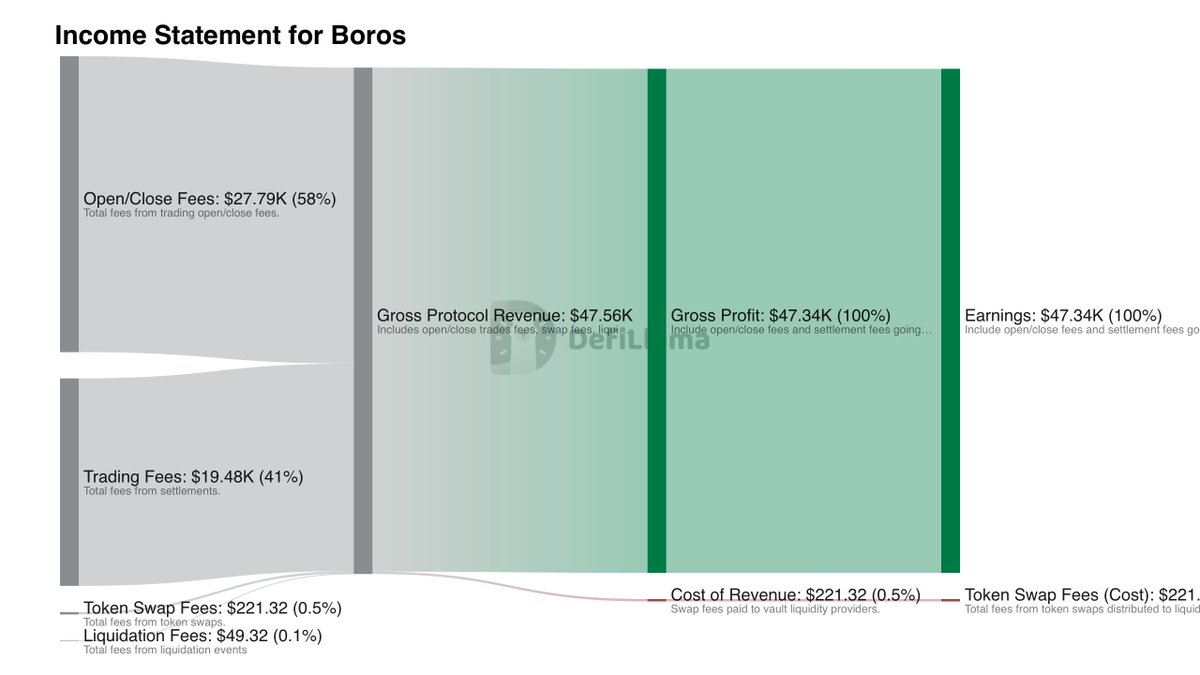
. @boros_fi revenue grew by 116% over the prior 30 days, and its income statement is showing a similar improvement in the protocol's financial performance.
And there's more to look at here than just the revenue increase
Alot of protocols can do well when their particular sector is attracting liquidity, but not all of them know what to build when that demand starts to fade
@pendle_fi already has an established position in yield trading, but Boros takes it into funding-rate markets, giving it another market to capture demand from
A few things that make this expansion interesting:
→ A different source of demand: Pendle isn't relying entirely on yield trading. Boros gives it exposure to funding-rate activity, which is already an important part of perpetual futures markets this year
→ A market with its own use cases: Funding rates has beyond just being another asset to speculate on. Traders can use @boros_fi to take positions on funding movements or manage their exposure to changing rates
→ A broader revenue opportunity: As Pendle expands into markets with different participants and trading needs, it creates more opportunities for activity and revenue beyond its original product
Boros is also showing some traction, with average OI reaching $106M in Q3, up 13% from Q2. Combined with the recent revenue growth, there's a developing market here that's worth keeping an eye on.
The opportunity isn't just about growing @boros_fi as a standalone product. It's also about how this expansion can give Pendle a broader position across yield and derivatives markets over time
Strong products make better times.
At least in DeFi, which now has its own yield curve.
@pendle_fi is bringing this to life with four @ethena USDe fixed-term markets, offering fixed rates ranging from 5.25% to 6%.
That's a meaningful yield premium over US Treasuries.
In tokenized stocks distribution decides who wins and the volume data makes that pretty hard to argue with.
Here's who's leading the weekly chart right now:
🔸 Coinbase (34%) → Coinbase app (Base)
🔸 Robinhood (18%) → RH app (Robinhood Chain)
🔸 xStocks (17%) → Kraken (Solana)
🔸 Backpack (17%) → Backpack Exchange
🔸 bStocks (10%) → Binance-affiliated (BNB Chain)
Together those 5 had about 96% of all weekly spot volume, and every one of them has an exchange behind it.
It makes sense when you look at what an exchange gives a new asset on day 1:
users who already have funded accounts, liquidity from the very first trade, and the trust that comes from people keeping their money there already.
@coinbase goes a step further because it owns every layer:
🔸 The exchange (Coinbase)
🔸 The token standard (B20)
🔸 The chain (Base)
That's how it went from launch on August 24 to 34% of weekly volume in 12 weeks.
Owning the full stack creates a loop:
You come in through the Coinbase app → buy NVDA or TSLA as a token on Base → post it as collateral on @aave V4 → borrow USDC against it → put that USDC back to work on Base.
So every step adds activity on Coinbase's own rails and you never leave the ecosystem.
You can see the same playbook with Robinhood, which runs its own chain and already holds 18% of weekly volume.
Today OKX and ICE (the owner of NYSE) open a tokenized stock venue for eligible US users with 70+ assets.
Which takes the same exchange-led pattern straight into the US market.
I'm convinced the winners here will be the platforms that own both the users and the rails, and Coinbase just showed everyone how fast that model works.
h/t: @ARKInvest / @BlockworksData
“For issuers, it is a new way to raise capital onchain.”
Many thanks to @coingecko for their amazing piece on USDe Fixed-Term Markets. Much like a company selling short-term paper in traditional markets. protocols can now issue their own fixed-term notes on Pendle with this new innovation.
Read the full article 👇
One thing that trading the markets has taught me is that the market doesn't owe anyone a particular regime.
What works exceptionally well today might completely fall apart tomorrow.
We've seen this play out countless times in crypto.
Strategies that print money during strong bull markets can struggle tremendously when liquidity dries up, volatility compresses or the market enters a prolonged downtrend.
And imo one of the biggest mistakes traders make is assuming that an edge which worked in the past will continue working indefinitely.
Markets are constantly evolving, and so must the strategies we deploy.
This is why I've always found market-neutral strategies particularly interesting esp. when it comes to building a more diversified approach towards generating returns.
Most retail participants are accustomed to directional trading, where profitability largely hinges on getting the market's direction right.
But there's an entirely different way to approach the markets.
Rather than betting on whether crypto goes up or down, what if you could focus on identifying which assets are likely to outperform others?
That's essentially the premise behind dollar-neutral long/short strategies.
By maintaining roughly equal dollar exposure on both sides, traders can reduce their reliance on broad market direction and instead seek to capture the relative performance between assets.
And this is particularly relevant in crypto, where dispersion across assets can be substantial even when the broader market isn't doing much.
Ofc, dollar-neutral doesn't mean risk-free, nor does it guarantee profitability in bearish markets. Poor asset selection, changing correlations + execution costs can still eat into returns.
But that's precisely the point.
There's no single strategy that works across every market condition.
The real advantage comes from understanding where your returns are actually generated, recognising when those conditions change + having the flexibility to adapt accordingly.
@Infinit_Labs' APEX Multi-Strategy vaults has piqued my interest amidst the harsh market conditions given it's dollar-neutral CTA momentum approach on on @HyperliquidX managed by @ApexQuants.
FYI: Its first vault reported a 37.65% gross annualised return, w/ 6.6% volatility compared to 9.3% for the S&P 500 over the reported comparison period.
What appeals to me more than the headline APR is the underlying approach to generating returns w/o depending entirely on a sustained crypto bull market.
And as onchain trading infrastructure continues to mature, I think access to strategies beyond simply buying + holding becomes increasingly valuable.
After all, surviving the markets isn't just about maximising returns when conditions are favourable. It's also about preserving the ability to participate when they aren't.
Markets change and opportunities rotate.
Those who can recognise these shifts + continuously adapt their approach are the ones best positioned to stay ahead of the curve.
And sometimes, the best trade isn't about figuring out where the market goes next, but figuring out where the opportunities lie regardless.
How does @Shift_DeFi approach risk management in DeFi?
I took a closer look at its credit-style risk framework, covering:
→ Asset, Protocol & Network risk assessment
→ The weakest-link rating principle
→ Block-by-block monitoring and risk controls
The video uses the Liquid USDC Vault as a practical example, with APY figures as of Nov 18, 2026.
Here's my breakdown ↓
Pls im begging u, divide fees by volume before getting excited about any dex volume chart
it takes 10s and tells u if a dex grew bc ppl traded more or bc each trade got pricier
so i ran it on @aeroxyz, week of Nov 12-18 vs the week before:
➥ volume: $5.8b → $6.5b (+10.8%)
➥ fees: $2.3m → $2.5m (+9%)
➥ fees per $1000 traded: ~39.5¢ → ~38.8¢
volume is up, fees nearly kept pace, each $1000 traded earned slightly less
so the fee growth tracked volume, not pricier trades
btw the slice that lands with sAERO holders grew faster than fees: $1.8m → $2.1m (+12%)
volume is the screenshot, 38.8¢ per $1000 and a bigger slice for sAERO holders are the receipt
.@aeroxyz did $20.7B in DEX volume over 30 days. #3 behind only Uniswap and Pancake.
Volume +40% vs. the prior 30 days. Yet the $AERO token is down 40% since the merger.
This is a case of the sell the news imo.
$AERO trades 3.5x sales vs. Uniswap's 32x.
~93% of Uniswap's holder revenue at ~10% of its market cap.
if you are looking for tokens to buy linn is a big fan of pendle, there's also pendle to look into, also if you've not heard of it before can check out pendle as well....little bit riskier is pendle, but if you're looking for a great safe value investment long term pendle is also good, something that most people don't know is really undervalued is pendle which is going to do very well
Yesterday I was sent this chart after sharing the post below.
What this chart shows is exactly the type of market-maker activity @aeroxyz's architecture is designed to attract.
Aero has a competitive advantage through its ability to coordinate liquidity using emissions and predictive allocation. Deeper liquidity attracts market makers, improves execution, and generates trading fees.
The metric to follow is emissions vs. revenue: how much revenue does Aero generate relative to the emissions required to attract liquidity?
That's where Aero's predictive allocation and AER engine shine.
The more efficiently Aero converts emissions into revenue, the stronger the economics become for $AERO stakers, and the more economically sustainable the protocol becomes.
One thing i really like seeing: @aave is keeping more rev while spending less on token rewards
in the 30 days to Otc 19, aave paid 14.9¢ in ethereum:0x7fc66500c84a76ad7e9c93437bfc5ac33e2ddae9 rewards for every $1 of revenue in kept... in the last 30 days, that's down to 7¢
the 30d numbers:
➥ aave incentives: $807k → $410k
➥ revenue retained in the treasury: $5.4m → $5.9m
this is one of the things i always look at when evaluating defi protocols: how many native tokens do they have to spend to generate $1 in revenue?
and Aave's revenue went up while token incentives went down
that's an efficient business model, especially in a market where most token prices are down
Had a great chat with Amanda on Endgame about Pendle and why we built Boros.
Perps are a $200B market, yet the funding rate that sits underneath it was never tradeable. That’s the gap we built Boros to close.
5.25% to 26.6% fixed on @pendle_fi stablecoin PTs, all on the same screen.
duration barely moves the rate... what sits underneath does
┃
┣ 📁time curve (USDe fixed-term)
┃ ┣ 4 maturities out to Nov 2027 run 5.25% to ~6%
┃ ┣ USDe itself pays 0% underlying
┃ ┗ less than 1 point separates the shortest and longest rung
┃
┣ 📁credit curve (stables maturing within ~5 weeks)
┃ ┣ PT-sUSDe (nov 26): 5.29%
┃ ┣ PT-reUSD (dec 10): 11.68%
┃ ┣ PT-USD3 (dec 17): 15.07%
┃ ┗ PT-sUSD3 (dec 17): 26.64%
┃
┣ 📁same 3jane pool, same dec 17 maturity
┃ ┣ ~11.6 points between sr USD3 and jr sUSD3 on the exact same date
┃ ┣ ~8 of those points already sit in the underlying (6.6% vs 14.6%), set by how 3jane splits pool interest
┃ ┗ Wall street prices that spread behind a credit desk, Pendle puts a live ticker on the rest
┃
┣ 📁what else sits next to the gap
┃ ┣ sUSD3 takes the first loss if borrowers default
┃ ┣ 30 day lock on sUSD3
┃ ┣ points stripped out to YT buyers so PT holders lock a fixed rate instead
┃ ┗ 31 days left to Dec 17 (~5 weeks)
┃
┗ 📁 what it adds up to
┣ "fixed" only locks your rate if u hold to maturity, and on sUSD3 only if losses don't eat into the junior
┗ the real product is an interest rate layer where time and default risk finally have separate prices
Instead of dwelling on depressing price action, I'm hunting for better ways to earn yield.
A few key criteria:
1⃣Deep liquidity, must be >$50M TVL
2⃣30D APY - proving sustained yield
3⃣Available as fixed Pendle PT, >$10M liq
4⃣Base yield of 15%, cuz 10% ain't cutting it
5⃣No exploit/major losses reported
These are 3 unique and attractive yields to look at:
sUSDx by @AxisFDN = 15.8%
Axis has the highest sustained 30D APY according to DeFiLlama with more than $50M TVL. The yield is sourced from cross-chain, cross-CEX arbitrage strategies. Axis sUSDx has one of the more liquid pools on Pendle ($16.5M) allowing you to lock in 16.84% APY through Dec 2nd, expect a new market expiry to spin up soon.
reUSDe by @re = 12.56%
reUSDe is the mezzanine offering on Re, not the junior, which last I checked had $80M to use as first-loss capital protecting reUSDe holders. PT-reUSDe allows you to lock in 18% for the next 26 days, expect a new pool and expiry soon too. There's $807M in Re and growing, one of the most impressive teams I've interviewed in DeFi, lifelong operators in reinsurance and running the entire junior pool with their own capital, real skin in the game.
sUSD3 by @3janexyz = 12.91%
This is a real yield backed by fintech borrowers in the cutting edge onchain credit facility 3Jane. 3Jane has $130M deposited on their platform, currently offers a Pendle PT-sUSD3 earning 15% fixed APY the next 33 days.
Honorable mention: Not quite 15% but 10-12%, reUSD by Re (most senior pool) earns a base 6.9% APY but can be locked in for a fixed 11.65% APY on Pendle for 26 days and @infiniFi's siUSD with a base yield of 8% APY, can be locked in for a fixed 9.83% APY the next 54 days, expiring in first week of January.
I prefer fixed yields with Pendle but I have to be certain the underlying is a reliable, safe asset to hold.
Note: NFA, you can still lose 100% of your deposits if the underlying in any of these fails. I am an investor in @3janexyz and @infiniFi.