🧠Introducing 𝐛𝐚𝐛𝐲𝐚𝐠𝐢-𝐚𝐬-𝐚-𝐬𝐞𝐫𝐯𝐢𝐜𝐞.
🤝Integrate @yoheinakajima 's babyagi with your own applications - thanks to @langchain and @JinaAI_'s langchain-serve with one simple command - 𝐥𝐜-𝐬𝐞𝐫𝐯𝐞 𝐝𝐞𝐩𝐥𝐨𝐲 𝐛𝐚𝐛𝐲𝐚𝐠𝐢
https://t.co/znsNhe8Klo
Today we’re announcing Open Responses: an open-source spec for building multi-provider, interoperable LLM interfaces built on top of the original OpenAI Responses API.
✅ Multi-provider by default
✅ Useful for real-world workflows
✅ Extensible without fragmentation
Build agentic systems without rewriting your stack for every model: https://t.co/ZJPNDemq40
I wrote about the issues we faced trusting "OpenAI-compatible" claims across models and providers. @simonw highlighted the same problem in his AAIF post. Hope @linuxfoundation considers this - a real spec would open doors for languages beyond Python/TS.
https://t.co/8cQoVPT1Vi
@ibuildthecloud@thdxr@ibuildthecloud this is such a pain while building for production! The compatibility claim is a lie. We need a standard.
I wrote about it in detail here - https://t.co/8cQoVPT1Vi
@swyx@ankrgyl@mojombo Streaming + structured output latency has been a real pain. godantic (Go) solves this among other things - repairs incomplete JSON mid-stream, returns typed results immediately.
https://t.co/Hi427HZGpO
okay this is a happy surprise. During the ICLR2024 keynote, in one slide of @jietang keynote speech about @ChatGLM to AGI, @JinaAI_ is there on the top 20 Github organizations 😃
🤨 This fine-tuning is too good to be true? Just tell us what you want your embeddings to excel at, e.g., car insurance claims, financial news, Spanish dialogs. Specify your wish in a prompt; and remember this is your only input to our API. In about 30 mins, we then deliver a ready-to-use, fine-tuned embedding model that can be loaded via SentenceTransformers. Behind the scenes, we take care of everything else: from generating useful synthetic data to managing the train-eval-test ML workflow, and finally, uploading the fine-tuned model to the @huggingface Hub. Yep, under this very minimal UI abstraction, so much happens!
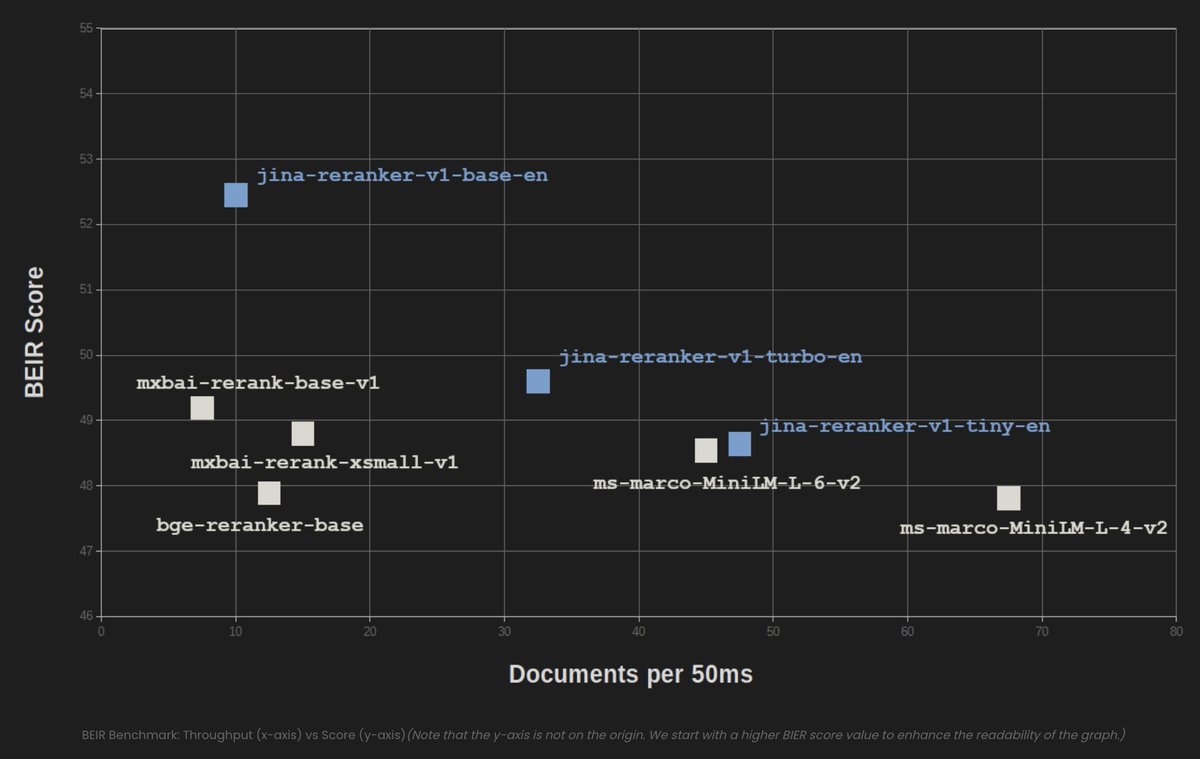
We are releasing two new open-source reranker models: jina-reranker-v1-turbo-en and jina-reranker-v1-tiny-en, the latter has only 30M parameters and four layers! 🤯 These two new rerankers enjoy 5X faster inference speed than our last jina-reranker-v1-base model at only a very small cost on the quality. You can find these two models on @huggingface
Turbo (6-layer, 37.8M parameters): https://t.co/U1g32ZjuLX
Tiny (4-layer, 33M parameters):
https://t.co/QlyXdkDTPw
Feeding webpages to LLMs is crucial for grounding, but it's hard to do right. Scraping webpages is complex and unreliable, especially with dynamic pages. 🥁Introduce Jina Reader: simply prefix any URL with 𝗵𝘁𝘁𝗽𝘀://𝗿.𝗷𝗶𝗻𝗮.𝗮𝗶 and get an LLM-friendly input! Our Reader API acts as a proxy that processes any URL by performing browser rendering, content extraction, and cleaning, ultimately converting it into well-formatted text that is ready to use. It does all the nasty job so you don't have to.
Jina's new reranker can dramatically improve the quality of your RAG application!
Vector search by itself can help you search your data by meaning, but paper after paper shows using a post-retrieval reranker like @JinaAI_'s just-released jina-reranker-v1-base-en can give the quality of your results and the resulting query to the LLM a big boost.
Step through using their reranker step-by-step with LlamaIndex and @MistralAI:
https://t.co/6U3hd3PZkR
🚀 Introducing Reranker API! Leveraging our latest research for top-notch performance, enjoy a boost of +20% in accuracy on vector search & RAG systems. Kickstart with 1 million tokens on us! https://t.co/mQru3mgWdp
Our open-source bilingual Spanish-English embedding model is now ready for download through @huggingface. Start using it right away to power your state-of-the-art AI applications.
https://t.co/EnbHAmcXIc