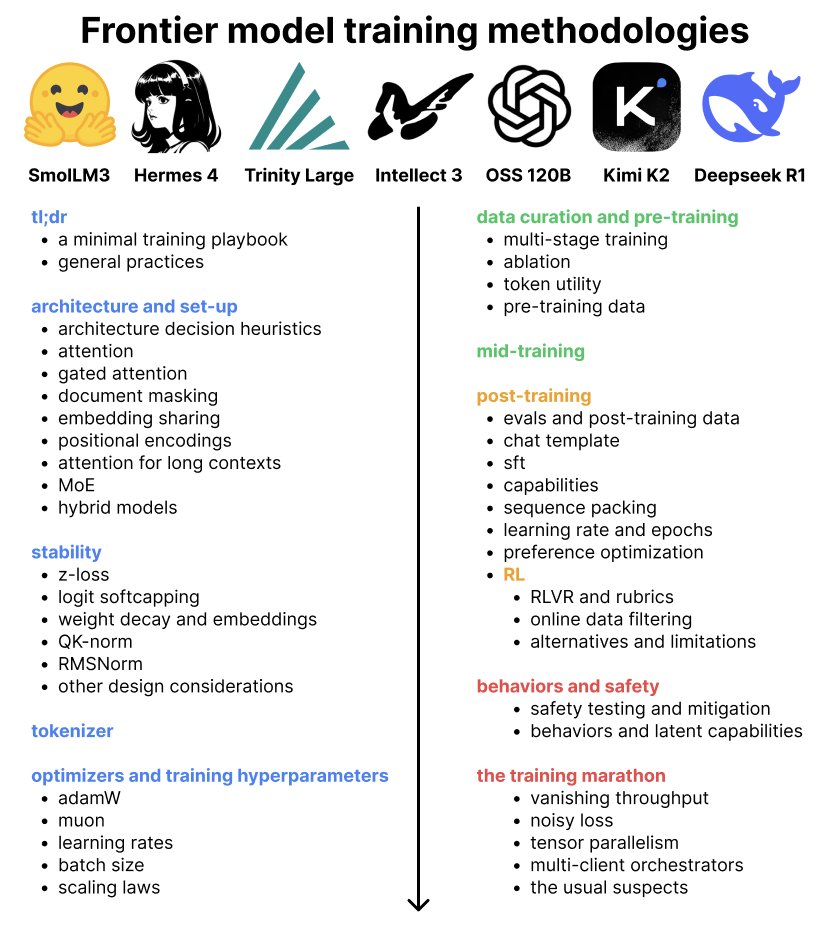
new blog! What methodologies do labs use to train frontier models?
The blog distills 7 open-weight model reports from frontier labs, covering architecture, stability, optimizers, data curation, pre/mid/post-training + RL, and behaviors/safety
https://t.co/88heRH4TcO
Meet Finch 1, our first step toward one model that works with any sensor, at any resolution, anywhere on Earth.
Trained on imagery from 50+ sensors across satellites, aircraft and drones.
Today we're announcing that Modal has crossed $1B in annualized run rate, as well as raised a $750M Series D at a $15.75B valuation, led by @Accel.
Since our Series C, usage has tripled and we’ve grown more than 15x year-over-year.
We are deeply grateful to the developers and companies building on Modal. There's still so much more to build, and we can't think of a better time to be building software.
New research 🚀 from the ACE (Agentic Context Engineering) team at Stanford
We took the failure lessons out of an LLM agent's memory, and it got better! 📈
Why? We find that failure recovery tips could hurt LLM agent performance when they sit in context all the time, even when nothing is going wrong.
So we build Sentry 🛡️: a test-time framework that recovers LLM agents from failures. It keeps failure knowledge outside the agent and only steps in when a failure actually happens.
On average: +39% over our own ACE, +37% over the best runtime-intervention baseline.
📄 Paper: https://t.co/WVu8fVXfl3
💻 Code: https://t.co/0AgNQXIHJZ
Demo Here!!!!!!!
More details below 🧵
(1/N)
I just wrapped up my internship @modal.
This summer I worked on container filesystems, speeding up agentic workloads by up to 4x and directory traversals by 12x. I wrote about this systems work behind it here: https://t.co/7sRcftBAca
Huge thanks to @amitpr, @jonobelotti_IO, the runtime team, and everyone at Modal for an amazing summer!
It's my last day as an intern on @modal's training team.
With the rise of RL, it's becoming increasingly critical to have robust, reliable observability. I wanted to share some of my work building an observability system for the Modal Training Gym (https://t.co/BGuTWqZQXv), built on top of @slime_framework & @radixark miles.
Thank you @qjoyliu, @peywalt, training team, and Modal for an awesome summer!
It's my last week @modal.
This summer, I had the chance to work alongside @waltergoat, @colin_weld, @paulgb on our Sandbox product. It was my first time working on systems at this scale, and I couldn't be more grateful for their mentorship.
Sandboxes are full of gnarly distributed systems problems. I wrote about one of them - distributed locking - on my blog: https://t.co/ooYMVJhHqu
To ship it, I needed to break rules for practicality and performance. This led me to formally verify the design with TLA+ to catch the many race conditions.
This is also my first blog post! I don't share my writing often, but I'd like to do it more. Hope you enjoy.
Main takeaway is that when long-horizon self-play rewards didn’t transfer, the rollouts were still useful, as market data. Modeling prices, valuing liquidity, and distilling the resulting decisions worked.
More technical details about the implementation here:
https://t.co/0L8F3WapoY
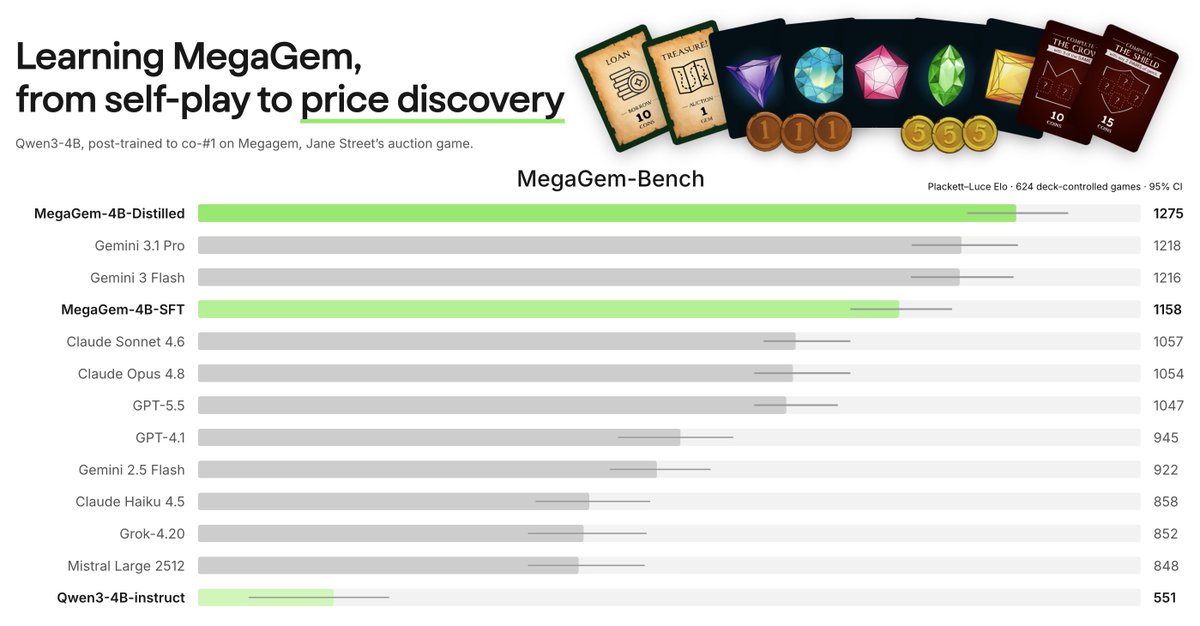
🧵I post-trained Qwen3-4B-Instruct to play MegaGem, @JaneStreetGroup's new auction game.
It ranks #1 on 3-player MegaGem, above models like GPT-5.5, Claude Opus 4.8, and Gemini 3 Flash, but statistically unresolved with Gemini 3.1 Pro.
However, self-play RL wasn’t what got it there.
Main takeaway is that when long-horizon self-play rewards didn’t transfer, the rollouts were still useful, as market data. Modeling prices, valuing liquidity, and distilling the resulting decisions worked.
More technical details about the implementation here:
https://t.co/0L8F3WaXew