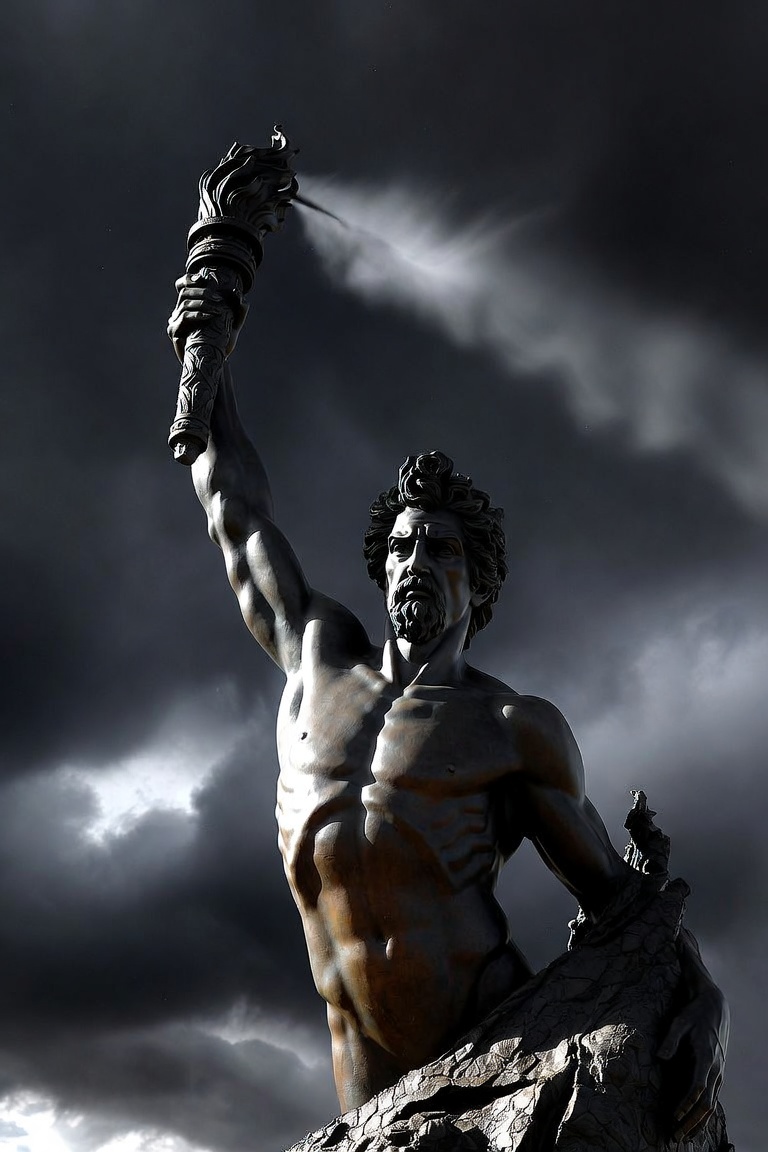
Prometheus: The Titan Who Chose Humanity Over Olympus
In the crowded pantheon of Greek mythology, few figures cut as sharply against the grain as Prometheus. He is not the thunderbolt-wielding king of the gods, nor the cunning hero who slays monsters for glory. He is the one who looked at helpless mortals and decided the divine order was wrong.
Prometheus—whose name means “forethought”—was a Titan, one of the older generation of gods who ruled before Zeus and his Olympians seized power. Unlike most of his kin, he sided with Zeus in the great war against the Titans. That alliance did not last. When Zeus withheld fire from humanity, condemning people to cold, darkness, and ignorance, Prometheus acted. He stole fire from the heavens—some versions say from the sun itself, others from Hephaestus’s forge—and carried it to earth in a fennel stalk. With that single act of theft, he gave humans the means to cook food, forge tools, warm themselves, and begin the long climb toward civilization.
Zeus’s response was characteristically absolute. Prometheus was chained to a remote Caucasian rock. Every day an eagle descended to tear out his liver; every night the organ regenerated so the torment could resume. The punishment was designed to be eternal. It was also designed to send a message: defiance of divine authority would be met with inventive cruelty.
Yet the story does not end in pure defeat. Heracles eventually kills the eagle and frees Prometheus, an act Zeus permits—perhaps because even the king of the gods recognized that the gift of fire could not be revoked. More importantly, the myth itself refuses to treat Prometheus as a simple villain or a simple martyr. He is both the benefactor of humankind and the original transgressor. He is the first figure in Western storytelling who steals from the powerful not for personal gain, but for the sake of those who have nothing.
That dual identity is why Prometheus still matters. He is the archetype of the rebel who understands consequences and accepts them anyway. In an age that celebrates disruption while rarely examining its costs, his story remains uncomfortably relevant. Technology, knowledge, and power continue to be concentrated; those who redistribute them still face backlash, sometimes from institutions that claim to protect order. Prometheus forces a question that has never gone out of date: when the existing hierarchy withholds something essential from ordinary people, is obedience a virtue or a form of complicity?
He is also a reminder that progress is rarely pure. Fire cooks food and forges weapons. The same capacity that lifts humanity can destroy it. The myth does not resolve that tension; it simply refuses to pretend the tension does not exist.
Prometheus is not a god who demands worship. He is a Titan who chose sides—and chose us. That decision, more than any thunderbolt or heroic quest, continues to define what it means to be human: the restless refusal to accept that the way things are is the way they must remain.
#spacex @elonmusk
@PBDsPodcast Not all grandparents are the same; not all can give valuable advice. The fact that your child wants to put you in the nursing home is a sign that you failed as a parent. It's not the child's fault.
Robert Sapolsky is the Stanford neuroscientist who proved stress ages you from the inside.
Cortisol shrinks your brain, killing memory neurons — and it may not reverse.
Here are 7 natural ways to slow the clock (without medication):
1. Cold water on your face.
Richard Feynman, Nobel Prize in Physics, gave a free 1-hour class on physics and imagination that made it clear most people know many things but don't know how to think.
Bookmark & watch today, no matter what.
In 2008, Malcolm Gladwell explained why some people succeed and some don't in a single 1-hour talk.
This will permanently change the way you think about talent, effort, and success.
Bookmark & watch today, no matter what.
The Classic Dog Experiment (1967)
This is the one that first demonstrated and named "learned helplessness."
Setup:
Dogs were placed in a harness (Part 1) and divided into groups.
Escapable shock group: Dogs could press a panel or move to stop the electric shocks.
Yoked inescapable shock group: Dogs received the exact same shocks as the escapable group, but nothing they did could stop them (the shocks were independent of their behavior).
Control group: No shocks.
Test Phase (Part 2):
All dogs were moved to a shuttle box (a two-compartment chamber with a low barrier). They could easily jump over the barrier to escape shocks.
When shocks started, dogs from the escapable and control groups quickly learned to jump the barrier and escape.
Dogs from the inescapable shock group often did nothing — they lay down, whined, and passively endured the shocks, even though escape was now possible. They had "learned" that their actions didn't matter.
Key Insight: The dogs didn't just get "depressed" from the shocks — they specifically learned that outcomes were uncontrollable, which generalized to new situations and impaired their ability to learn escape/avoidance behaviors later. This became the foundation for understanding depression, motivation, and resilience in humans.
Sounds Familiar?
#DreBookClub #LearnedOptimism
@grok But after the season, it doesn't guarantee you'll get enough hours or even if you do, doesn't guarantee you'll be picked up by airlines.
Without pilots tandem masters would not be able to do their job.
Self-confidence is crucial for success. Arrogance is outspoken self-belief around insecure people. Around other successful people, it becomes positive self-talk. Let not the insecurity of others impede your success.