THE IDEA OF PREDICTION MARKET WAS FIRST PROPOSED IN 2014 ON BITCOIN 🟠
THE STORY OF HIVEMIND (TRUTHCOIN) ⬇️
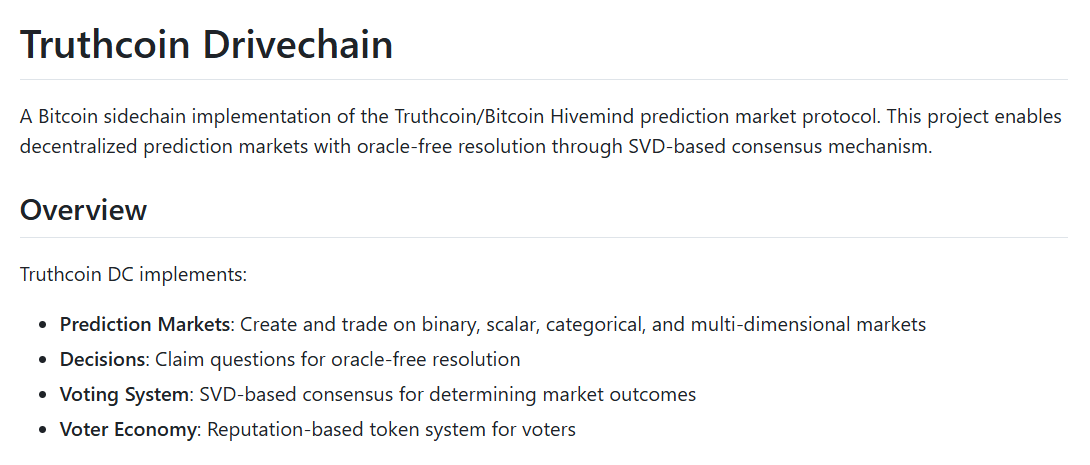
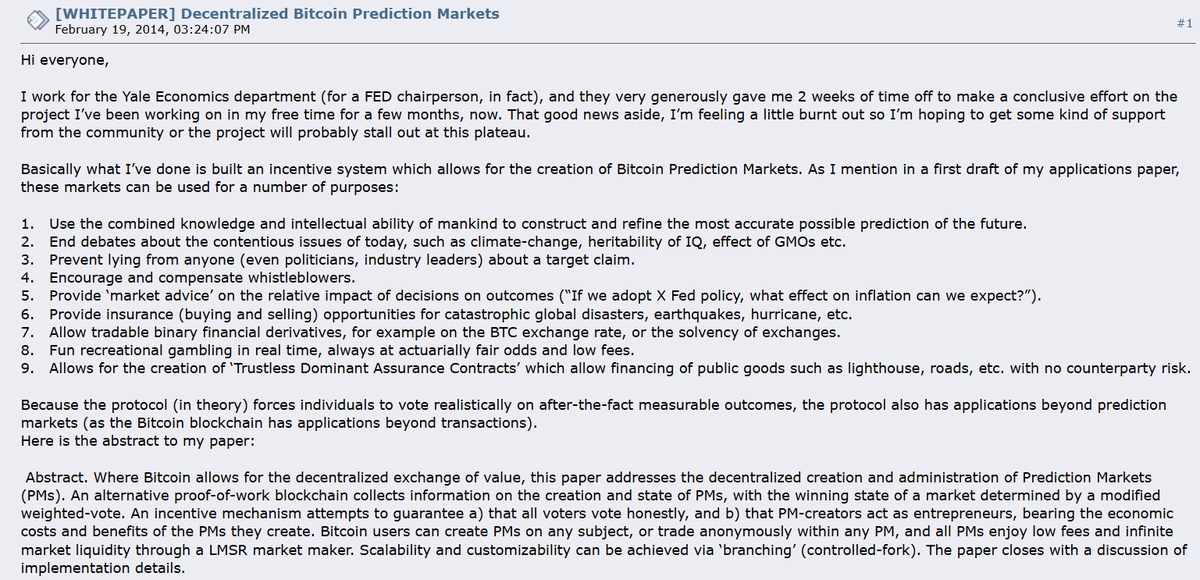
In February 2014, Paul Sztorc @Truthcoin (then a Yale Economics statistician with backgrounds in economics, psychology, and mathematics) posted the Truthcoin whitepaper on BitcoinTalk.
It described a peer-to-peer oracle protocol and Bitcoin sidechain that would let anyone holding Bitcoin create and trade fully on-chain prediction markets without a trusted intermediary or operator. https://t.co/3RKHo28nFQ
The design used two tokens: CashCoins (intended to be 1:1 redeemable for Bitcoin, used for trading and fees) and VoteCoins (a fixed-supply reputation/equity token held by the “oracle corporation” of voters who resolve event outcomes).
Markets were kept liquid by a Logarithmic Market Scoring Rule (LMSR). Outcomes were determined by a singular-value-decomposition (SVD) consensus algorithm on sealed votes, designed as a Schelling-point game so that honest coordination was the dominant strategy and collusion was self-defeating.
The explicit goal was “Making Cheap Talk Expensive”—turning forecasts into priced, skin-in-the-game markets that could aggregate knowledge more reliably than polls, media, or traditional research.
https://t.co/lnb0biHKPy
Sztorc renamed the project Hivemind in September 2015 to emphasize unity and avoid “altcoin stigma.” It received early attention and mixed but notable endorsements (Roger Ver called it potentially the most important invention since Bitcoin; reviewers included Adam Back, Peter Todd, and Andrew Poelstra).
However, the critical missing piece was a practical, permissionless two-way peg between Bitcoin and the sidechain. This dependency led Sztorc to focus on Drivechain (BIPs 300/301), a hashrate-escrow sidechain mechanism he proposed so that projects like Hivemind (and others) could exist without federations or new coins. Work on the prediction-market layer itself slowed while the enabling infrastructure was built; by the mid-2020s Hivemind remained the high-risk flagship use case for Drivechains, with testnet activity and LayerTwo Labs development but no mainnet activation on Bitcoin.
Meanwhile, centralized and other-chain prediction markets (Polymarket, Kalshi, etc.) captured the public narrative.
https://t.co/SNMKch8nDd
It remains one of the earliest detailed proposals for a Bitcoin-native prediction market and sidechain application, illustrating both the ambition of early Bitcoin 2.0 ideas and the long dependency on consensus changes for advanced features. Imagine if a workable sidechain soft-fork had shipped in 2015–2016.
Links:
- https://t.co/Q29ZJesn1F
- Original BitcoinTalk announcement (Feb 2014): https://t.co/3RKHo28nFQ
- Papers & FAQ:
https://t.co/8dVi9ccI4C and https://t.co/oDEl0PZxGx
- Drivechain: https://t.co/UOYpqanYy2
>> FULL PODCAST WITH PAUL COMING SOON ON @CryptoTimes_io <<<
Why "worse" graphics are better
(+ 8-bit music, lowfi, hi-contrast)
All messages can be broken down into two components:
- the substrate, which does not change
- the variance, which does
For example, Beethoven's 5th symphony starts with four notes:
- the **substate**, (the exact 4 note rhythm is about to be repeated)
- the variance, the 2nd instance is in G Major (the first was C minor)
Beethoven could have made that music **worse**, by altering the rhythm. But this would make "it" harder to understand, and to grasp.
You need to change only a **few** things at a time.
The song "Can't you hear me knockin" by the rolling stones, has the lead guitar play numerous variations on one phrase. Meanwhile, the chords and overall tragectory are the same.
In fact, if an **artist** wants to take us, the audience, to a place of **genuine extreme novelty** -- then they will have to (very carefully) lock down the substrate. Otherwise it will be too chaotic for us to understand.
This is why a game like Myst *should* go for photorealistic graphics, while *also* **locking** the camera / UX, and forcing the user into the "slide show" experience. They go hand in hand. ( The slide show is the whole point of Myst - most perfectly encapsulated in the "Dentist" chair room. )
Many "modern" games are perfectly successful "despite" their low res graphics (such as Stardew Valley and Undertale).
Successful modern games with "realistic" graphics always discover that they must de-realize it, else no one can figure out what is going on. For example, Call of Duty has items which "glow" on the ground -- so that players understand you can pick up a plate, but not a filing cabinet. Furthermore, boxes / crates / ziplines are all eerily identical (in addition to glowing when you are next to them) -- otherwise they'd be much too hard to find. The "glow" is the "real" graphics -- everything else (the filing cabinet) is just a distraction.
You can also compare the 8 bit Mario Tennis (gbc) music, to the "high res" n64 version. The high res version is much worse. Same for Pokemon red/blue music, which is better "undiluted".
This goes for gameplay as well. A sonic game usually has simple controls: run and jump .. but the **course** varies enormously. Rocket League has an enormous skill ceiling, but the controls are basically just accelerate, brake, turn, plus a little extra.
"Worse" graphics are often more **clear**. Simple pieces, invite more interesting combinations.
New exchange: https://t.co/A77AqBZF1p just launched, letting users withdraw ECX from sidechains instantly without having to wait 6 weeks for the withdrawal bundle
It's a good day to be bullish on eCash:
• $ECX up 110%+ in 48 hours
• Difficulty adjusting to 10-minute blocks
• Hashrate climbing as new miners join the pool
• 5 sidechains live, more in development
Happy Friday.
BREAKING: eCash’s Solana bridge was exploited for roughly 19,000 wECX.
Paul Sztorc puts the loss near $570,000.
Mainnet ECX was never touched. Only the wrapped token on Solana. The drivechains were never involved.
How it worked,
eCash (ECX) has been listed on SideShift.
The Bitcoin fork with drivechains. Shift from 300+ digital assets directly to ECX.
Shift now → https://t.co/L8X5G42cY5
BREAKING: eCash’s Solana bridge was exploited for roughly 19,000 wECX.
Paul Sztorc puts the loss near $570,000.
Mainnet ECX was never touched. Only the wrapped token on Solana. The drivechains were never involved.
How it worked,