@mrexodia Code is not cheap with LLMs. It's one thing to create PoCs, or get something up and running (even in environments you're not familiar with). It's another thing entirely to solve problems of consequence. How to reason about what goes wrong is severely underestimated here.
It's game over.
All those criticizing Vibecoding for creating code that will supposedly be impossible to maintain don’t realize that in less than a couple of years, just by asking, AI will be able to refactor projects with 100k+ lines, along with their libraries, and optimize anything better than the best experts in the world. Want it in assembly? No problem. Want it encoded in colored marbles? Whatever 😂
Programming was just a means, not an end. We’ve moved up a layer of abstraction.
Ghidra 11.3 is OUT!
PyGhidra is the new feature to be excited about.
It’s a Python library providing direct access to the Ghidra API.
I expect this to massively increase Reverse Engineering tool development, as it significantly reduces the barrier to entry.
sorry @nostarch to bother you but is like a year that I'm waiting for information regarding the delivery of a book but no one answers to my emails (Order 370977)
Perhaps so if you live in the Bay Area or some other major tech hub. However, remote work has never been an conveniece thing for me. It has been a way to get to work on fun problems with awesome people, like folks at @ScyllaDB and now @tursodatabase!
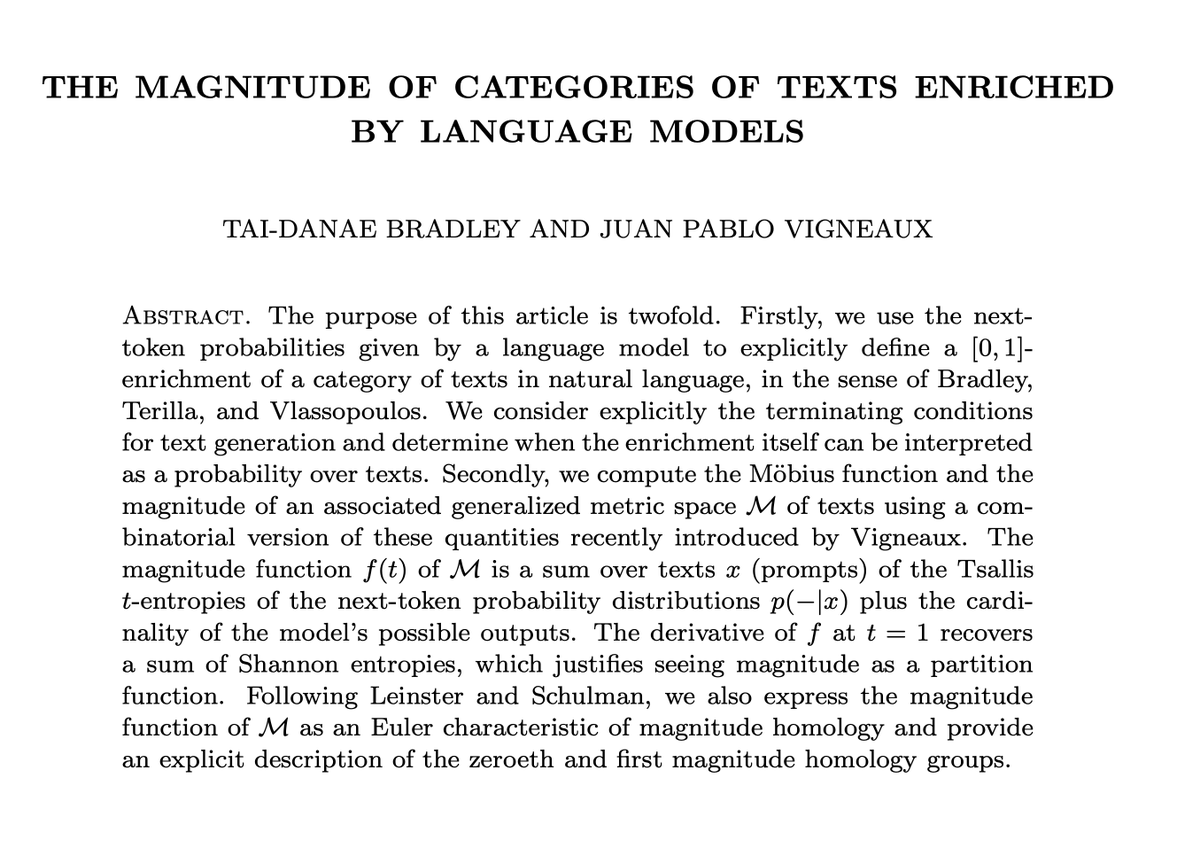
New preprint with Juan Pablo Vigneaux! 🎉 Every LLM has a (generalized) metric space associated to it. We compute its “magnitude,” which is sort of like an Euler characteristic, and find it involves a sum Tsallis entropies. And more. A neat blend of ideas: https://t.co/JXtUPyQ23Q
TIL how easy it is to ask curl to dump TLS session keys to disk 🛠️
Simply set the environment variable `SSLKEYLOGFILE=/path/to/file` 😅 Note: it also works for Firefox and Chrome
Extremely useful when combined with Wireshark 👍
🚀Excited to announce ghidralib - a library that makes #Ghidra scripts drastically shorter and easier to write. I've been using it daily for #reverseengineering and decided it’s time to share! Check it out: https://t.co/dYKqRjADju And the docs: https://t.co/OosH9VIALT #infosec
This "LLM generated" 3D plot was written by Christian Feuersänger, published in the pgfplots manual (4.6.10 Parameterized Plots), and also seen at https://t.co/8gx72z3w2r, with exactly this design, including labels. Grok2 took this from the GNU GPLv3 licensed pgfplots manual.