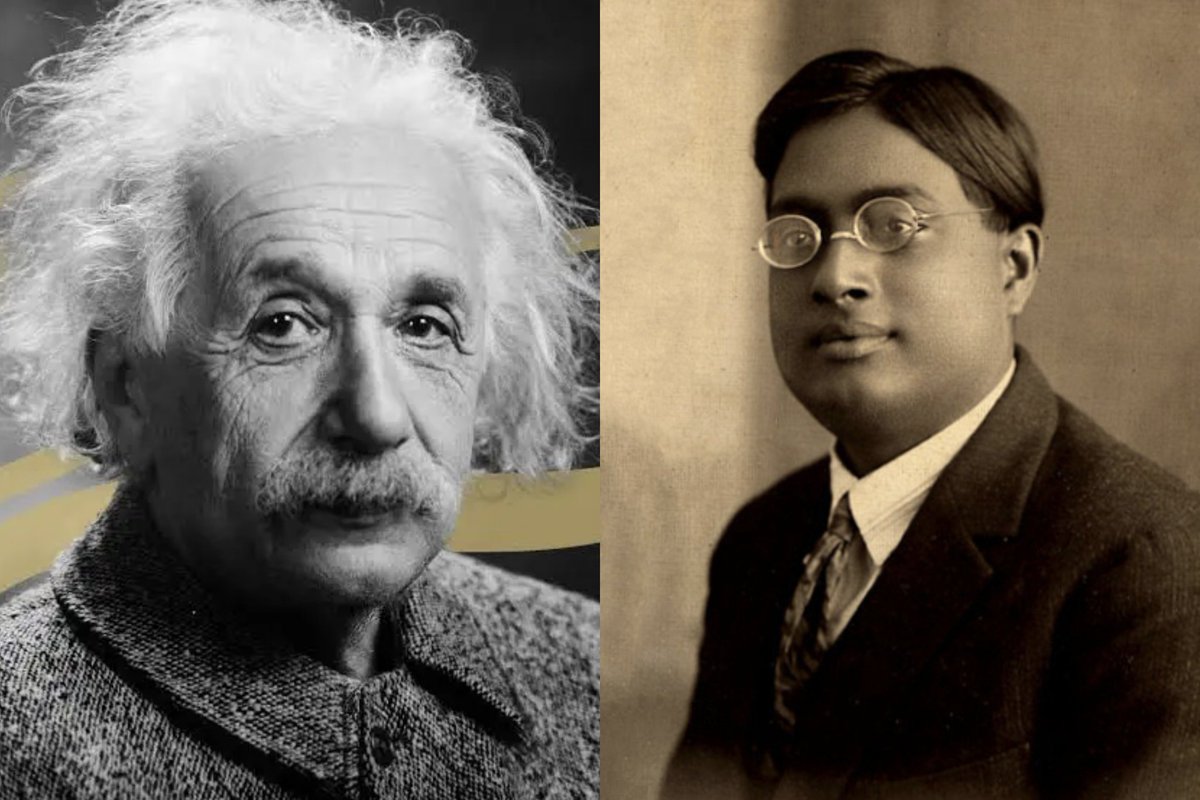
In 1924, a little-known physicist from India made what many thought was a mistake.
At least, that’s what the journals told him. His equations describing particles of light were rejected — too radical, too strange.
So he sent them directly to Albert Einstein.
Einstein did not reject them. Instead, he translated the paper into German, helped publish it, and used the ideas to build an entirely new branch of physics.
Today, lasers, superfluids, and quantum computing all rely on Bose–Einstein statistics.
Einstein became immortal in textbooks. Bose was reduced to a footnote.
Every boson carries his name, yet history almost forgot the man behind Satyendra Nath Bose.
Rishab Rikhiram Sharma performed on the sitar at the T20 World Cup opening ceremony at Wankhede Stadium yesterday, and his music left the entire crowd mesmerized.🎻❤️
AMI Labs founder Yann LeCun on why LLMs are fooling us the same way AI has for decades:
He argues that every generation of AI scientists has made the same mistake: confusing task performance with real intelligence.
LeCun's core challenge to the current hype:
"We're fooled into thinking those machines are intelligent because they can manipulate language. And we're used to the fact that people who can manipulate language very well are implicitly smart."
He's clear that LLMs are useful, but being a useful tool and being intelligent are two very different things.
The real insight is the historical pattern he's lived through.
Since the 1950s, wave after wave of AI researchers have claimed their breakthrough was the path to human-level intelligence.
Marvin Minsky. Herbert Simon. Frank Rosenblatt — who invented the perceptron, the first learning machine, in the 1950s — all predicted machines as smart as humans within a decade.
"They were all wrong."
LeCun has personally witnessed three of these cycles of hype and disappointment. And his verdict on the current one is blunt:
"This generation with LLMs is also wrong. It's just another example of being fooled."
The pattern: A new technique emerges → machines get good at specific tasks → we assume general intelligence
The question worth asking: are we impressed by these tools because they're intelligent, or because they sound like they are?
Javed Akhtar claims Sholay's temple scene where Lord Shiva and Hinduism were mocked can't be screened in today's India.
Wrong, Javed saab. You can screen it even today, just that in today's India, Hindus will ask you why you never had the guts to mock Allah or Islam similarly.
It's a weird time. I am filled with wonder and also a profound sadness.
I spent a lot of time over the weekend writing code with Claude. And it was very clear that we will never ever write code by hand again. It doesn't make any sense to do so.
Something I was very good at is now free and abundant. I am happy...but disoriented.
At the same time, something I spent my early career building (social networks) was being created by lobster-agents. It's all a bit silly...but if you zoom out, it's kind of indistinguishable from humans on the larger internet.
So both the form and function of my early career are now produced by AI.
I am happy but also sad and confused.
If anything, this whole period is showing me what it is like to be human again.