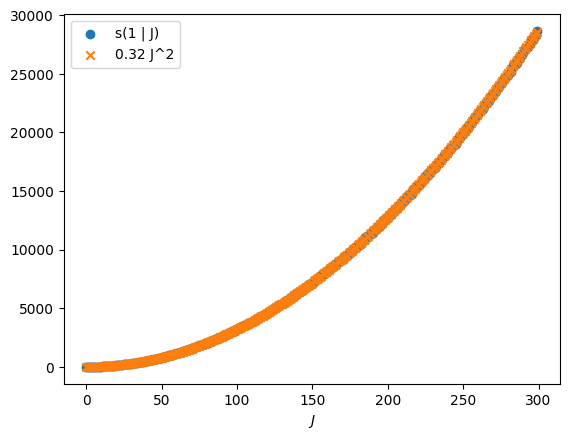
for J = 38, this is 454. we can also think about the value of s(1) given the value of J, s(1|J). we found this follows s(1|J) ≈ 0.32 J^2 very closely, and offer it without justification. @nah951413
for #ThisWeeksFiddler (standard credit), the number of survivors in round s(n+1) is the number of survivors of round n minus the number of those left ungrouped in round (n+1). @xaqwg
in symbols, this is s(n) = s(n+1) + s(n) % (n+1) where s(n) is the smallest value satisfying the equation. we can recurse from the upper bound J where s(J) = J down to the number of people who must have started the game s(1).
in #thisweeksfiddler we find stable arrangements for magnatiles, magical magnet tiles that stick to each other regardless of spins and flips. first, how are the magnets arranged?
https://t.co/RTnwPd2PEB @xaqwg
but when θ is π/4, we get a repulsive peak at the origin surrounded by stable minima. these are a bit contrived as they're projections formed by holding θ still by fiat, but as it happens, these values of theta are the ones corresponding to the global minima.