@jibreelkateb@stationarymarx Just like when mathematical physicists use C*-algebras instead of Hilbert spaces to study QM bc they want to underdtand the theory more deeply
@jibreelkateb@stationarymarx Tbf while physics-envy in economics is a whole thing, some physics tools do seem well suited for economics, very useful to think of Lagrangians if you're doing constrained optimization for example
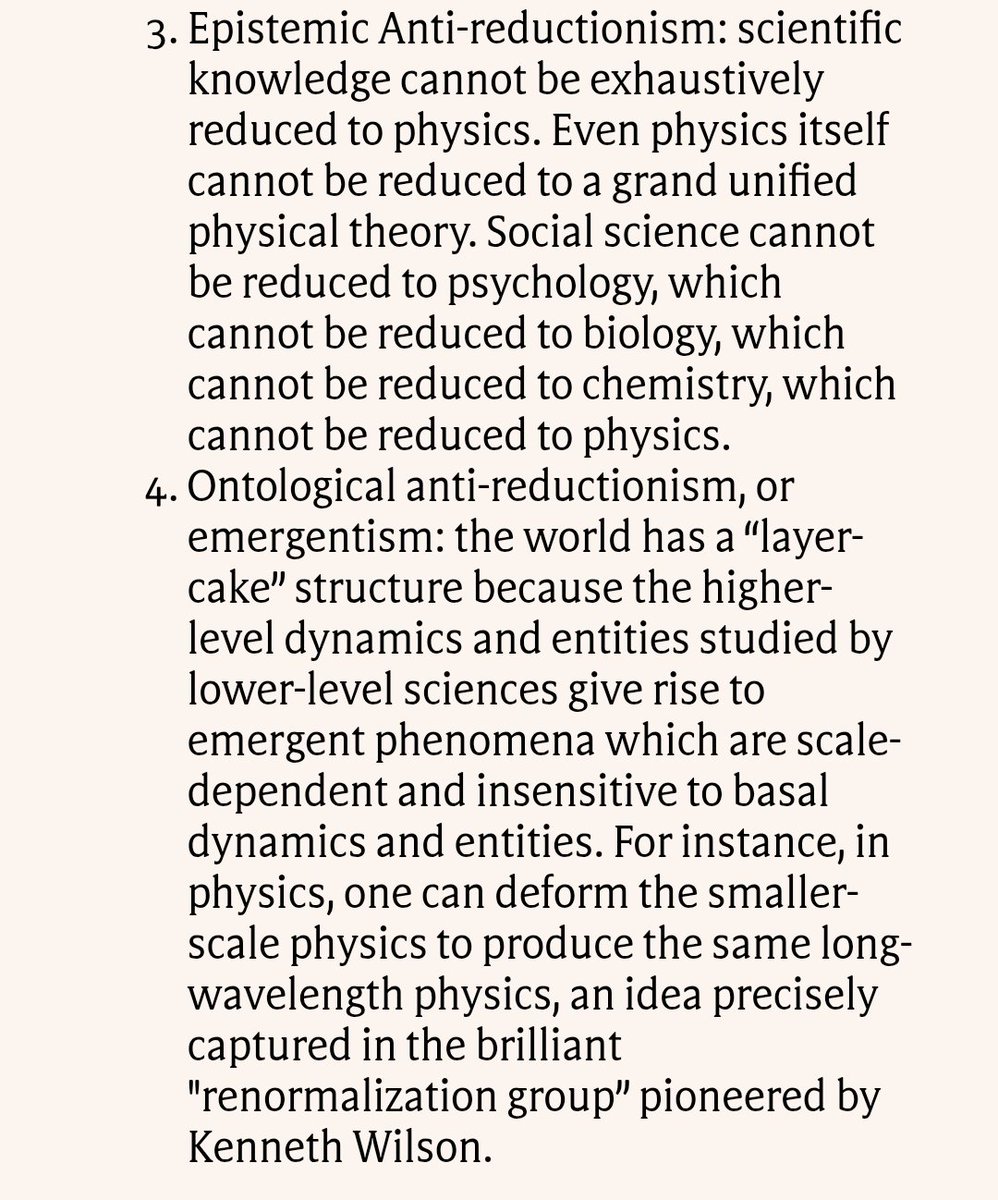
@jibreelkateb @kaywisehero @CosmonautMag Btw I read on your past posts and found these points very agreeable, would love to hear your thoughts on ontic structural realism and current debates about renormalization theory and scientific realism (say, by people like Laura Ruestsche and James Fraser)
@jibreelkateb @kaywisehero @CosmonautMag By similar issues I meant that they all run into frictions of some kind, which some people might not be willing to accept, not that they're all at odds with SR. The measurement problem and other things like Wigner's friend being the sticking points of textbook QM
@kaywisehero @jibreelkateb@CosmonautMag Yeah Bohm put some silly stuff out there
And yeah I don't really agree with you on the rest, I don't think that follows from the theory at all. I also don't like superdeterminism, so I guess we'll have to agree to disagree when it comes to QM
@jibreelkateb@kaywisehero@CosmonautMag Oh I'm not advocating for BM, just making the point that Bell had no issue with hidden variables as long as they were non-local
@tiago0693@GamerReserva Vale más porque Maudlin es especialista tanto en las desigualdades de Bell como en las interpretaciónes de la MC (sobre todo la mecánica bohmiana, que la tesis también discute), QF no. De conocer literatura relevante, dudo que la discusion hubiera sido tan superficial/simplista
@capi_spa@cyrnosofia La filosofía de la física cuántica es un campo bastante maduro que si requiere conocer de la física, se me hace más un tema de ignorancia del área por parte del autor
@tiago0693@GamerReserva Pero existe literatura interpretativa/divulgativa rigurosa dirigida a una audiencia filosófica, por ejemplo este libro del filósofo de la física Tim Maudlin. No hay excusas para citar un vídeo de YouTube en una tesis.
@arne__ness Anyone who has worked doing data annotation can tell you that. Reading (or listening in the case of devices like Alexa) and classifying actual conversations is a big pary of reinforcement learning with human feedback