Today I blocked a “Police Man” and his light skin side chic on the road from passing one way. We have to hold each other accountable.
A new Nigeria is possible.
Hassan, former aide of a northern senator, continues naming terrorists linked to deadly attacks in Nigeria. The whistleblower earlier accused sitting Senator Shehu Buba Umar of Bauchi South of sponsoring terrorism, citing video and pictorial evidence.
The face of a rapist. Let it be known, may his family be shamed, may everything he loves be taken from him, may he never find peace on earth, may he rot in jail.
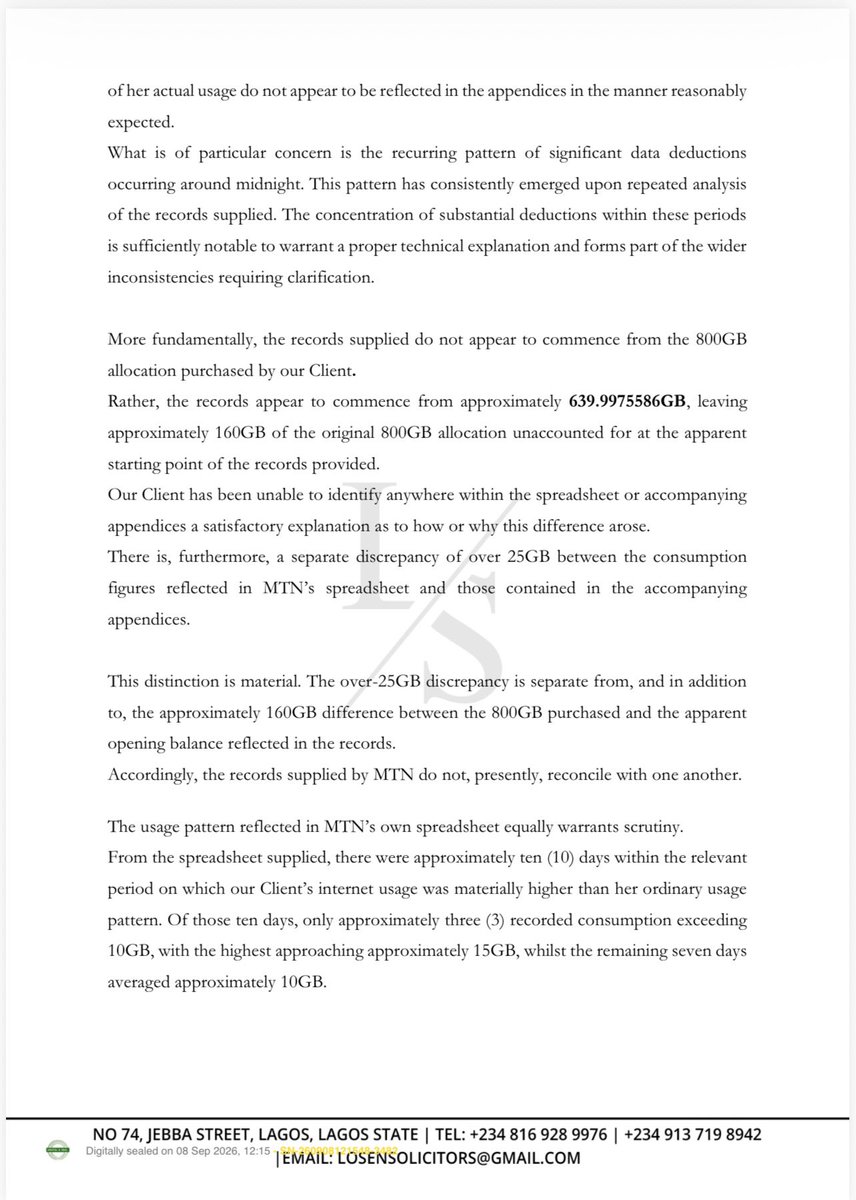
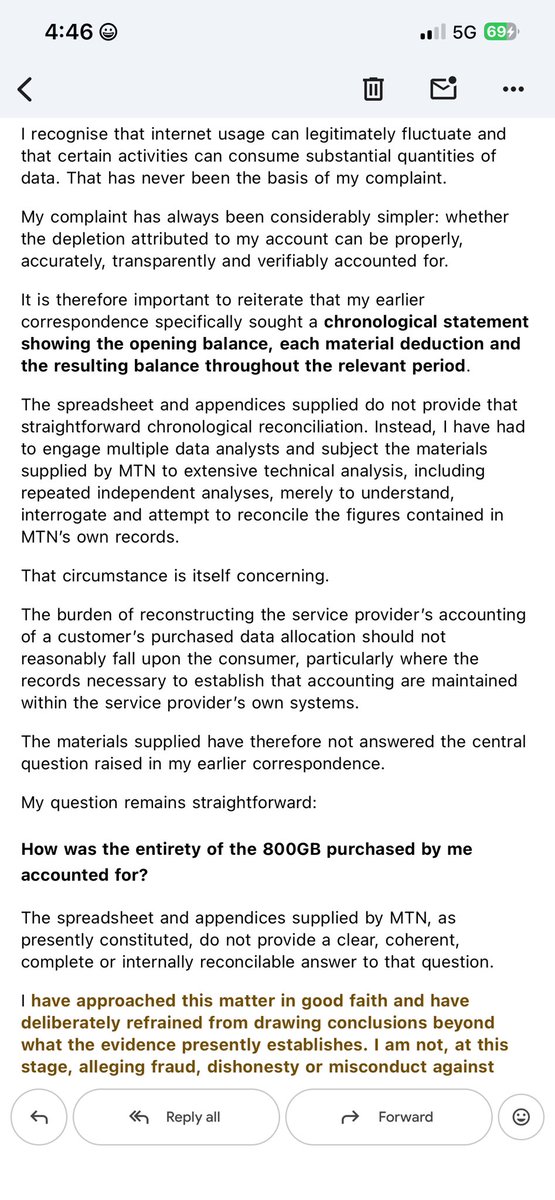
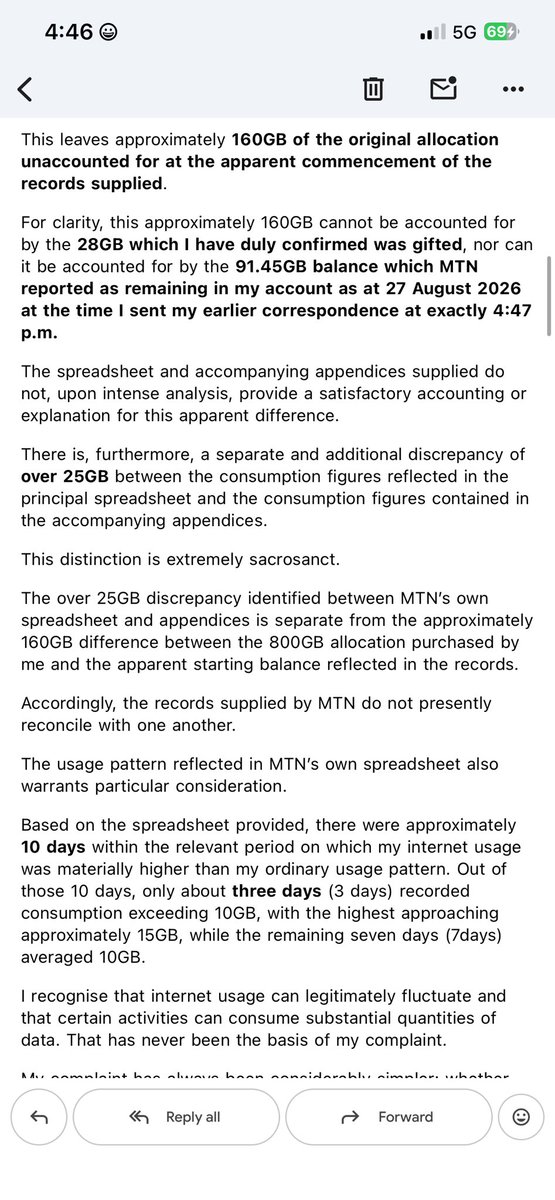
In furtherance of my earlier correspondence, my legal team, @losensolicitors & @KinandCounsel, have also written to MTN Nigeria regarding the material discrepancies identified in the two documents supplied by MTN in response to my complaint.
What makes this particularly interesting is that these are not discrepancies arising from my/our own calculations or assumptions. They are inconsistencies identified within the records MTN itself provided.
Let the data speak.
Let the records speak.
And, ultimately, let the facts speak for themselves.
Dear @MTNNG I FINALLY HAVE A RESPONSE FOR YOU
After a thorough review and analysis of your response to my earlier sent mail and the documents attached thereto, including an independent assessment by a number of data experts, and having allowed eight (8) days from the date of receipt of your correspondence for the materials provided to be properly scrutinised, I have now concluded my review.
My formal response to your correspondence has accordingly been sent to your email, with the relevant authorities previously copied into this matter by you duly retained in copy @NgComCommission and @fccpcnigeria
For the avoidance of doubt, this Twitter post is also part of my response to MTN’s correspondence. My decision to communicate publicly on the matter does not derogate from, replace or constitute a waiver of my formal written response. Rather, it is an additional exercise of my right to publicly communicate my experience and position concerning a matter that is already the subject of a formal complaint and regulatory engagement.
All rights and remedies available to me remain expressly reserved.
Zaenab Olawunmi Adams, ESQ.
Barrister and Solicitor of the Supreme Court of Nigeria
Uber is leaving Nigeria today.
And I think there is a much bigger economic lesson here than simply “Uber is leaving.”
Uber launched in Lagos in 2014. At the time, it was entering one of the most exciting consumer markets in Africa. It helped create an entirely new category of mobility and eventually expanded beyond Lagos.
So why leave now?
Uber says the decision follows a review of its business priorities and investment focus across Africa. Importantly, the company says the decision is not related to the recent FAAN airport restrictions.
But the economics are worth examining.
1. A huge population does not automatically equal a huge addressable market.
Nigeria has more than 200 million people, but the relevant market for Uber isn’t 200M people.
It is people who:
- have smartphones and reliable connectivity
- can afford app based transportation regularly
- live in cities where Uber operates;
prefer Uber over alternatives
and can pay fares that make the platform economically viable.
That distinction matters enormously.
2. Purchasing power is probably the biggest structural challenge.
Nigeria can have enormous demand for mobility while simultaneously having relatively low purchasing power.
When household incomes are under pressure, transportation becomes highly price sensitive.
Consumers don’t necessarily ask:
“Which platform has the best experience?”
They ask:
“Who can get me there for the least money?”
And that creates a brutal environment for premium or differentiated platforms.
Nigeria’s recent economic reforms have improved some macroeconomic indicators, but inflation and cost-of-living pressures continue to squeeze household incomes.
3. Competition makes monetisation even harder.
Uber isn’t operating in a vacuum.
Bolt has become a formidable competitor, while inDrive and several local platforms compete aggressively on price, driver supply and geographic coverage.
Bolt was reported as Nigeria’s most downloaded mobility app in 2025, ahead of Uber and inDrive.
And this is important:
In a low-purchasing-power market, the cheapest acceptable product can beat the best product.
That is a very different competitive dynamic from markets where consumers have more disposable income.
4. The market itself isn’t necessarily small.
This is the fascinating part.
One 2026 market estimate puts Nigeria’s ride-hailing and mobility-platform market at about $450 million in 2025, with projected growth toward almost $1 billion by 2032.
So this isn’t necessarily a story about no demand.
It is potentially a story about the size of the opportunity relative to the capital, operational complexity and returns required by a global company.
That’s a very different question.
5. And Uber is making capital-allocation decisions globally.
Today, Uber is also cutting approximately 3,300 jobs, around 10% of its workforce, as it simplifies the organisation and redirects resources toward strategic priorities, including autonomous mobility.
That context matters.
A company doesn’t have to believe Nigeria is a bad market to decide that another market is a better use of the next $1 of capital.
And I think this is the most important lesson.
The lesson for African founders:
If the money is not big enough for Uber but it’s good enough for you, get in there.
Africa doesn’t just need bigger markets.
It needs business models designed around the economics of African consumers.
Uber’s exit is a useful reminder of that.
My daddy says our colonizers used religion to create the most tamed & obedient demographic on the planet. We're never going to be free until this type of Christian dies off.
Nonso,
If KC Luxury retained me to defend him, I would represent him without apology. I render legal services. I represent, advise and defend. But does my retainer suddenly make KC Luxury qualified to keynote the next NBA conference? That is the point you’re missing and one that is being lost in this conversation about VDM.
The yardstick for selecting a SPEAKER at a national conference of lawyers is not POPULARITY. It is not CONFRONTATIONAL ENERGY. It is not the NUMBER OF FOLLOWERS one commands. It is CALIBRE. It is EXPERTISE. It is the quality of what that person can contribute to the intellectual and professional advancement of the legal profession.
The best graduating student in professional ethics recently had her award withdrawn. Not because she committed a crime. Not because she insulted anyone but because of how she dressed in a photograph on social media. That is the standard the profession publicly enforces. Strict, Disciplined, Uncompromising. Image conscious to the last detail. And then the same profession turns around and invites VDM to speak at its national conference.
VDM is not a symbol of professionalism. He is by his own design and by public acknowledgment a SYMBOL OF REBELLION. And that rebellion has thrived not because of VDM's genius but because our institutions are weak, broken, corrupt and the common man is frustrated. Weak institutions create the vacuum that confrontational figures like VDM fills. VDM exists at the intersection of institutional decay and public frustration. He is a symptom not a solution.
His public relevance thrives only because our institutions are weak enough to allow someone who weaponises defamation, harassment, and cyber‑bullying to masquerade as a civic advocate.This is not about one good act or his isolated acts of public service but about his sustained pattern of operating outside the confines of the law, a pattern that would collapse instantly if our institutions were functioning as they should. Many admire him for it. Many find it entertaining. But admiration and entertainment are not qualifications.
At a national conference of lawyers, the expectation is that speakers should be individuals capable of diagnosing institutional decay and articulating credible, lawful solutions. VDM cannot do that. He is not a security expert, not a policy thinker, and certainly not a model of lawful civic engagement.
Now look at the topic itself. Known Gunmen. What exactly is VDM's expertise on this subject? Is he a security analyst? A conflict resolution expert? A policy architect? Is he there to offer strategic legal or institutional frameworks for addressing the problem? Or is he there to dramatically retell what he personally witnessed and narrated to us already on social media? Because if it is the latter, that is a performance, not a contribution.
The NBA has in the past hosted sitting presidents, heads of state and genuine subject matter experts at its conferences. People who brought intellectual weight to the room. People who advanced the conversation. What is being offered now is a parade of politicians and social media personalities, a substitution of spectacle for substance.
This is not a small thing ooo. It is a reflection of where the institution sees itself and what it believes its members deserve. It is a new low. And we should call it exactly that.@MrsBBold@NigBarAssoc@afamosigwe
Kano’s decline is one of the most instructive deindustrialisation stories.
The dye pits at Kofar Mata were established in 1498 and were still being used by families in the traditional textile trade into recent times.
By 1980 Kano alone had 40 textile factories (my grand father owned one too). Nationally the industry employed over 350,000 workers directly and was the single largest employer of labour in Nigeria after the federal government. Between 1970 and 1987 demand for Nigerian textile products exceeded supply by 91%. That is a sector with more demand than it could physically meet.
The Structural Adjustment Programme came in the mid-1980s under external pressure, raised production costs, destroyed purchasing power, and removed policy protection. By 1995 employment had fallen to 100,000. Then cheap Chinese textiles moved through the Sahara in volume and there was no serious policy response because the federal government had already established a pattern of treating manufacturing as optional. By 2003 Kano’s 40 factories had become fewer than 10. The total human cost when indirect employment is counted exceeds 2m livelihoods. It is also funny how that number has never featured prominently in any federal policy document as a failure requiring accountability.
The leather industry never made the transition from raw material supplier to finished goods manufacturer at scale. The hides were processed and exported as wet blue skin and semi-finished leather rather than being converted domestically into bags, shoes, and luxury accessories. The value capture remained at the bottom of the chain. Italy, France, and Germany built luxury goods industries partly on Nigerian raw material and sold the finished products back to Nigerian consumers at prices that reflected the value Nigeria never captured. This did not require external sabotage. It required only the absence of an industrial policy that deliberately pushed investment toward vertical integration. That absence was consistent across every administration that governed through the relevant decades.