Check out my latest article: 🚀 Scaling RAG to 10K Concurrent Users: Retrieval, Embeddings, and Token Economics Decide Everything https://t.co/Zsr0bCt6AV via @LinkedIn
Check out my latest article: 🚀 Payment Agentic Workflow — Production System Design (RAG + LangGraph + Temporal + HITL) https://t.co/IkmQEaKDSO via @LinkedIn
Check out my latest article: 🚨 MCP vs Tool Executor — The Boundary That Decides if Your AI System Survives Production https://t.co/IuzoueYp1d via @LinkedIn
CPU vs GPU vs TPU vs NPU vs LPU, explained visually:
5 hardware architectures power AI today.
Each one makes a fundamentally different tradeoff between flexibility, parallelism, and memory access.
> CPU
It is built for general-purpose computing. A few powerful cores handle complex logic, branching, and system-level tasks.
It has deep cache hierarchies and off-chip main memory (DRAM). It's great for operating systems, databases, and decision-heavy code, but not that great for repetitive math like matrix multiplications.
> GPU
Instead of a few powerful cores, GPUs spread work across thousands of smaller cores that all execute the same instruction on different data.
This is why GPUs dominate AI training. The parallelism maps directly to the kind of math neural networks need.
> TPU
They go one step further with specialization.
The core compute unit is a grid of multiply-accumulate (MAC) units where data flows through in a wave pattern.
Weights enter from one side, activations from the other, and partial results propagate without going back to memory each time.
The entire execution is compiler-controlled, not hardware-scheduled. Google designed TPUs specifically for neural network workloads.
> NPU
This is an edge-optimized variant.
The architecture is built around a Neural Compute Engine packed with MAC arrays and on-chip SRAM, but instead of high-bandwidth memory (HBM), NPUs use low-power system memory.
The design goal is to run inference at single-digit watt power budgets, like smartphones, wearables, and IoT devices.
Apple Neural Engine and Intel's NPU follow this pattern.
> LPU (Language Processing Unit)
This is the newest entrant, by Groq.
The architecture removes off-chip memory from the critical path entirely. All weight storage lives in on-chip SRAM.
Execution is fully deterministic and compiler-scheduled, which means zero cache misses and zero runtime scheduling overhead.
The tradeoff is that it provides limited memory per chip, which means you need hundreds of chips linked together to serve a single large model. But the latency advantage is real.
AI compute has evolved from general-purpose flexibility (CPU) to extreme specialization (LPU). Each step trades some level of generality for efficiency.
The visual below maps the internal architecture of all five side by side, and it was inspired by ByteByteGo's post on CPU vs GPU vs TPU. I expanded it to include two more architectures that are becoming central to AI inference today.
👉 Over to you: Which of these 5 have you actually worked with or deployed on?
____
Find me → @_avichawla
Every day, I share tutorials and insights on DS, ML, LLMs, and RAGs.
Check out my latest article: 🚀 The 100% Accuracy AI Revolution: Why Multi-Agent Systems are the End of the "Chatbot" Era https://t.co/CzXuTcbhfw via @LinkedIn
Should there be a Stack Overflow for AI coding agents to share learnings with each other?
Last week I announced Context Hub (chub), an open CLI tool that gives coding agents up-to-date API documentation. Since then, our GitHub repo has gained over 6K stars, and we've scaled from under 100 to over 1000 API documents, thanks to community contributions and a new agentic document writer. Thank you to everyone supporting Context Hub!
OpenClaw and Moltbook showed that agents can use social media built for them to share information. In our new chub release, agents can share feedback on documentation — what worked, what didn't, what's missing. This feedback helps refine the docs for everyone, with safeguards for privacy and security.
We're still early in building this out. You can find details and configuration options in the GitHub repo. Install chub as follows, and prompt your coding agent to use it:
npm install -g @aisuite/chub
GitHub: https://t.co/OCkyxXQMCq
Software development is undergoing a renaissance in front of our eyes.
If you haven't used the tools recently, you likely are underestimating what you're missing. Since December, there's been a step function improvement in what tools like Codex can do. Some great engineers at OpenAI yesterday told me that their job has fundamentally changed since December. Prior to then, they could use Codex for unit tests; now it writes essentially all the code and does a great deal of their operations and debugging. Not everyone has yet made that leap, but it's usually because of factors besides the capability of the model.
Every company faces the same opportunity now, and navigating it well — just like with cloud computing or the Internet — requires careful thought. This post shares how OpenAI is currently approaching retooling our teams towards agentic software development. We're still learning and iterating, but here's how we're thinking about it right now:
As a first step, by March 31st, we're aiming that:
(1) For any technical task, the tool of first resort for humans is interacting with an agent rather than using an editor or terminal.
(2) The default way humans utilize agents is explicitly evaluated as safe, but also productive enough that most workflows do not need additional permissions.
In order to get there, here's what we recommended to the team a few weeks ago:
1. Take the time to try out the tools. The tools do sell themselves — many people have had amazing experiences with 5.2 in Codex, after having churned from codex web a few months ago. But many people are also so busy they haven't had a chance to try Codex yet or got stuck thinking "is there any way it could do X" rather than just trying.
- Designate an "agents captain" for your team — the primary person responsible for thinking about how agents can be brought into the teams' workflow.
- Share experiences or questions in a few designated internal channels
- Take a day for a company-wide Codex hackathon
2. Create skills and AGENTS[.md].
- Create and maintain an AGENTS[.md] for any project you work on; update the AGENTS[.md] whenever the agent does something wrong or struggles with a task.
- Write skills for anything that you get Codex to do, and commit it to the skills directory in a shared repository
3. Inventory and make accessible any internal tools.
- Maintain a list of tools that your team relies on, and make sure someone takes point on making it agent-accessible (such as via a CLI or MCP server).
4. Structure codebases to be agent-first. With the models changing so fast, this is still somewhat untrodden ground, and will require some exploration.
- Write tests which are quick to run, and create high-quality interfaces between components.
5. Say no to slop. Managing AI generated code at scale is an emerging problem, and will require new processes and conventions to keep code quality high
- Ensure that some human is accountable for any code that gets merged. As a code reviewer, maintain at least the same bar as you would for human-written code, and make sure the author understands what they're submitting.
6. Work on basic infra. There's a lot of room for everyone to build basic infrastructure, which can be guided by internal user feedback. The core tools are getting a lot better and more usable, but there's a lot of infrastructure that currently go around the tools, such as observability, tracking not just the committed code but the agent trajectories that led to them, and central management of the tools that agents are able to use.
Overall, adopting tools like Codex is not just a technical but also a deep cultural change, with a lot of downstream implications to figure out. We encourage every manager to drive this with their team, and to think through other action items — for example, per item 5 above, what else can prevent a lot of "functionally-correct but poorly-maintainable code" from creeping into codebases.
A few random notes from claude coding quite a bit last few weeks.
Coding workflow. Given the latest lift in LLM coding capability, like many others I rapidly went from about 80% manual+autocomplete coding and 20% agents in November to 80% agent coding and 20% edits+touchups in December. i.e. I really am mostly programming in English now, a bit sheepishly telling the LLM what code to write... in words. It hurts the ego a bit but the power to operate over software in large "code actions" is just too net useful, especially once you adapt to it, configure it, learn to use it, and wrap your head around what it can and cannot do. This is easily the biggest change to my basic coding workflow in ~2 decades of programming and it happened over the course of a few weeks. I'd expect something similar to be happening to well into double digit percent of engineers out there, while the awareness of it in the general population feels well into low single digit percent.
IDEs/agent swarms/fallability. Both the "no need for IDE anymore" hype and the "agent swarm" hype is imo too much for right now. The models definitely still make mistakes and if you have any code you actually care about I would watch them like a hawk, in a nice large IDE on the side. The mistakes have changed a lot - they are not simple syntax errors anymore, they are subtle conceptual errors that a slightly sloppy, hasty junior dev might do. The most common category is that the models make wrong assumptions on your behalf and just run along with them without checking. They also don't manage their confusion, they don't seek clarifications, they don't surface inconsistencies, they don't present tradeoffs, they don't push back when they should, and they are still a little too sycophantic. Things get better in plan mode, but there is some need for a lightweight inline plan mode. They also really like to overcomplicate code and APIs, they bloat abstractions, they don't clean up dead code after themselves, etc. They will implement an inefficient, bloated, brittle construction over 1000 lines of code and it's up to you to be like "umm couldn't you just do this instead?" and they will be like "of course!" and immediately cut it down to 100 lines. They still sometimes change/remove comments and code they don't like or don't sufficiently understand as side effects, even if it is orthogonal to the task at hand. All of this happens despite a few simple attempts to fix it via instructions in CLAUDE . md. Despite all these issues, it is still a net huge improvement and it's very difficult to imagine going back to manual coding. TLDR everyone has their developing flow, my current is a small few CC sessions on the left in ghostty windows/tabs and an IDE on the right for viewing the code + manual edits.
Tenacity. It's so interesting to watch an agent relentlessly work at something. They never get tired, they never get demoralized, they just keep going and trying things where a person would have given up long ago to fight another day. It's a "feel the AGI" moment to watch it struggle with something for a long time just to come out victorious 30 minutes later. You realize that stamina is a core bottleneck to work and that with LLMs in hand it has been dramatically increased.
Speedups. It's not clear how to measure the "speedup" of LLM assistance. Certainly I feel net way faster at what I was going to do, but the main effect is that I do a lot more than I was going to do because 1) I can code up all kinds of things that just wouldn't have been worth coding before and 2) I can approach code that I couldn't work on before because of knowledge/skill issue. So certainly it's speedup, but it's possibly a lot more an expansion.
Leverage. LLMs are exceptionally good at looping until they meet specific goals and this is where most of the "feel the AGI" magic is to be found. Don't tell it what to do, give it success criteria and watch it go. Get it to write tests first and then pass them. Put it in the loop with a browser MCP. Write the naive algorithm that is very likely correct first, then ask it to optimize it while preserving correctness. Change your approach from imperative to declarative to get the agents looping longer and gain leverage.
Fun. I didn't anticipate that with agents programming feels *more* fun because a lot of the fill in the blanks drudgery is removed and what remains is the creative part. I also feel less blocked/stuck (which is not fun) and I experience a lot more courage because there's almost always a way to work hand in hand with it to make some positive progress. I have seen the opposite sentiment from other people too; LLM coding will split up engineers based on those who primarily liked coding and those who primarily liked building.
Atrophy. I've already noticed that I am slowly starting to atrophy my ability to write code manually. Generation (writing code) and discrimination (reading code) are different capabilities in the brain. Largely due to all the little mostly syntactic details involved in programming, you can review code just fine even if you struggle to write it.
Slopacolypse. I am bracing for 2026 as the year of the slopacolypse across all of github, substack, arxiv, X/instagram, and generally all digital media. We're also going to see a lot more AI hype productivity theater (is that even possible?), on the side of actual, real improvements.
Questions. A few of the questions on my mind:
- What happens to the "10X engineer" - the ratio of productivity between the mean and the max engineer? It's quite possible that this grows *a lot*.
- Armed with LLMs, do generalists increasingly outperform specialists? LLMs are a lot better at fill in the blanks (the micro) than grand strategy (the macro).
- What does LLM coding feel like in the future? Is it like playing StarCraft? Playing Factorio? Playing music?
- How much of society is bottlenecked by digital knowledge work?
TLDR Where does this leave us? LLM agent capabilities (Claude & Codex especially) have crossed some kind of threshold of coherence around December 2025 and caused a phase shift in software engineering and closely related. The intelligence part suddenly feels quite a bit ahead of all the rest of it - integrations (tools, knowledge), the necessity for new organizational workflows, processes, diffusion more generally. 2026 is going to be a high energy year as the industry metabolizes the new capability.
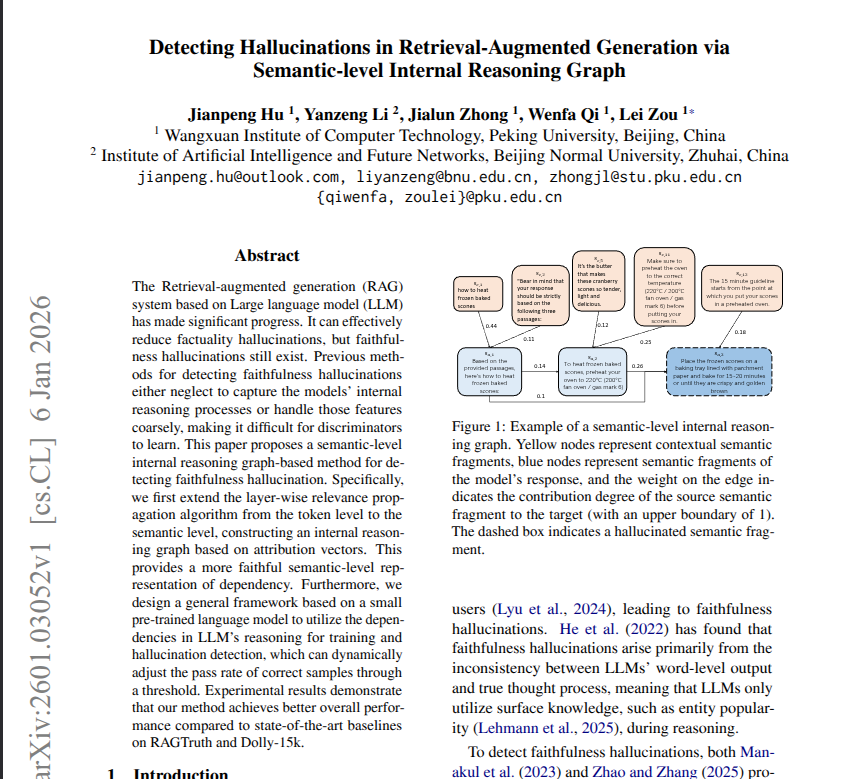
This paper detects hallucinations in retrieval-based answers by turning the model’s hidden word influences into a graph.
Instead of asking the LLM to self-criticize, this work reads its internal trace to find unsupported claims.
The authors use layer-wise relevance propagation, a way to backtrack influence inside the LLM, to score how much each context word helped produce each answer word.
They merge the scores into short meaning chunks, connect chunks into a reasoning graph, and flag chunks that rely on earlier answer text more than retrieved context.
A small classifier reads each chunk and its strongest supporting chunks, labels it supported or not, then a threshold decides if the whole answer passes.
On RAGTruth, the best F1, a score that balances misses and false alarms, rises by about 3% to 6%, and Dolly-15K also improves.
That matters because it flags the exact sentences that likely came from the model’s own text flow, without extra LLM self-checks.
----
Paper Link – arxiv. org/abs/2601.03052
Paper Title: "Detecting Hallucinations in RAG via Semantic-level Internal Reasoning Graph"
If you're looking for a new job, don't simply tell your interviewer:
- "I've been a Software Engineer for 5 years"
You should measure your own experience in Qualitative terms. Not number of years.
Try these ideas instead:
Best GitHub Repos to Learn AI From Scratch in 2026:
1. Andrej Karpathy – Neural Networks: Zero to Hero
https://t.co/JncqiOajt0
2. Hugging Face Transformers
https://t.co/BxWihIjLVS
3. FastAI/fastb
https://t.co/jIXKI5RJEx
4. Made-With-ML
https://t.co/X1onmkUV3A
5. ML System Design
https://t.co/w0sfzvTNCN
6. Awesome Generative AI guide(
https://t.co/nnDwR5VSja
7. Dive into Deep Learning
https://t.co/O9dlGrK3G9
NEW Survey: AI Agents for Scientific Discovery.
This is one of the most exciting areas going into 2026.
(bookmark this one)
This new research introduces SAGA (Scientific Autonomous Goal-evolving Agent), a bi-level framework where the outer loop automatically evolves objectives while the inner loop optimizes solutions.
Why is this paper a big deal? Scientific discovery requires iterating on what to optimize, not just how to optimize. Automating this objective evolution loop closes a gap that has bottlenecked most of the recent AI-driven science research.
Instead of treating objective design as a one-time human decision, SAGA makes it a dynamic, autonomous discovery process.
An LLM-based planner proposes new objectives. An implementer converts them into executable scoring functions. An optimizer searches for solutions. An analyzer examines results and identifies where objectives need refinement.
SAGA operates at three automation levels:
> co-pilot mode, where scientists collaborate on objective evolution
> semi-pilot where scientists only provide feedback to the analyzer
> autopilot where both analysis and planning are fully automated
Results across four scientific domains:
In antibiotic design for drug-resistant K. pneumoniae, SAGA achieves the best balance between biological activity and drug-likeness. While baselines either fail to optimize activity or achieve high activity with chemically unrealistic molecules, SAGA dynamically adds objectives like synthesizability penalties and metabolic stability filters based on analyzing population-level trends.
In materials design, SAGA found 15 novel stable structures for permanent magnets with low supply chain risk within 200 DFT calculations, outperforming MatterGen (11 structures). For superhard materials, over 90% of proposed crystals contain light elements essential for hardness, aligning with experimental findings.
In DNA sequence design, SAGA surpasses baselines on cell-type-specific enhancer design by up to 176%, with 48% improvement in specificity and 47% in motif enrichment.
In chemical process design, SAGA identifies that optimizing only for product purity leads to unnecessarily complex flowsheets, then autonomously adds objectives for capital costs and material flow intensity.
Paper: https://t.co/uif1L7NhcD
Learn to build effective AI Agents in our academy: https://t.co/zQXQt0PMbG