Introducing "Spectrally-Guided Diffusion Noise Schedules", accepted to #ICML2026! With @kiamada.
We propose noise schedules that follow the power spectrum of each image, improving pixel diffusion quality and requiring fewer denoising steps.
At test time, we conditionally sample the spectrum before generating the image.
Denoising is conditioned on the spectrum, which allows manipulating properties like the amount of details, as the animations show.
Introducing "Spectrally-Guided Diffusion Noise Schedules", accepted to #ICML2026! With @kiamada.
We propose noise schedules that follow the power spectrum of each image, improving pixel diffusion quality and requiring fewer denoising steps.
At test time, we conditionally sample the spectrum before generating the image.
Denoising is conditioned on the spectrum, which allows manipulating properties like the amount of details, as the animations show.
An excellent book only requiring undergraduate level with many color figures.
The last chapter is the culmination of this book:
It explains how to build manifolds from group actions and describes symmetric spaces.
We'll present "Spectral Image Tokenizer" at #ICCV2025 later today, afternoon session.
We tokenize the image spectrum, train an autoregressive transformer for coarse-to-fine generation, and show applications to image generation, upsampling and editing.
w/ @kiamada@msuhail153
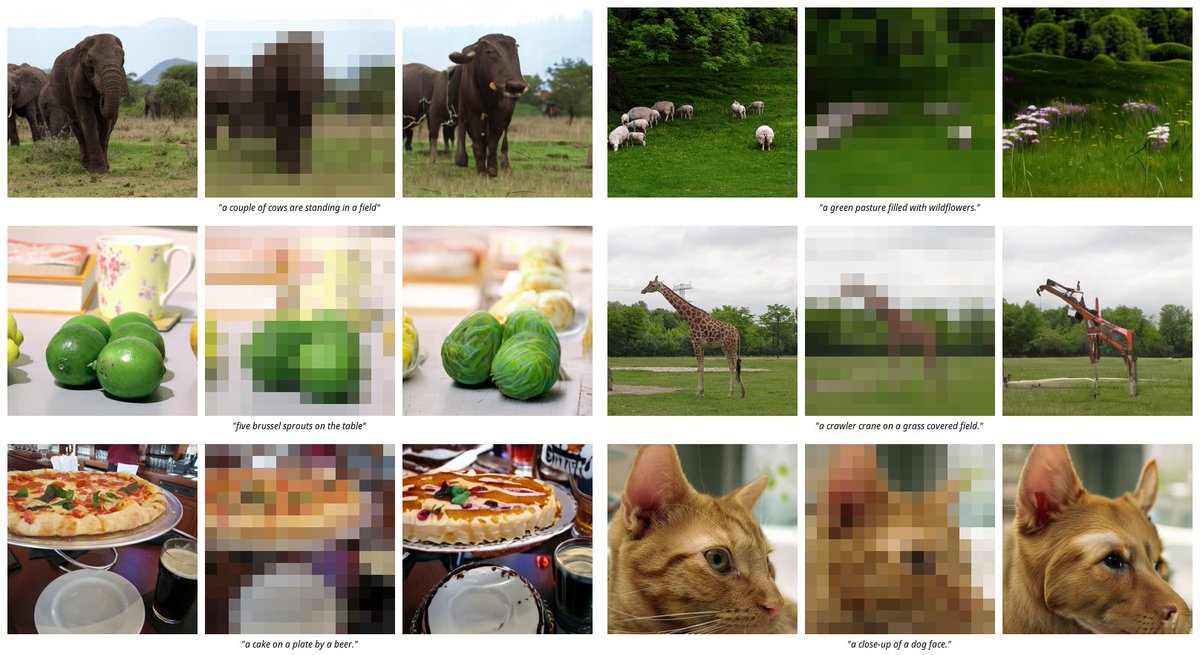
Our new paper, "Spectral Image Tokenizer", is on arXiv! We train a tokenizer on DWT coefficients
that enables autoregressive coarse-to-fine image generation, w/ applications to multiscale text-to-image, and text-guided editing.
w/ @kiamada, @msuhail153 https://t.co/0s4KYduBRx
We can't wait to welcome Carlos Esteves, Research Scientist at Google, tomorrow, January 22nd for a session on "Spectral Image Tokenizer."
🗓️ Learn more and add this event to your calendar: https://t.co/9RYHLDapN6
Don't miss the upcoming session on "Spectral Image Tokenizer" presented by @_machc, Research Scientist at @Google, on Wednesday January 22nd!
Huge thanks to @AhmadMustafaAn1 for coordinating this event! 💫
Learn more: https://t.co/9RYHLDapN6
Our new paper, "Spectral Image Tokenizer", is on arXiv! We train a tokenizer on DWT coefficients
that enables autoregressive coarse-to-fine image generation, w/ applications to multiscale text-to-image, and text-guided editing.
w/ @kiamada, @msuhail153 https://t.co/0s4KYduBRx
Our Equivariant Vision workshop features five great speakers @erikjbekkers@HaggaiMaron@ninamiolane@_machc, and Leo Guibas, spotlight talks, posters, and a tutorial prepared for the vision audience. Come tomorrow, Tuesday, at 8:30am in Summit 321! Thank you @CongyueD for leading the organization!
https://t.co/tp7HaCoa4H
I've never used this website for this but let's try: I'm on the lookout for full-time positions. The more research it involves the better. Open to both industrial and academic positions. If you know of good openings, my DMs are open, and I'll send my CV!
PS: I'm on an O1-A visa.
At #CVPR2024, I will give a talk about "Geometric Deep Learning for Weather" at the Equivariant Vision workshop Tue 2pm https://t.co/lz4fzCZOtK, and I'll present a poster on Single Mesh Diffusion Wed 5pm https://t.co/lQV19vg41z w/ @twmitchel and @kiamada. Hope to see you there!
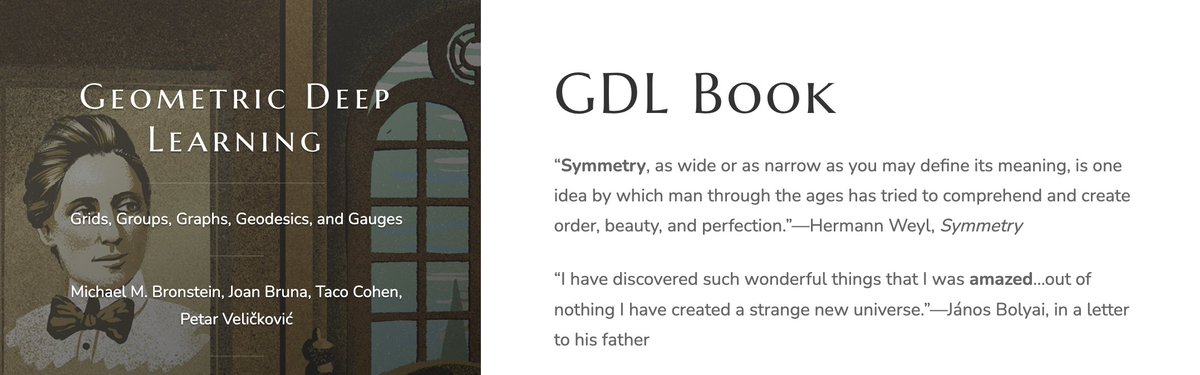
After 3 years, it's time for us to start sharing the chapters of the GDL book! ❤️
Also included: companion slides from our @Cambridge_Uni & @UniofOxford courses 🧑🎓
Chapter 1 is out **now**!
More to follow soon 🎉
https://t.co/g7SqyZBCgX 📖
@mmbronstein@joanbruna@TacoCohen
Generate high quality textures with single mesh LDMs!
#CVPR2024
Our *intrinsic* 3D diffusion models, trained on a single mesh, can generate texture variations, perform inpainting, and even transfer textures to different shapes.
https://t.co/SQ9WcF5DdE
w/@twmitchel & @_machc
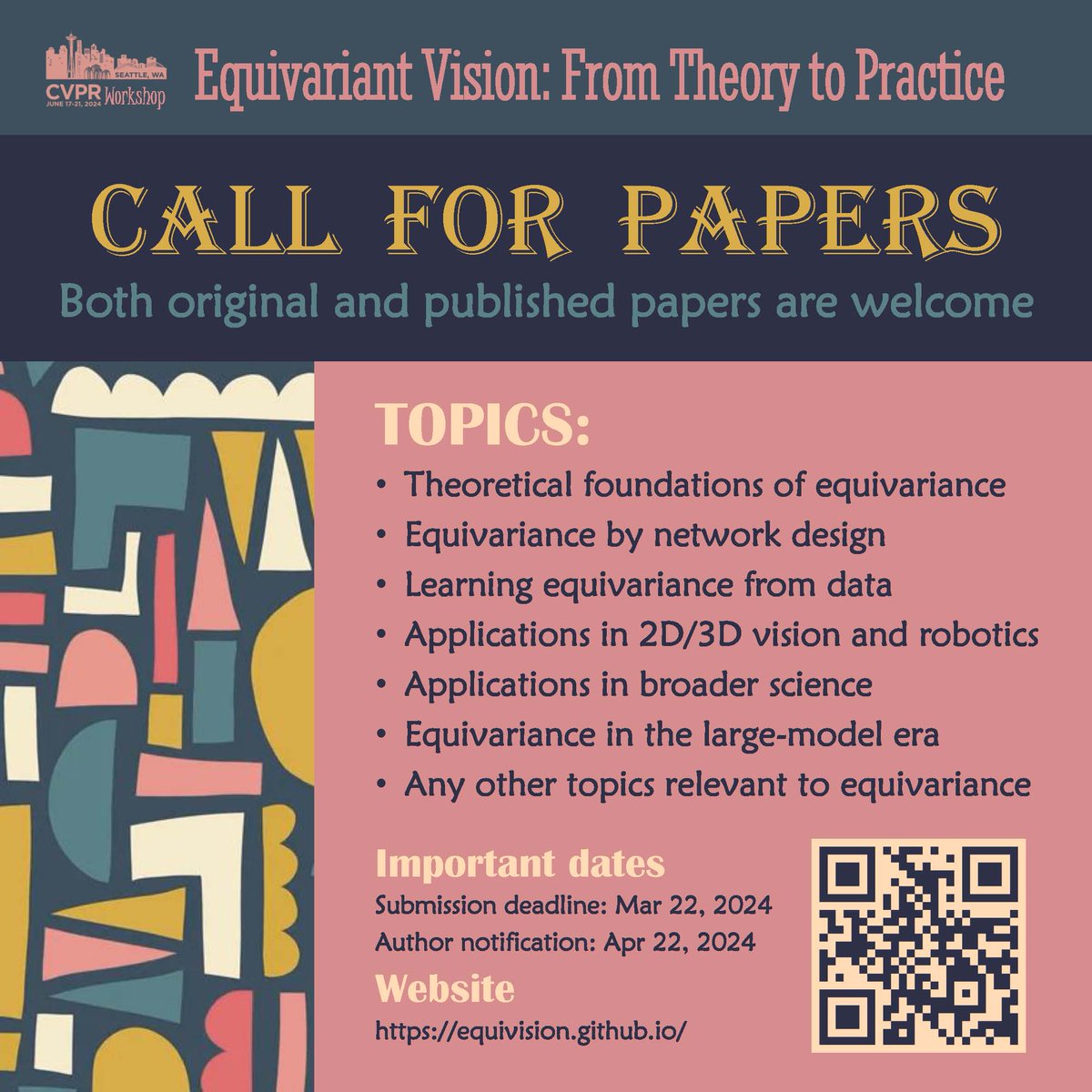
Our workshop "Equivariant Vision: From Theory to Practice" will be hosted at #CVPR2024 in Seattle this summer! @CVPR
Both original and published works are welcome to submit to our workshop!
🔗https://t.co/gpqW8Mkktx
⏰Deadline: Mar 22, 2024
We proudly present our 524 page book on equivariant convolutional networks.
Coauthored by Patrick Forré, @erikverlinde and @wellingmax.
https://t.co/y9YBpqhyLG
[1/N]
Some well-rounded results: @GoogleResearch work shows that deep learning on a sphere -- instead of flat space -- is superior for things like prediction of weather & molecular properties.
Consider spherical surfaces (much better than pretending the world is flat!). See JAX code!
Applying computer vision models designed for planar images to data projected on spherical surfaces is challenging. Here we present an open-source library in JAX to solve the challenges of rotation and regular sampling for state-of-the-art performance → https://t.co/wXdIpkmtDy
📢 Join us as we present ASIC at #ICCV2023 on Wed! We propose a method for dense correspondence that DOES NOT need tons of data/3D priors/manual annotations! How do we do it? Check out the 🧶 and visit
Oral: Wed 4:30-6:00 PM
Poster: Wed 2:30-4:30 PM
Web: https://t.co/Q6Sfq4eZlU
The weather forecast is improving… literally! Introducing WeatherBench 2, a benchmark for the next generation of data-driven, global weather forecast models, providing data, tools, & an evaluation platform. Learn how to use it and check out the website →https://t.co/xDUZ3pfLvX
Scaling Spherical CNNs
paper page: https://t.co/FOEEWINK4x
Spherical CNNs generalize CNNs to functions on the sphere, by using spherical convolutions as the main linear operation. The most accurate and efficient way to compute spherical convolutions is in the spectral domain (via the convolution theorem), which is still costlier than the usual planar convolutions. For this reason, applications of spherical CNNs have so far been limited to small problems that can be approached with low model capacity. In this work, we show how spherical CNNs can be scaled for much larger problems. To achieve this, we make critical improvements including novel variants of common model components, an implementation of core operations to exploit hardware accelerator characteristics, and application-specific input representations that exploit the properties of our model. Experiments show our larger spherical CNNs reach state-of-the-art on several targets of the QM9 molecular benchmark, which was previously dominated by equivariant graph neural networks, and achieve competitive performance on multiple weather forecasting tasks.












![maurice_weiler's tweet photo. We proudly present our 524 page book on equivariant convolutional networks.
Coauthored by Patrick Forré, @erikverlinde and @wellingmax.
https://t.co/y9YBpqhyLG
[1/N] https://t.co/Xf7DzkZx4I](https://pbs.twimg.com/media/F8tveafWoAANtjt.jpg)


