.@Kimi_Moonshot K3 lands on Together on Monday!
We ran 452 DeepSWE rollouts against Claude Fable 5: near-flagship coding at ~35% of the price, and K3 pulls ahead at higher pass@k's.
Full deep-dive: https://t.co/9mmP6pHTKu
@varunneal@jxbz Awesome blog! shouldn't we bring back shared expert here? might help with validation loss? As all experts can learn a mutual orthogonal direction which helps them all?
This paper sparked my interest in linear attention and I have been learning about how it evolved, over the past few days. This is far from complete and I wish to do some research experiments around the same! Below is the link for the github repository.
This is a really interesting direction. This can help with model merging/continual learning if can be adapted for transformers though closed form solution for rms norm would be a little tricky.
Excited to share about what I’ve been working on over the past year: quantifying the capacity of a neuron😅
This led to a mathematical framework we call HOPE, which lets us rigorously deconstruct what deep networks might have learned. Paper: https://t.co/bDn03zBkS0
Felt like the world started with compute poor suddenly we had a lot of compute credits to be won in several ways and cheap compute now we are back to being compute poor and not so cheap compute.
Reasoning models have a verbosity tax, and it turns out you can distill it away without touching the reward function.
In our new Miles blog, we ran pure On-Policy Distillation on Qwen3.5-35B-A3B: zero task reward, only reverse-KL against an RLVR teacher that had learned to reason ~3x shorter.
What surprised me is how fast it worked. Rollout length collapsed from ~18.6k tokens to 5.5k–6.7k after the FIRST update — and held-out DAPO accuracy improved, 0.8457 → 0.8945. The student didn't trade accuracy for brevity; it just stopped wasting tokens.
Under the hood, the part I'd highlight is sparse per-position teacher scoring. The naive path materialized an O(R²K) JSON payload for a computation that only needs O(RK) values — on long-response workloads, teacher scoring drowns in payload before it drowns in compute. Sparse scoring is what makes this practical at throughput.
Thanks @nvidia — single 8×B200 node, fully colocated. 👇
since the last one blew up here's a video for the below problem too.
this time we actually got the chat thread so i was able to get fable to try to show the entire process and thinking that was used here
Really interesting, the paper shows that, under same compute budget, starting RL from a stronger pretrained model win. But I'm curious about can a weakly pretrained model ever catch up with enough RL? If yes, how much additional RL compute does it need? or is it capped?
New paper: Understanding Reasoning from Pretraining to Post-Training!
We study the full LLM training pipeline from pretraining to post-training, find a joint scaling law, figure out how the compute should be allocated, and study what RL is doing to the policy.
🧵
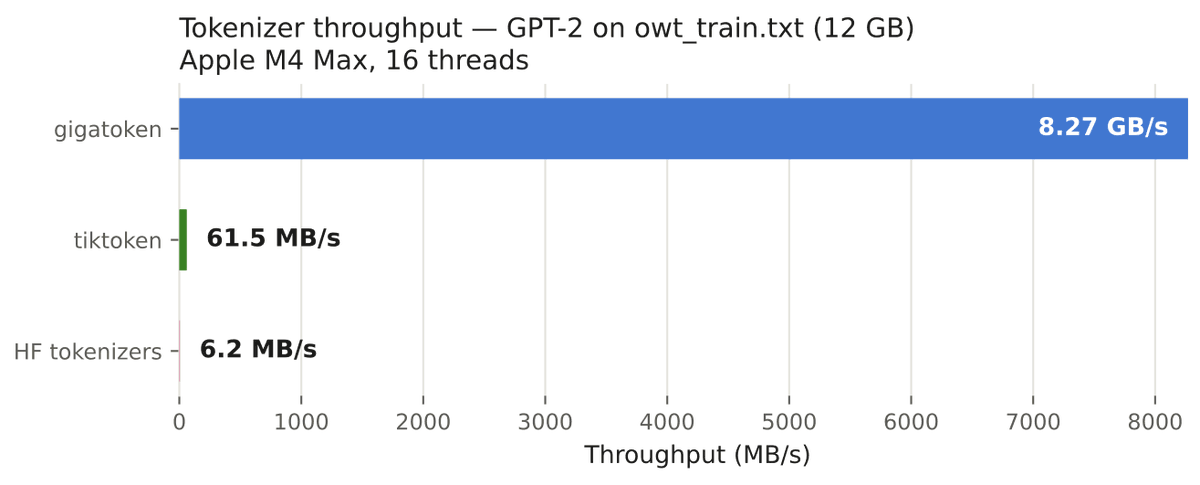
Introducing the world's fastest tokenizer implementation, Gigatoken!
Gigatoken is ~500-1000x faster than HuggingFace, and ~100x faster than OpenAI's tiktoken for most tokenizer definitions on most machines.
These baselines are already multithreaded Rust implementations! 🧵