In 2024, Hyperliquid
1) redefined the crypto meta to put community above all. With Hyperliquid, there are no investors, no market makers, and no fees paid to any company. Billions of dollars of value were created by a common vision and relentless hard work. This value went directly to hundreds of thousands of users, building a passionate community with real skin in the game. You all continue to inspire me every day.
2) became the first mature, permissionless financial hub where liquidity and UX matched the most liquid centralized venues. Recent highlights include $15B 24-hour volume, reaching 20% of Bybit futures and 8% of Binance futures volume. Unlike CEXs, Hyperliquid accomplished this as a user-owned protocol.
3) reinvented several of the most entrenched and predatory centralized practices to be crypto-aligned: fair, transparent, and accessible.
Examples of the last point:
1) Listings have always been controlled by CEXs that extort projects through listing fees to maximize their own profits. This is absurd, as the community drives long term success. CEXs tempt projects with immediate liquidity but kill their ultimate vision. On Hyperliquid, listings are fair, permissionless, and transparent: anyone can bid in the auction to deploy a new spot asset. Projects that want to control their own fate increasingly see Hyperliquid as one-stop infrastructure for both the tech stack and liquidity.
2) Historically, CEXs capture the lion's share of revenue in crypto. On Hyperliquid, builders are already bootstrapping 9 figure businesses. Some are monetizing >$100k per day in revenue entirely onchain through builder codes, which are a primitive built into the L1 to allow customizable monetization for applications. Others carve out and own entire verticals in the budding ecosystem.
Builders are tapping into Hyperliquid as their blockchain of choice, and I’m excited for more and more to join the ecosystem this year.
--
In 2025, I expect the technology of Hyperliquid to close much of the gap towards housing all of finance. The maturing technology will include a growing and permissionless validator set while improving the world-class liquidity infrastructure that Hyperliquid provides.
Some concrete predictions:
1) Multiple billion dollar applications/protocols will be built on Hyperliquid. They will own their full stack but tap into the ever-growing liquidity and community.
2) More than 50% of volume from new defi projects will happen natively on Hyperliquid. Hungry teams will value the integration of CEX-level liquidity with the permissionless accessibility of blockchains.
3) Millions of users will use Hyperliquid without knowing about the blockchain at all. Just like web2, users will experience the magic of their favorite products without thinking about the underlying technology.
These predictions are ambitious, but as I look back and realize just how much we've accomplished in a year, I think they're quite reasonable.
Back to work!
Let's imagine things are green for a while.
The higher timeframes are set up very well for a lot of charts right now.
How do you take advantage of this?
How do you ensure you make money and not lose it during strong momentum?
EDUCATION TIME 🧵
Sad day, especially for a great team like @euler_mab, @MacroMate8, et. al who singularly focused on liquidation mechanism innovation for enriching long tail assets with the powers of their elderly and more liquid brethren.
But I don’t think the “flash loans/mints should die” or pure insurance answers are viable in permissionless systems; in concert, these views belie the fact that composability is in some sense an unbounded operation in both compute and capital/resource exhaustion
There’s a natural trade-off between the size of an outcome space achievable with a fixed quantity of resource (e.g. resource borrowable/mintable via flash mechanisms) and the ability to search this space for an individually utility maximizing payoff. This trade-off is *precisely* analogous to the statistical-computational complexity trade-off of ML/AI (https://t.co/WzzNB9NlV0). The only difference is that instead of trying to minimize the trade-off (e.g. minimize both statistical error and computational complexity, in spite of the fact that these are antipodal goals), we want to maximize social welfare while minimizing the likelihood of a sequences of actions reaching an epsilon neighborhood of a minima (another set of antipodal goals).
DeFi, as a community, has currently focused on maximizing the surface area of how you can plug callback functions into a resource (e.g. lending pools) via flash loans and flash mints while spending no time on making the computational complexity of finding a social welfare minimizing but individual utility maximizing set of callback functions hard.
But we *know* how to do the latter within ZK/FHE/IO land by adding structured randomness to enlarge the search space for an attacker dramatically (while making honest verification cheap). There will be a day we use these tools to make DeFi safe by making it “easy” to do simple things with flash mechanisms but computationally intractable to do complex attacks (where the complexity is a blended combination of computational search complexity and some notion of a minima/maxima of a social welfare invariant that a contract enforces).
This, to me, is the real “ZK reinforcement learning”: using ZK like techniques to make it hard for ML and/or simple search mechanisms to find social welfare minima (but easy to find maxima). Generic aggregated payoff functions do not have this property but with small amounts of randomness you can make such payoffs indistinguishable from hard to minimize functions.
The question is if DeFi people will be willing to learn enough algebra and finite field geometry and if cryptography people are willing to learn enough probability for this to happen 🔮
I am optimistic, but of course, this is my bias because I’m in the intersection of these groups!
SUI has quietly enabled testnet ✅
The team has *not* officially announced it yet.
$APT: People that minted a free NFT in APTOS got a 8,000 USD airdrop.
$SUI: Now there is a similar oportunity in SUI, you can mint their free NFT 👇
You don’t need to spend $150k plus to learn blockchain development.
Here's a list of 7 Youtube videos that will teach you all you need to know about blockchain development —completely free: 🧵
Private order flow and MEV accrual rights are hot topics right now, and these conversations are happening alongside debate over transaction censorship, the anticipation of ZK roll ups, and the gaining momentum of stat arb MEV on atomic MEV.
They're all linked, anon
1/x
2 types of TWAP oracle have generally been used w/in DeFi:
💠 Arithmetic mean
💠 Geometric mean
In this new piece, @jjooeerr compares them against each other in 2 key dimensions: manipulation resistance & accuracy. Some of the findings are surprising
https://t.co/k7zxAhXBRa
How Uniswap V3 works, visually 🧵
I had difficulty understanding some of the Uni-v3 tutorials out there, so I’ll try to explain how concentrated liquidity works visually and by using a simple example. I'll assume you have an understanding of Uni-V2, which is much simpler.
Announcement: I will teach you Zero Knowledge Proofs. Eight Zoom classes over the next 4 weeks. 100% free (I'm doing this for fun in my free time). Reply or dm if interested.
Joseph Delong's Guide to Developer Success in Web3
Everyone starts at zero and you want to get involved in web3. There are two paths for web3 developers protocols or defi/smart contract development.
An MEV bot executed a very sophisticated attack on one of our @BrinkTrade executor tx’s
This was a generalized attack where the MEV bot modified and deployed a piece of our bytecode in a new smart contract, just for a small profit on a single tx
Here's a thread to explain
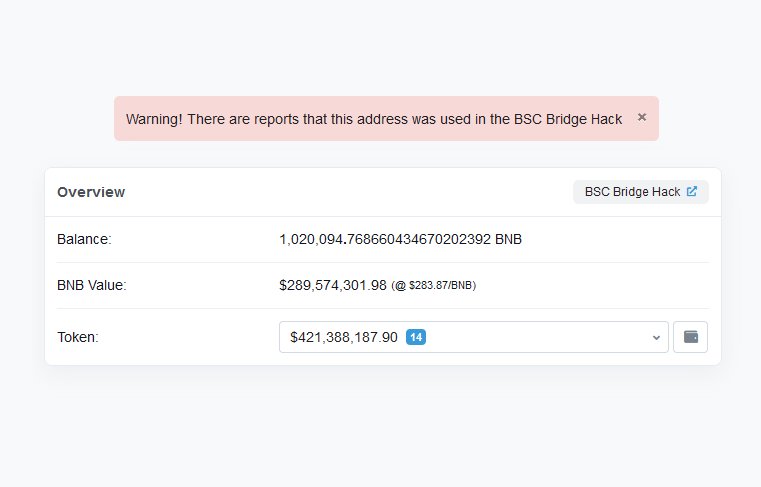
Five hours ago, an attacker stole 2 million BNB (~$566M USD) from the Binance Bridge. During that time, I've been working closely with multiple parties to triage and resolve this issue. Here's how it all went down.
This is a pretty awesome token standard with great implications for DeFi as it lays the foundation for unique loans and structured products
It is similar to how some loans & swaps work in tradfi
Here is a thread on why this is an exciting tool for NFT financialization🧵 (1/11)
The U.S. dropped a massive bill that could change Crypto.
It’s a 68 page report covering stable coins, taxes & the regulation of crypto.
I’ve read it all so that you don’t have to.
Here's everything you need to know in 5 minutes:
Putin just gave a speech with massive implications for #Bitcoin and global macro.
We won't read a word of it in Western media, so I pulled out the interesting bits 👇