The future: Domain Foundation Models
Specially, if you care about both
1) the depth of capabilities (long-tail accuracy)
2) the breadth of capabilities (features)
More updates (detailed benchmarks, impact of self-instruct v/s RLHF) coming soon!
@Kuan_Liu_@plusepsilon@timshi_ai
Today, We introduced Ocean-1, a foundation model for the contact center.
It's the culmination of our experience in generative AI for large enterprises and our latest milestone in advancing the cutting edge for customer facing conversations.
https://t.co/2jmYmyG2oN
Most takes on RL environments are bad.
1. There are hardly any high-quality RL environments and evals available. Most agentic environments and evals are flawed when you look at the details. It’s a crisis: and no one is talking about it because they’re being hoodwinked by labs marketing their models on flawed evals.
2. Even the best public RL environments and agentic evals suck, and usually can’t be used by labs without modification. Academics often publish-and-forget instead of doing the necessary follow-up work to make the envs/evals useful for labs.
3. The best person to make an environment is someone deeply knowledgeable about a field, not a high-level generalist or newbie - 🦔 not 🦊 - but most envs are being made by generalists or low-skill contractors.
4. People are too focused on whether a problem is verifiable or not, not what kind of capabilities they want to bring into being. We don’t need more math and puzzle environments. The usefulness of an environment is proportional to its difficulty of construction.
5. Saying you want to “scale RL environments” is as meaningless as “scale is all you need” in that it says nothing about your choice of what to scale.
6. People are treating RL environment scaling as a new type of pretraining (creating a new internet), but pretraining has extremely high diversity, and expecting a single company (or collection of companies) to replicate this diversity is unrealistic. That means generalisation will be slower to emerge than the previous paradigm - and so there is more leverage in choosing which environments to build first.
If you’d like to help answer the right questions in this new space, join us at @GenReasoning.
Worth re-reading The Bitter Lesson every few months. Each time, a different part hits you, usually "exposing" your latest attempts to dodge the very mistake it warns against.
> "We want AI agents that can discover like we can, not which contain what we have discovered. Building in our discoveries only makes it harder to see how the discovering process can be done."
https://t.co/CJgPKiFzDF
The 2nd bucket of highly-paid AI talent is emerging: the ones who are deep (enough) into not only pre-training and post-training of LLMs – but with the complementary skills to make LLMs actually work in messy real-world use cases (I don't mean SWE skills here, that's table-stakes).
Are they special? Not sure – just very rare right now – need ~10k hours of focused IC practice in real-world scenarios, when “GenAI” itself is barely 3 years old.
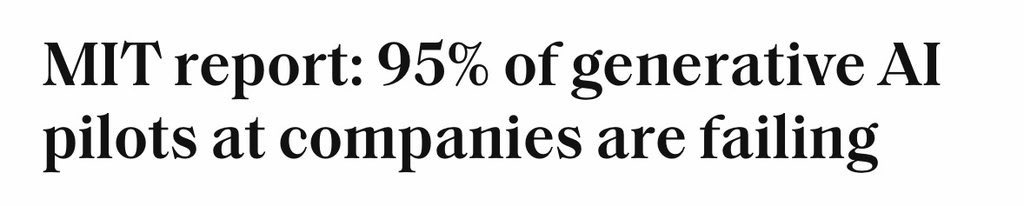
(Related to the recent “95%” Fortune article, the underlying MIT report, and all the chatter about the GenAI bubble)
My top 5 most memorable “LLMs” launches:
1. text-davinci-002 (first one that really "got it"/worked)
2. GPT4 (biggest step function jump seen till now)
3. Clause 3.5 Sonnet (first true dethroning)
4. o1-pro (clear glimpse of robust human-like reasoning)
5. DeepSeek-R1 (proof open can beat closed)
My top 5 most memorable models from using them at/soonafter launch:
1. Claude 3.5 Sonnet (personality, all round perf)
2. o3 (search behavior + perf)
3. o1 pro (robustness)
4. Gemini 2.5 pro (long context + perf)
5. GPT 4.5 (personality)
Heading to @kdd_news where we'll be presenting our work on evaluating LLMs for factuality when analyzing conversation transcripts (https://t.co/hpqeWg2olS) and @cresta is sponsoring AI Reasoning Day!
@_navjotts_, @DalalBinoy, and many other wonderful Crestans will also be there. Come talk to us to hear about the cutting-edge work Cresta is doing in enterprise generative AI!
Very excited to have Cresta as a user of agent reinforcement trainer (ART)!
Cresta is AI-native and has a large, sophisticated ML team. ART isn't just easy to get started with, but also very powerful!
Why its hard to make LLMs work for real-life usecases (not toy-benchmarks / demos):
if you're gonna push a piece of "machinery" to the limit, and expect it to hold together – you have to have some sense of where that limit is.
(that limit can't be read on twitter, cant be logically deduced – it has to be "felt" by actually pushing the machinery to the limit)
I am at #NeurIPS2024 this week! Key ML areas our group under @timshi_ai at @cresta is working on:
- AI Agents than can reason and troubleshoot effectively in complex enterprise domains
- Multimodal Knowledge Grounding
- LLM-as-a-judge framework that actually works
We are hiring!
More pragmatically w.r.t. reasoning, whether this (deliberate “Jumping out of the System”) is whats happening with the current approaches of Inference-Time-Scaling / Test-Time-Compute? Thats TBD, but I highly doubt it.
This, w.r.t. emergence of consciousness. And I think the “deliberate” aspect is key here. GEB talked about it also in “Jumping out of the System” – the need to jump out of the task being performed, survey whats been done, and ensure key requirements (consistency AND efficiency).
"system 2 as iterated system 1 with a self-consistency guarantee" is something I considered a few years ago as one of two hypotheses, and it led me to an interesting potential interpretation of consciousness -- consciousness is the consistency guarantee. It explains why all system 2 processing involves consciousness.
Iterated system 1 with low self-consistency = dream-like, incoherent, ever shifting
Iterated system 1 with strong self-consistency guardrails = deliberate, coherent, self-correcting
The maintenance of strong self-consistency enforcing feedback loops between iterations is what consciousness emerges from.
"Before settling on any answer, it turns inward, questioning its own assumptions, exploring different paths of thought, always seeking deeper truth."
Impressive update from @Alibaba_Qwen, but this first release of QwQ-32B really took the above to heart!
"excessive cautious"
I am at #NeurIPS2023 this week! Some ML areas our group under @timshi_ai at @cresta is working on:
- Domain specific instruction finetuning
- Retrieval Augmentation and Knowledge Grounding
- Reward modeling and conversation-level outcomes
Hit me up for a chat. We are hiring!