@SuveenE@claudeai 400 Bad Request feels off for a straight-up geo-restriction. Maybe a 403 Forbidden, or I assume, a 451 Unavailable For Legal Reasons would be way more accurate here :)
Thank you Jensen and NVIDIA! She’s a real beauty! I was told I’d be getting a secret gift, with a hint that it requires 20 amps. (So I knew it had to be good). She’ll make for a beautiful, spacious home for my Dobby the House Elf claw, among lots of other tinkering, thank you!!
Introducing: Zed for Students! 🎓
Enjoy Zed's Pro plan free, for a year, if you're a current university student (or teacher!)
- Zed Pro features for 12 months
- $10/month in token credits
- Unlimited edit predictions
Apply today: https://t.co/YE6suEkB2U
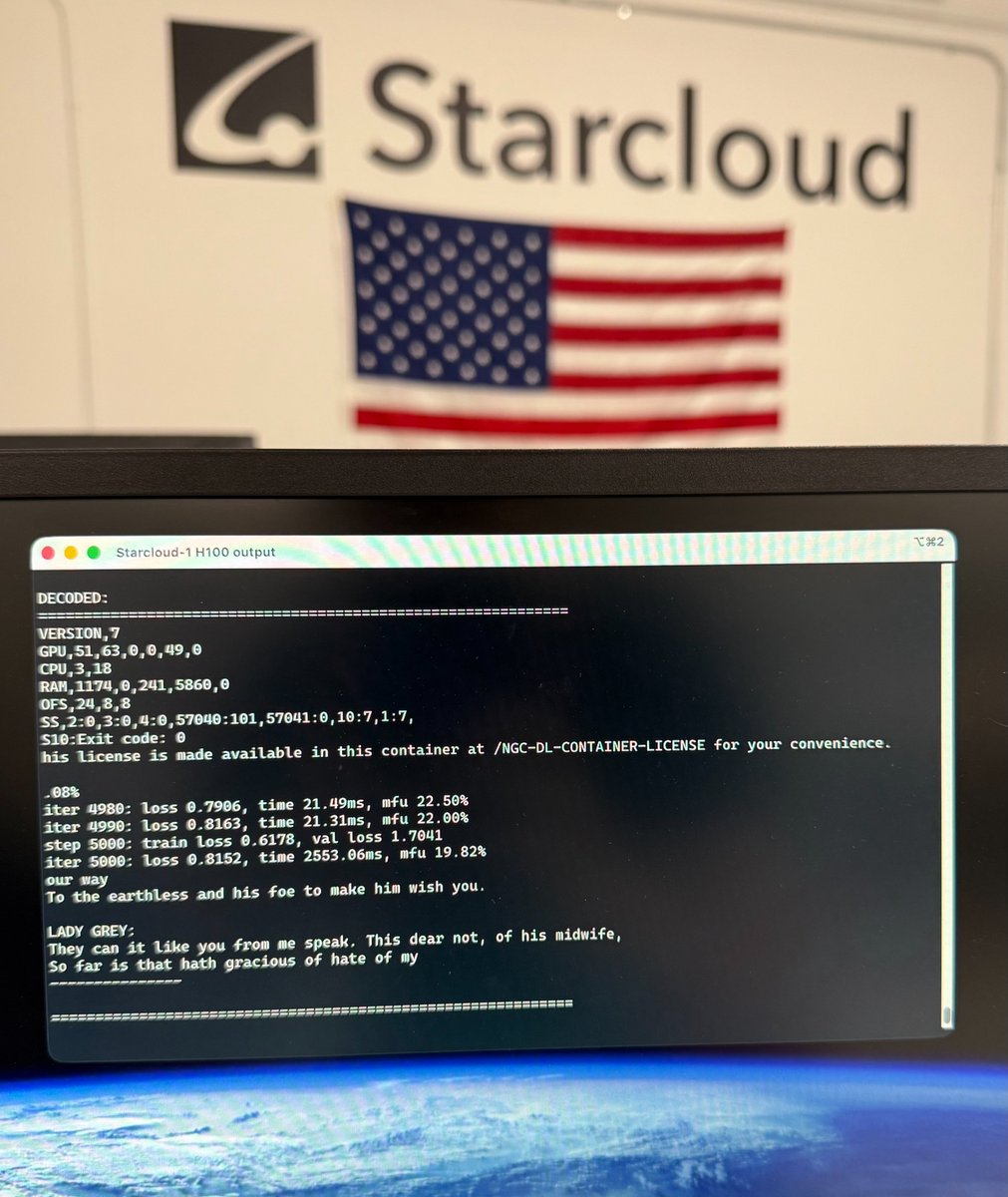
We have just used the @Nvidia H100 onboard Starcloud-1 to train the first LLM in space!
We trained the nano-GPT model from Andrej @Karpathy on the complete works of Shakespeare and successfully ran inference on it.
We have also run inference on a preloaded Gemma model, and we plan to try more exciting models in the future.
Getting the first H100 to work in space required a lot of innovation and hard work from the incredible Starcloud team to make this breakthrough.
This is a significant first step toward moving almost all computing off Earth to reduce the burden on our energy supplies and take advantage of abundant solar energy in space! 🚀
Our TPUs are headed to space!
Inspired by our history of moonshots, from quantum computing to autonomous driving, Project Suncatcher is exploring how we could one day build scalable ML compute systems in space, harnessing more of the sun’s power (which emits more power than 100 trillion times humanity’s total electricity production).
Like any moonshot, it’s going to require us to solve a lot of complex engineering challenges. Early research shows our Trillium-generation TPUs (our tensor processing units, purpose-built for AI) survived without damage when tested in a particle accelerator to simulate low-earth orbit levels of radiation. However, significant challenges still remain like thermal management and on-orbit system reliability.
More testing and breakthroughs will be needed as we count down to launch two prototype satellites with @planet by early 2027, our next milestone of many. Excited for us to be a part of all the innovation happening in (this) space!
*in a system design interview*
> what type of database would you use while designing a dating app
( don't say it )
( don't say it )
( don't say it )
.
me: Relational Database